Feeds:
Posts
Comments

Archive for the ‘Nature’ Category

Today’s topic is biocentrism … and, yes, I’m out of my fucking mind even beginning to go there on a Saturday morning in November, especially after an evening involving wine … and starts with its seven principles:

1. What we perceive as reality is a process that involves our consciousness. An “external” reality, if it existed, would by definition have to exist in space. But this is meaningless, because space and time are not absolute realities but rather tools of the human and animal mind.

2. Our external and internal perceptions are inextricably intertwined. They are different sides of the same coin and cannot be divorced from one another.

3. The behavior of subatomic particles, indeed all particles and objects, is inextricably linked to the presence of an observer. Without the presence of a conscious observer, they at best exist in an undetermined state of probability waves.

4. Without consciousness, “matter” dwells in an undetermined state of probability. Any universe that could have preceded consciousness only existed in a probability state.

5. The structure of the universe is explainable only through biocentrism. The universe is fine-tuned for life, which makes perfect sense as life creates the universe, not the other way around. The “universe” is simply the complete spatio-temporal logic of the self.

6. Time does not have a real existence outside of animal-sense perception. It is the process by which we perceive changes in the universe.

7. Space, like time, is not an object or a thing. Space is another form of our animal understanding and does not have an independent reality. We carry space and time around with us like turtles with shells. Thus, there is no absolute self-existing matrix in which physical events occur independent of life.

Got that? No … me neither.

I’ve been giving this thought since learning about that whole particles need observers to do much thing, chicken/egg/cart/horse thinking that shakes my brain like a rattle in the hand of Insane Demon Baby.

It’s this article in the Huff post that handed the noise toy to the toddler-from-hell-living-in-my-head this morning, luring me in by speaking directly to me in the opening sentence:

Why do you happen to be alive on this lush little planet with its warm sun and coconut trees?

Why, indeed.

Although the bit about the coconut trees is nothing but overkill, the Why are you here? question is one I ask often, although usually framed differently: What the fuck do you think you’re doing? … How the fuck did you end up here? … Now what?

Although those questions-posed-to-self are often self-focused, I do ponder the point of me in the greater sense … What is the point of me and him and her and them and those thingies over there? … and the article puts the little in little ole me:

How did inert, random bits of carbon ever morph into that Japanese guy who always wins the hot-dog-eating contest?

In short, attempts to explain the nature of the universe, its origins, and what’s really going on require an understanding of how the observer, our presence, plays a role. According to the current paradigm, the universe, and the laws of nature themselves, just popped out of nothingness. The story goes something like this: From the Big Bang until the present time, we’ve been incredibly lucky. This good fortune started from the moment of creation; if the Big Bang had been one-part-in-a-million more powerful, the cosmos would have rushed out too fast for the galaxies and stars to have developed. If the gravitational force were decreased by a hair, stars (including the Sun) wouldn’t have ignited. There are over 200 physical parameters like this that could have any value but happen to be exactly right for us to be here. Tweak any of them and you never existed.

Okay, so I’m a statistical probability as remote as my coconut tree sprouting legs and jogging on the beach … and so are you, neener neener neener.

Or not.

Indeed, according to biocentrism, it’s us, the observer, who create space and time (which is the reason you’re here now). Consider everything you see around you right now. Language and custom say it all lies outside us in the external world. Yet you can’t see anything through the vault of bone that surrounds your brain. Your eyes aren’t just portals to the world. In fact, everything you experience, including your body, is part of an active process occurring in your mind. Space and time are simply the mind’s tools for putting it all together.

So, we are all legends in our own mind?

Cogito ergo sum, folks.

In ethics, biocentrism puts us in our place:

Biocentrism states that nature does not exist simply to be used or consumed by humans, but that humans are simply one species amongst many, and that because we are part of an ecosystem, any actions which negatively affect the living systems of which we are a part, adversely affect us as well, whether or not we maintain a biocentric worldview. Biocentrists believe that all species have inherent value, and that humans are not “superior” in a moral or ethical sense.

There is no doubt my dog’s version of me varies greatly from mine, as does mine from hers, and since both she and I exist on the same plane … or veranda, as is the case at the moment … each reality is as valid as the other.

I find the notion of biocentrism in both cosmology and ethics more than interesting, but it falls short for me, lacking just a bit of the imagination it would take to move it just a smidgen beyond the biology that gives the theory its name.

It’s consciousness that seems the point, the indefinable, unmeasurable dimension of consciousness, and it’s biology that limits our capacity to fully grasp what must be accessible when the biojar that contains consciousness is eventually jettisoned.

As Einstein put it:

“A human being is part of a whole, called by us the Universe, a part limited in time and space. He experiences himself, his thoughts and feelings, as something separated from the rest a kind of optical delusion of his consciousness. This delusion is a kind of prison for us, restricting us to our personal desires and to affection for a few persons nearest us. Our task must be to free ourselves from this prison by widening our circles of compassion to embrace all living creatures and the whole of nature in its beauty.”

Although there are plenty of peeps whose consciousness is suspect … yeah, they watch Fox News … it’s still the elephant in every room — the invisible, densely-packed-empty-vacuum, infinitely there-and-not-there-always-never powering the deus ex machina life inserts to cause all to lose the plot, yet save the day after day after day.

In the case of that ‘particles need observers’ deal, it’s not the fact that eyeballs are aimed in the general direction, it’s that consciousness is, and as Ray Charles proved beyond doubt, functioning eyes are no requirement for soul.

Much like a tortoise is not the shell, yet defined by it … since without a carapace it’s either dead or not a tortoise … we are not our biology. It does define us and, like the tortoise, it also CONfines us.

Einstein again:

“My feeling is religious insofar as I am imbued with the consciousness of the insufficiency of the human mind to understand more deeply the harmony of the Universe which we try to formulate as “laws of nature”.

It’s the limiting nature … biology … of the human mind that makes so illusive the far reaches of consciousness, not the other way round, and it’s the consciousness that makes everything else, including the biology. It follows, then, that we are more than our physical form. We’re like tequila … whether it be rotgut or nectar de dioses … most of our potential is wasted while in the bottle.


Read Full Post »

Ack!

What’s the difference between a theoretical physicist and me?

For starters, in the last third of my life I’m writing a book about wild sex, but can only dream of getting a grip on mathematical formulas, while today’s premier theoretical physicist … also of a certain age … publishes volumes based on complicated math, and can only dream about wild sex.

Yes, I’m notoriously crap with numbers and Stephen Hawking has ALS.

I would never presume to have anything in my head that comes anywhere close to the vast stores of knowledge the professor carries around. The man is a genius whose dumbing-down for the masses even gives me a massive headache.

I have read “A Brief History of Time” … many times … yet still can’t even begin to wrap my head around a black hole, those massive light-gravity-time suckers that he not only understands, but can prove.

Nope. I’m a simple poet; a writer of fluff and nonsense and speeches and status updates, a mere mortal handicapped from birth with a math aversion.

So … there are some differences.

But, what’s the same? We both dream. And we both think. We both ponder.

And one of the things we ponder separately in our parallel universes … his being the rarified atmosphere of academia, while mine is this island … is time.

Over the past days I’ve been watching all the YouTube vids available on the Professor, the topic of time and his theories on traveling through it and have come up with another difference between us.

Professor Hawking sees time travel as an eventual possibility given the physics involved and future potential for building the sort of equipment necessary to take advantage of the laws of the universe and travel fast enough to hit the groove of time’s warping.

I see it as a sure thing for every one of us as soon as we manage to get rid of the sort of equipment that makes it impossible.

Although I have no doubt that he’s spot on with the numbers, it seems the Prof is missing the point … or, rather, making a point that will end up being rather pointless, which is, after all, what theoretical science is often about, adding to the wealth of knowledge humans can mull.

One thing science knows is that the law says nothing in the universe can travel faster than light; Hawking puts this well within even my grasp when he clearly signposts 186,000 miles per second as the universal speed limit. Interestingly, anything approaching that speed has funny things happening to time, and as Einstein so succinctly put it with his E = mc2 thingy — go that fast and you’re no longer you, but the energy of you, which is kind of the same, but different. Go just a bit slower and you’re still you, but what passes for a year in some places happens in a week.

The equation E = mc2 indicates that energy always exhibits mass in whatever form the energy takes. Mass–energy equivalence also means that mass conservation becomes a restatement, or requirement, of the law of energy conservation, which is the first law of thermodynamics. Mass–energy equivalence does not imply that mass may be “converted” to energy, and indeed implies the opposite. Modern theory holds that neither mass nor energy may be destroyed, but only moved from one location to another. In physics, mass must be differentiated from matter, a more poorly defined idea in the physical sciences. Matter, when seen as certain types of particles, can be created and destroyed, but the precursors and products of such reactions retain both the original mass and energy, both of which remain unchanged (conserved) throughout the process.

Yeah … headache stuff, but stick with me …

So … mass / energy. What are we? At the moment, both, and that’s where the time travel thing goes tricky. Check this:

“The brain is the ‘local’ creator of time, space and space-time as our special maps of reality we ‘observe’ and participate in” (Catalin et al., 2005). “Time is a fundamental dimension of life. It is crucial for decisions about quantity, speed of movement and rate of return, as well as for motor control in walking, speech, playing or appreciating music, and participating in sports. Traditionally, the way in which time is perceived, represented and estimated has been explained using a pacemaker–accumulator model that is not only straightforward, but also surprisingly powerful in explaining behavioral and biological data. However, recent advances have challenged this traditional view. It is now proposed that, the brain represents time in a distributed manner and tells the time by detecting the coincidental activation of different neural populations (Hitchcock, 2003).

Linear time “past-present-future” is psychological time. Physical time is run of clocks in a space. Motion that we experience through psychological time happens in space that is timeless; past, present and future do not exist in space. There is no physical time existing behind run of clocks.

Somethings to think on …

The brain creates time. Space is timeless. “Matter, when seen as certain types of particles, can be created and destroyed, but the precursors and products of such reactions retain both the original mass and energy, both of which remain unchanged (conserved) throughout the process.”

And the kicker: Time is a fundamental dimension of life.

Yep. There’s the key to time travel … kick the life habit.

The body of knowledge gathered from Near Death Experiences, a misnomer since the peeps reporting back were not near death but dead, suggest the limits imposed by our biology.

A recent study by Dr. Sam Parnia (despite his acknowledgment that he was initially a skeptic), shows that such patients are “effectively dead”, with their brains shut down and no thoughts or feelings possible for the complex brain activity required for dreaming or hallucinating; additionally, to rule out the possibility that near-death experiences resulted from hallucinations after the brain had collapsed through lack of oxygen, Parnia rigorously monitored the concentrations of the vital gas in the patients’ blood, and found that none of those who underwent the experiences had low levels of oxygen. He was also able to rule out claims that unusual combinations of drugs were to blame because the resuscitation procedure was the same in every case, regardless of whether they had a near-death experience or not. According to Parnia, “Arch sceptics will always attack our work. I’m content with that. That’s how science progresses. What is clear is that something profound is happening. The mind – the thing that is ‘you’ – your ‘soul’ if you will – carries on after conventional science says it should have drifted into nothingness.”

Although Richard Dawkins would disagree with my self-evaluation, I consider myself an atheist. Dawkins, you see, considers us nothing more than our biology, when I see our physical form the least of us but having more to do with science than anything god-given.

What the heck, heh? It’s a Jedi master that sums it up in my book:

Luminous beings are we, not this crude matter.

Okay, Yoda is very much not Stephen Hawking, and the limits of the imagination that created him still have that future depending on flying machines. (We’re hooked on gadgets, we are … and I’d blame it on being a boy thing, and could be right about that. Look back at visions of the future past and recognize that we’re not getting around in flying cars, but we ARE connected by the millions, and what comic book ever had Skype superheroes?)

Machines are still where the mind goes because we’ve yet to get a grip on the fact that when the mind goes we have no need of the bloody machines. We are no more our brains, nor our brains us, than our hearts are the repository of our love.

Given the brevity of the human lifespan, it’s no wonder that the idea of traveling through time during it captures the imagination. Truth is, though, I suspect, that it’s old hat to us as we bounce around in time and space, but beyond our capacity to recall … seeing the home movies we have of vacation from flesh and bone only run in our sleep.

Read Full Post »

Yes, today it’s about time. It is also about immortality. A weird mix, perhaps … especially in a post starting out with the intro from one of the dumbest shows in TV history … but in actuality is where the rubber meets the road we travel.

Now he has departed from this strange world a little ahead of me. That signifies nothing. For us believing physicists the distinction between past, present, and future is only a stubbornly persistent illusion. ~Albert Einstein

I like it. There’s something William Penn in that, since he did say, “For death is no more than a turning of us over from time to eternity,” and that seems a freeing conversion.

But I’m not dead yet and today is an illusion. Hm. Does that mean I can just go back to sleep? Sure. But if today is an illusion, and so is tomorrow … the past, present and future … it’s probably a better idea to pay attention and see if I can figure at least some of it out. After all, if someone was to saw me in half someday, I wouldn’t sleep through that, even if it was merely deception of the entertaining kind.

Instead of plopping back to the pillow, I’m giving my mind a wander around the wonder of time, a favorite confused meander, prompted by this article in the Huff Post titled: Is Death the End? Experiments Suggest You Create Time.

We watch our loved ones age and die, and we assume that an external entity called time is responsible for the crime. But experiments increasingly cast doubt on the existence of time as we know it. In fact, the reality of time has long been questioned by philosophers and physicists. When we speak of time, we’re usually referring to change.

Philosophers have been taking this on for as long as there have been philosophers, going back to the oh-so-cool-named Zeno, who came up with the Arrow Paradox mentioned in the article.

Zeno states that for motion to occur, an object must change the position which it occupies. He gives an example of an arrow in flight. He states that in any one instant of time, for the arrow to be moving it must either move to where it is, or it must move to where it is not. However, it cannot move to where it is not, because this is a single instant, and it cannot move to where it is because it is already there. In other words, in any instant of time there is no motion occurring, because an instant is a snapshot. Therefore, if it cannot move in a single instant it cannot move in any instant, making any motion impossible.

… this paradox starts by dividing time—and not into segments, but into points.

Wrapped your head around that one? Then take on the the idea that “space and time are forms of animal intuition”, simply “tools of the mind and thus don’t exist as external objects independent of life.”

An experiment published in 1990 suggests that Zeno was right. In this experiment, scientists demonstrated the quantum equivalent of the adage that “a watched pot doesn’t boil.” This behavior, the “quantum Zeno effect,” turns out to be a function of observation. “It seems,”said physicist Peter Coveney, “that the act of looking at an atom prevents it from changing”. Theoretically, if a nuclear bomb were watched intently enough — that is, if you could check its atoms every million trillionth of a second — it wouldn’t explode. Bizarre? The problem lies not in the experiments but in our way of thinking about time. Biocentrism is the only comprehensible way to explain these results, which are only “weird” in the context of the existing paradigm.

We are limited by our biology, peeps, packed into a container that can only perceive space and time in relation to our point in both.

Oh! For Stephen Hawking’s brain, who said, “There is no way to remove the observer — us — from our perceptions of the world … In classical physics, the past is assumed to exist as a definite series of events, but according to quantum physics, the past, like the future, is indefinite and exists only as a spectrum of possibilities.” The guy who finds thinking about paradoxes great fun and probably never gets headaches like the one I’m developing just writing this bloody post.

The whole series, plus another 5-parter, is on YouTube, so if you have the inclination you can fill up on his ideas … since it seems time is not a problem.

Check out the bit in the episode above about the worm holes that are everywhere. Tiny, yes, but I can’t help wondering what that’s all about and what would be different if there weren’t there.

Yes, those tiny, tiny passages through time exist in the quantum world, but is that not our world, too?

But this “two-world” view (that is, the view that there is one set of laws for quantum objects and another for the rest of the universe, including us) has no basis in reason and is being challenged in labs around the world. Last year, researchers published a study in Nature suggesting that quantum behavior extends into the everyday realm. Pairs of ions were coaxed to entangle, and then their properties remained bound together when separated by large distances (“spooky action at a distance,” as Einstein put it) as if there were no time or space. And in 2005, KHCO3 crystals exhibited entanglement ridges half an inch high, demonstrating that quantum behavior could nudge into the ordinary world of human-scale objects.

Do you realize that we all see our own noses all the time? It’s right there in our vision every time we open our eyes, but our brain ignores it. Our noses are big … some more than others … not anything close to microscopic, yet invisible to us unless we consciously focus attention. What in the nanosphere is just as ‘there’ that we’re missing?

Okay. So we know time is not linear, and although it’s trippy to watch someone talking on a cell phone in footage shot in 1928, that’s really not the point. Time travel … backward, forward, sideways … sounds like fun, sure — who wouldn’t want to hear Lincoln deliver the Gettysburg Address or tool around in a flying car or see themselves young and their lost loved ones walking around — but if there is no time, aren’t we doing that already?

Maybe we’re just missing our noses again …

Read Full Post »

Frans de Waal / Wiki images

Yeah, yeah … it’s bad form to discuss politics and religion in polite company. Shoot me now, but I’ve never been able to take either of those issues off the table no matter how well behaved fellow talkers may be, even though I’m well aware of how pointless debate on the topics always is.

Up until recently, my world has been mainly peopled by those whose biggest religious difference amounted to disagreements over how god-like they were … or weren’t, that being closer to my view. Lately, though, the potential scope of the divide created a rift valley that makes the one in Africa seem no bigger than the gap between my two front teeth … a cute little trademark (I’ve been told) that only becomes inconvenient when I bite into hot pizza.

Of course the debate rages and rears its ugly head one hell of a lot lately. Much of the blame for the spate of suicides amongst gay teens lately can be laid directly at the genuflected knees of the christian self-rightous, and the Tea Party race to pull the US back to 19th century thinking divides the country in ways that are hard to follow, much less absorb.

No idea why it’s taking three paragraphs to get to the point of this post, but this article from the NY Times is what I’m all about.

Written by one of my personal heroes, Dr. Frans de Waal, and titled “Morals Without God?”, it says it all brilliantly, making and substantiating points I consider unassailable on evolution and altruism, on religion and logical reasons for, and on atheism in its various manifestations.

Take for example Dr. de Waal’s observations on the deeper meanings of “inequity aversion” in chimps … a process whereby chimpanzees don’t like it one bit when things aren’t fair:

According to most philosophers, we reason ourselves towards a moral position. Even if we do not invoke God, it is still a top-down process of us formulating the principles and then imposing those on human conduct. But would it be realistic to ask people to be considerate of others if we had not already a natural inclination to be so? Would it make sense to appeal to fairness and justice in the absence of powerful reactions to their absence? Imagine the cognitive burden if every decision we took needed to be vetted against handed-down principles. Instead, I am a firm believer in the Humean position that reason is the slave of the passions. We started out with moral sentiments and intuitions, which is also where we find the greatest continuity with other primates. Rather than having developed morality from scratch, we received a huge helping hand from our background as social animals.

I find it interesting that hardcore atheist Richard Dawkins shares at least part of the view held by christians that postulates humans are born flawed, although his idea of gaining redemption has more to do with socialization than baptism and salvation.

Let us try to teach generosity and altruism, because we are born selfish.

Frans de Waal disagrees and gives evolutionary biological arguments in favor of our species having more good going for us that we realize.

Even though altruistic behavior evolved for the advantages it confers, this does not make it selfishly motivated. Future benefits rarely figure in the minds of animals. For example, animals engage in sex without knowing its reproductive consequences, and even humans had to develop the morning-after pill. This is because sexual motivation is unconcerned with the reason why sex exists. The same is true for the altruistic impulse, which is unconcerned with evolutionary consequences. It is this disconnect between evolution and motivation that befuddled the Veneer Theorists, and made them reduce everything to selfishness. The most quoted line of their bleak literature says it all: “Scratch an ‘altruist,’ and watch a ‘hypocrite’ bleed.”

Then later in the article:

Mammals may derive pleasure from helping others in the same way that humans feel good doing good. Nature often equips life’s essentials — sex, eating, nursing — with built-in gratification. One study found that pleasure centers in the human brain light up when we give to charity. This is of course no reason to call such behavior “selfish” as it would make the word totally meaningless. A selfish individual has no trouble walking away from another in need. Someone is drowning: let him drown. Someone cries: let her cry. These are truly selfish reactions, which are quite different from empathic ones. Yes, we experience a “warm glow,” and perhaps some other animals do as well, but since this glow reaches us via the other, and only via the other, the helping is genuinely other-oriented.

The idea that god separates us from the animals and makes humanity human, meaning that without a god people would revert to savagery … or never would have left it … is addressed very well, right after this quote from Al Sharpton that echos a wide belief in religious circles: “If there is no order to the universe, and therefore some being, some force that ordered it, then who determines what is right or wrong? There is nothing immoral if there’s nothing in charge.”

Similarly, I have heard people echo Dostoevsky’s Ivan Karamazov, exclaiming that “If there is no God, I am free to rape my neighbor!”

Perhaps it is just me, but I am wary of anyone whose belief system is the only thing standing between them and repulsive behavior. Why not assume that our humanity, including the self-control needed for livable societies, is built into us? Does anyone truly believe that our ancestors lacked social norms before they had religion? Did they never assist others in need, or complain about an unfair deal? Humans must have worried about the functioning of their communities well before the current religions arose, which is only a few thousand years ago. Not that religion is irrelevant — I will get to this — but it is an add-on rather than the wellspring of morality.

Nope … it’s not just you Doc!

Even Martin Luther King Jr. … a man of the cloth and professionally religious … appeared to understand that we’re equipped the at least some of the right stuff when he said, “Every man must decide whether he will walk in the light of creative altruism or in the darkness of destructive selfishness,” although he may well have gone on to insist that can only be done under certain well-dictated formulas.

I get it that ignoring the science is a huge part of the system that keeps the faithful from questioning, as Dr. de Waal puts it: Deep down, creationists realize they will never win factual arguments with science. This is why they have construed their own science-like universe, known as Intelligent Design, and eagerly jump on every tidbit of information that seems to go their way.

What I don’t get is how that continues to happen in a modern world with high literacy rates. Sure, we once filled in the gaps of our knowledge with fantastical fairy tales … that was a function of language … but eventually learned that the world is round, that thunder isn’t anyone yelling at us, that smoking really isn’t good for a body and where babies come from.

We’re nowhere near the end of our learning, but it is interesting how some choose to cherry-pick what science they buy and what gets rejected out-of-hand. Our brains are bigger than those of other primates, (but don’t have any extra parts, so it’s plain enough our relation), yet they seem to have a better handle on what it takes to form and maintain cohesive societies with no need of some dude sitting in judgement to keep them from annihilating each other and the world around them. We started at the same place, so where did we screw it up?

It’s a human thing, as Dr. de Waal points out: Humans are so sensitive to public opinion that we only need to see a picture of two eyes glued to the wall to respond with good behavior, which explains the image in some religions of an all-seeing eye to symbolize an omniscient God.

We strive for a logically coherent system, and have debates about how the death penalty fits arguments for the sanctity of life, or whether an unchosen sexual orientation can be wrong. These debates are uniquely human. We have no evidence that other animals judge the appropriateness of actions that do not affect themselves. The great pioneer of morality research, the Finn Edward Westermarck, explained what makes the moral emotions special: “Moral emotions are disconnected from one’s immediate situation: they deal with good and bad at a more abstract, disinterested level.” This is what sets human morality apart: a move towards universal standards combined with an elaborate system of justification, monitoring and punishment.

So, that’s what it’s all about: justification, monitoring and punishment. That says a mouthful, don’t it? It takes a human to us/them, and doesn’t that just work out so well. Not. Why anyone would choose to deny common roots with non-human primates is as puzzling to me as why some insist that homosexuality is a choice without wondering why anyone would jump into that very difficult life. Apparently humans on the whole need to relinquish person responsibility, need to judge and be judged and base actions on results.

I leave the summation to Dr. de Waal:

I take these hints of community concern as yet another sign that the building blocks of morality are older than humanity, and that we do not need God to explain how we got where we are today. On the other hand, what would happen if we were able to excise religion from society? I doubt that science and the naturalistic worldview could fill the void and become an inspiration for the good. Any framework we develop to advocate a certain moral outlook is bound to produce its own list of principles, its own prophets, and attract its own devoted followers, so that it will soon look like any old religion.

I can just hope we eventually evolve to be a bit smarter ….

Read Full Post »

Eight and a half months of pregnancy, feeling puffy, exhausted, grumpy as hell, with a belly that not only turns your feet into complete strangers, but also decides to rumba every time you want to sleep. The rest of your body is well into the drama, shooting you up with mega-hormonal gushes to set your head spinning, your temperature rising, your moods swinging like a fruit bat in a cyclone and your cervix thinning.

Thinning right along with cervical tissue … patience. Can’t wait to get your body back and meet the little human you’ve been gestating? Well … that’s coming up on the dance card after just a few more sambas, a cha-cha and the bunny hop.

Excited? You bet! Primed to have your personal premises vacated? Sure nuff! Looking forward to a reintroduction to your waist? Deffo! Jazzed about mastering the art of Pamper-ing? Yeah, even that.

It’s all going to happen. There’s just one little thing you have to do first.

There’s more than one reason making a person from scratch takes almost a year. Sure, there’s the baking process that brings the little bun from Open Sesame! Seed to full sweeter than CinnaBun form, but that’s just the biology bit. The really vital thing about the duration of gestation is getting you to the point that you’re so sick and tired of being preggers that the idea of evicting your womb renter sounds really, really good no matter the mess you have to go through to get the bugger out.

Intimidating? Well, yeah, but here are a couple of things to keep in mind over the next days:

1) You’re not the first to go through this. Heck! If your mother could do it, you can certainly pull it off, and with style!

2) Birth is a natural process, neither an illness nor a contrived torture, but finite in its duration and what you were built for.

3) You are the star of the show, so can be as demanding, bitchy and whiny as you want and no one will do anything but applaud at the end of the performance. Plus, you go home with a prize more valuable than any statuette could ever hope to be.

4) It’s a bit too late to change your mind.

Doctors can explain the reasons for the pain in the birthing process … and, yes, it does hurt … and it helps to know why it seems someone is cranking the rack way beyond all limits of even the most sadistic persecutor, so make them tell you exactly what’s going on, and in detail. Focusing on what’s happening where will help, and understanding your body’s responses can bring you into the picture rather than leave you screaming from the sidelines.

This is, after all, an active process. You are not a victim birthing is happening to, but the whole damned team for the only game in town.

Not that it’s play. Oh, no! This is WORK. That’s why they call it LABOR. And it’s a job that you do, then finish. Preparation is important, and you’ve had months for that (See above), so the early pangs of labor won’t come as a surprise.

“It’s time …”, may be your first thought, but don’t panic — you’re ready. Your body is ready. Your baby is ready. And whether you know it or not, you ARE ready.

You’re young, fit and strong. Your muscles know what to do without you having to even think about guiding the process. All you have to do is let it happen and do the work.

It’s a marathon and quitting is not an option, so pull on your Big Girl Panties … crotchless is good in this circumstance … and get ready to sweat. You’ll be running hills and valleys, so let yourself coast when you can, then pull your guts out when the going is steep, the exhaustion sets in and your body starts screaming at you to pull over and throw in the towel. That AIN’T GONNA HAPPEN! You WILL win. You WILL conquer. And all those wimps inside snidely suggesting you’re a loser will eat your dust.

If someone offers some comfort and ease along the way, take it. Having fans shout encouragement is good, too. But you’re in this alone and no one can carry you across the finish line. That you do alone, and for that you get the glory. For that, for the rest of your life, you earn the best title ever bestowed on any woman anywhere: Mom.

I’ve given birth, and it was … hands down … the most exciting experience of my life, and the most fun I’ve ever had. I envy you your upcoming adventure!

Read Full Post »

Picking out some sexy genes …

I know I’ve been writing a lot lately about the differences between men and women, and perhaps some readers are a bit fed up with the topic. Well, too bad, because today’s NYT reports new science shedding light on this often cloudy subject, and it’s looking more and more as if biology is the culprit.

Under Mendel’s laws of inheritance, you could thank mom and dad equally for all the outstanding qualities you inherited.

But there’s long been some fine print suggesting that a mother’s and father’s genes do not play exactly equal roles. Research published last month now suggests the asymmetry could be far more substantial than supposed. The asymmetry, based on a genetic mechanism called imprinting, could account for some of the differences between male and female brains and for differences in a mother’s and father’s contributions to social behavior.

Beginning way before the body produces a penis on a child destined to be male, the embryonic future dude may already be cherry-picking traits that have more to do with the end product that we have known.

In another novel pattern, she found sex differences in imprinted genes in different region of the brain, particularly those concerned with feeding and with mating behavior.

Sex differences in the brain are usually attributed to the influence of hormones, but sex-based differences in imprinting may be another mechanism by which nature spins male and female brains out of the same genome.

The research is, as it should be, heavy going with a lot of sciency stuff about imprinting … a sort of tuning out some genes while letting others do the driving.

A person gets one set of genes from each parent. Apart from the sex chromosomes, the two sets are equivalent, and in principle it should not matter if a gene comes from mother or father. The first sign that this is not always true came from experiments in which mouse embryos were engineered to carry two male genomes, or two female genomes. The double male and double female mice all died in the womb. Nature evidently requires one genome from each parent.

Biologists then made the embryos viable by mixing in some normal cells. The surprising outcome was that mice with two male genomes had large bodies and small brains. With the double female genome mice, it was the other way around. Evidently the maternal and paternal genomes have opposite effects on the size of the brain.

Hinting that there’s a difference between man and mouse, researchers are guessing that because of monogamy, fewer genes are imprinted … in humans … so less asymmetry?

Working in mice, the Harvard team showed that around 1,300 genes are imprinted. Dr. Dulac said that she expects a substantial, though lesser, proportion to be imprinted in people — maybe some 1 percent of the genome — because humans are more monogamous than mice and so the parents’ interests are more closely aligned.

Really?

Can it be true that millions of years of developing our big brains and thousands of years of socialization getting us all civilized and stuff have made such a difference?

Much of the available evidence comes from mice, and people may to some extent have emancipated themselves from imprinting when they evolved the pair bond system of mating about a million years ago. But the pair bond does not mean perfect monogamy, and in its deviations from perfection there is plenty of room for imprinting to thrive.

No shit.

Read Full Post »

In my time zone … GMT+4 … it’s Friday the 13th, and seeing how crap the rest of the week … month … year … has gone, I’ll be watching my back thankyouverymuch.

In prep for doing so, I gathered some info on history not my own concerning the reasons behind this particular combo of day and date having ominous overtones.

Friggatriskaidekaphobia is the bon mot coined to describe the fear of Friday the 13th, and if that’s not reason enough to stay in bed the whole day, head under the covers, and a refusal to speak to anyone for fear of having to admit to having the condition … well … I could think of a couple of others, but don’t need to.

Thankfully, planning ahead is possible — a stock of tea on hand, a couple of good books, that sort of thing — since every year has at least one … but no more than three … Paraskevi the dekatreis, and any month that begins on a Sunday is warning that the 13th on a Friday will happen.

Funnily enough, while most people now welcome Fridays with open arms and high hopes for a hoot and a half, historically, the whole TGIF thing wasn’t happening until recently:

The actual origin of the superstition, though, appears also to be a tale in Norse mythology. Friday is named for Frigga, the free-spirited goddess of love and fertility. When Norse and Germanic tribes converted to Christianity, Frigga was banished in shame to a mountaintop and labeled a witch. It was believed that every Friday, the spiteful goddess convened a meeting with eleven other witches, plus the devil — a gathering of thirteen — and plotted ill turns of fate for the coming week. For many centuries in Scandinavia, Friday was known as “Witches’ Sabbath.

Unlike moderns eagerly packing up cars and heading outta Dodge in a Dodge, as far back as the 14th century Fridays were considered an unlucky day to begin a journey, as Chauser suggests as he sees his folks off to Canterbury.

So, Friday was a downer, and the idea that 13 is an unlucky number has a few traceable roots:

In numerology, the number twelve is considered the number of completeness, as reflected in the twelve months of the year, twelve signs of the zodiac, twelve hours of the clock, twelve tribes of Israel, twelve Apostles of Jesus, twelve gods of Olympus, etc., whereas the number thirteen was considered irregular, transgressing this completeness. There is also a superstition, thought by some to derive from the Last Supper or a Norse myth, that having thirteen people seated at a table will result in the death of one of the diners.

Numerology, astrology, mythology, Christianity … hang a hat already.

When some bad shit happened on Fridays that fell on 13ths, folks started putting two and two together and came up with a baker’s dozen called spooky.

The Knights Templar weren’t happy about the day after King Philip had a slew of them arrested on Friday the 13th, 1307, the Battle of Hastings startedon the Friday the 13th of 1066 and ended badly for King Harold, Wall Street crashed Friday the 13th of 1929. Hurricane Charley made landfall in south Florida on Friday, August 13, 2004. The “Friday the 13th Storm” struck Buffalo, New York on Friday, October 13, 2006. The Andes Plane Crash of 1972 occurred on Friday, October 13, 1972.(For the same sorts of reasons, the Spanish-speaking world has Tuesday the 13th marked as a bad day in the making.)

And how does all this impact today? Well …

According to the Stress Management Center and Phobia Institute in Asheville, North Carolina, an estimated 17 to 21 million people in the United States are affected by a fear of this day. Some people are so paralyzed by fear that they avoid their normal routines in doing business, taking flights or even getting out of bed. “It’s been estimated that $800 or $900 million is lost in business on this day”.

So my idea of resting recumbent lo lili has me thinking I should have lots of company … so to speak.

But does the day actually attract shit? Hm. Debatable. The wiki:

There are conflicting studies about the risk of accidents on Friday the 13th. The Dutch Centre for Insurance Statistics (CVS) on June 12, 2008, stated that “fewer accidents and reports of fire and theft occur when the 13th of the month falls on a Friday than on other Fridays, because people are preventatively more careful or just stay home. Statistically speaking, driving is slightly safer on Friday the 13th, at least in the Netherlands; in the last two years, Dutch insurers received reports of an average 7,800 traffic accidents each Friday; but the average figure when the 13th fell on a Friday was just 7,500. However, a 1993 study in the British Medical Journal that compared the ratio of traffic accidents between Friday the 6th and Friday the 13th stated that there is a significant increase in traffic-related accidents on Friday the 13th. There are indications that there are more accidents on Fridays than average weekdays (irrespective of the date) probably because of alcohol consumption. Therefore it is less relevant for this purpose to compare Friday the 13th with, say, Tuesday the 13th.

Driving in Holland is okay, but stay well off the roads in the UK? Okay … and I’ll add, avoid the M25 on any day!

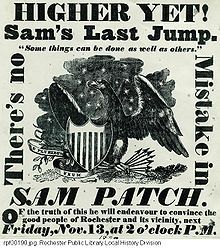
There is, after all, no sense in tempting fate, unless such things get your rocks off. That didn’t work out so well for stuntman Sam Patch who picked the day back in 1829 to make his biggest jump … even bigger than his history-setting plunge over Niagara Falls … and died in the process. (Have to add his personal slogan here, since it cracks me up: Some things can be done as well as others.)

I leave it up to readers to decide what to do with their day … once it rolls around to longitudes more westerly … and take some comfort in the idea that I, for one, can avoid the friggatriskaidekaphobia outbreak warming up already in anticipation of Friday the 13th of April speeding toward us for contact in 2029 … or 2036 … or whatever … when 99942 Apophis puts an end to such silliness.

Read Full Post »

Let’s talk about climate change; blah, blah blah.

And that sums up the progress made toward preventing catastrophe, as highlighted in today’s news from Bonn where guys in suits have gathered to hobnob one last time before jetting off to Cancun … notice these summits seem to happen in fun places … to blather a bit more.

“At this point, I am very concerned,” said chief US negotiator Jonathan Pershing at the conclusion of a week of talks in Bonn.

“Unfortunately, what we have seen over and over this week is that some countries are walking back from progress made in Copenhagen, and what was agreed there.”

And it’s not as if the Copenhagen deal was an epiphany, being, of course, just talk.

What’s it going to take before it all goes to shit? Well … it all going to shit.

We’re well on our way, and although the writing is on the wall it is not on any document that carries enough weight to make any difference at all to the consequences of greedy short-sightedness.

While far too many folks are thinking gay marriage in California is the abomination worth getting het up about, seriously bad stuff is happening … bad stuff that is getting worse and will eventually cause discomfort at church picnics … yet causing little of the outrage stirred by a bit of wedded bliss between consenting adults.

So, let’s look at some news of the day …

A big chunk fell off of Greenland.

Floods in Pakistan have caused misery for 12 million people, destroyed 1.4 million acres of farmland and killed thousands … so far.

In Russia, 560 wildfires are raging and people in Moscow should stop breathing if they know what’s good for them since the city’s mortality rate has risen at least 30% in July.

As the UN and pals start thinking about packing their Armani into Vuittons, champaign goes on ice, every limo in western Mexico gets a good spit and polish and hundreds of jets are fueled up, the planet goes to hell in an ever-hotter hand basket.

Do the name Nero ring a bell? This time is ain’t just Rome, though … it’s the whole damned world, still the only one we have.

Read Full Post »

Three stories in the news this morning have me thinking about mothers and what it means to be one. Not that it directly relates, but I have mentioned often in my writing about adoption that “mother” is also a verb which legitimizes the noun. I leave it to readers today to decide which out of the three here qualify for both the action and the title.

mother |ˈməðər|
noun
1 a woman in relation to a child or children to whom she has given birth.
• a person who provides the care and affection normally associated with a female parent : my adoptive mother.
• a female animal in relation to its offspring : [as adj. ] a mother penguin.

verb [ trans. ]
1 [often as n. ] ( mothering) bring up (a child) with care and affection : the art of mothering.
• look after kindly and protectively, sometimes excessively so : she felt mothered by her older sister.

First, we have a heartwarming video of one mom putting herself on the line to save her baby.

Amateur video has captured footage of a mother bear saving her cub from a fishing net in Anchorage, Alaska.

The mother desperately struggled to save her cub as fisherman Dane Havard pulled the small bear out of tall reeds behind his house with his truck.

The trapped black bear squirmed and thrashed around inside the net, while another small cub watched at a distance.

The mother bear tried to free the screaming cub for several moments before cutting through the net with her teeth and claws.

The mother then ran away with the cub in her mouth.

Anyone thinking there was no actual danger involved will want to check out this story detailing what can go wrong when moms of a certain size and species cross paths with perceived threats of another sort.

Wildlife authorities have captured a mother grizzly bear that they believe killed a Michigan man and injured two other campers in the north-western US state of Montana.

Wildlife authorities then left the mother grizzly overnight to attract her three cubs, two of which were caught in adjacent traps on Thursday.

Officials say the adult bear will be killed if the DNA test results, expected on Friday, link it to the attacks.

These moms are both bears in the wild raising cubs. One is celebrated, the other on death row, both doing what they could to protect their offspring from the havoc that humans bring to their world.

Yes, we’re talking now about animals, their instincts and the potential for mayhem that sometimes occurs when their ‘lesser brains’ and greater bulk set a good part of the mothering agenda.

The third story is also about lesser brains and greater bulk, but taxonomists would actually classify the subject here as human.

A woman in northern France has admitted killing her eight newborn babies but said her husband knew nothing about it, the prosecutor in the case has said.

Mrs Cottrez said she was fully aware of her pregnancies, but that she did not want any more children and did not want to see a doctor for contraception …

Mr Cottrez said he had never noticed his wife’s pregnancies because of her heavy weight, and had no idea she had been getting rid of the babies at birth …

Lest anyone get the idea that this woman is an unparalleled aberration in the species, the article goes on with a disturbing list:

In March, a mother confessed to killing six of her newborn children and hiding them in the cellar of her house in north-west France.

In 1984 a couple in Correze, central France, were jailed for killing seven of their newborn infants over a period of seven years.

In Germany in 2006, Sabine Hilschenz was sentenced to 15 years in prison for the manslaughter of eight of her newborn babies. A ninth baby also died, but too long ago to allow a prosecution.

Somehow, I just don’t see bears doing this …

Read Full Post »

« Newer Posts