Feeds:
Posts
Comments

Archive for the ‘International Adoption’ Category

This blog might begin to show signs of neglect for a while, as I’ve just taken on a new pro blog at Adoption.com covering news from the adoption world.

This came about as a direct result of the slur campaign Mirah Riben and cohorts conducted in reaction to my post shredding a piece of trash she tried to pass off as ‘information’ that started out here, then was moved … by popular demand … to my International Adoption Blog.

By coordinating efforts within the ranks of the anti-adoption league, conducting a full-scale attack on my job and integrity and pulling out all the stops … including the one that would have masquerading as your own biggest fan seem like a really sleazy and desperate move, and understanding that such action is the very definition of ‘fraud’ … they managed to propel me ahead in my work and gain for me a level of respect it would have taken longer to reach without their help.

Finally seen as the scrapper I am, a new category of blog was created as a platform for not only the copious amounts of adoption-related news I glean daily as a matter of course, but also for my views and opinions.

Now, if they start paying me what I’m worth I’ll have found my dream job!

Read Full Post »

I’m starting out this week’s wrap of the news from Cambodia with three links to one of my pro blogs where I posted an interview with Kari Grady Grossman, author of “Bones That Float: A Story of Adopting Cambodia”. Kari was gracious and loquacious, and the interview, like the woman and the book, is interesting and informative.

Part 1 is here. Part 2 is here, and part 3 is here.

I also want to give a link to a great source of info from Cambodia that also has a terrific blog roll — Details are Sketchy. Check it out.

Now, for the news …

The environmental group, Global Witness, released a report highly critical of government officials and the role they play in illegal logging in Cambodia that has many of the powers that be more than a little hot and bothered. In fact, the report itself has been banned from the country.

Like that’s going to make it go away! Sheesh. You’d think they’d understand by now that that’s the best way to get everyone to read the thing.

“The report centers its accusations on the government leader (Prime Minister Hun Sen) with an aim to provoke political animosity in the country, which exceeds the business of this organization,” said Information Minister Khieu Kanharith.

Not that reading will make all that much difference. As the group noted:

International donors, who bankroll the impoverished Southeast Asian nation, do virtually nothing to stop the plunder.

“When are the donors going to start addressing the asset-stripping, Mafioso behavior of the current regime?” Simon Taylor, the Global Witness director, said in a statement Friday.

In an interview ahead of the release of the report, Taylor described the logging business as “part of a massive asset stripping for the benefit of a small kleptocratic elite.

“The forests of Cambodia have been ransacked over the past decade by this mafia with little or no benefit flowing down to the ordinary people,” he said.

The report specifically focused on the Seng Keang Company, the country’s most powerful logging syndicate headed by Dy Chouch, Hun Sen’s first cousin.

When, indeed?

Later in the week came time to start urging donors to review funding for Global Witness!

Cambodia’s embassy in London called the allegations “totally groundless, unacceptable rubbish” and called on Britain, Canada, Ireland, Sweden, and the Netherlands to “seriously re-consider their support in funding Global Witness in the future.”

Yeah … like it’s their fault for noticing.

And it’s not just Global Witness pissing off Hun Sen this week. UN human rights envoy, Yash Ghai, has worked his way under the PM’s fingernails like a splinter of sharp of bamboo again, and the PM isn’t shy about giving him the cold shoulder …

‘This guy comes from a country which completely violates human rights,’ the premier added. ‘You can come here, but I do not need you. If I live to be more than 1,000 years old, I will still never meet with you, so please do not come to see me. The prime minister is not obliged to meet you.’

Hun Sen said Ghai’s report could be compared to a Cambodian proverb that says the dog barks, but the ox cart still rolls forward. ‘However, I will not compare you to a dog,’ he said, referring to Yash Ghai.

Okay, that’s not exactly diplomatic language, but Hun Sen does make a couple of valid points.

First, he, “issued a press release that did not deny human-rights abuses existed in the country but claimed Ghai’s report was unfair, biased and failed to acknowledge any progress the government had made, focusing instead only on negatives.”

Fair enough.

Second, and I love this:

Hun Sen said Monday that he had told former UN secretary general Kofi Annan personally that he never expected to hear a good report on Cambodia’s human-rights record while the human-rights envoy worked for a salary.

‘If you say good things about the government’s human-rights efforts, you will lose your salary,’ he said, adding that he viewed UN human-rights officials as tourists.

Keeping in mind Kari Grady Grossman’s observations from her book that the UN is almost single-handed responsible for the development of prostitution as an industry in Cambodia, I’d say the PM isn’t off base.

Not off base, perhaps, but certainly no where near a level playing field, as this story marking the one year anniversary of mass evictions illustrates.

On June 5th of last year, a pre-dawn eviction of more than 1,700 families from a Phnom Penh site set for development to the village of Trapeang Krasaing 13 miles away was eerily reminiscent of the 17th of April in 1975.

The problem begins, rights groups say, when government officials sell off vast swathes of property to a growing host of private companies promising to develop the land.

Ironically, the roadside leading out to Trapeang Krasaing is lined with billboards advertising yet-to-be-built apartment blocks, condominiums or planned communities of tidy single-family homes.

“There is all of this luxury development going on and the poor people are being discarded,” said one land rights advocate.

Many of those displaced — refugees of one calamity or another, from fires to flood, drought or civil strife — have lived for years on previously worthless real estate.

But the same land can now fetch millions.

Those legally entitled to their property are rarely fairly compensated, and there are very few avenues to fighting land grabs.

Interestingly, the German ambassador to Cambodia is urging the country join the Extractive Industries Transparency Initiative … How’s that for a catchy title? … an oil ethics group, to learn to properly manage what is bound to be lucrative old revenues about to start pouring in.

Hey! They haven’t even cottoned on to how to deal honestly, legally, ethically and morally with trees yet!

And now on to business …

Cambodia is planning to set up a limited stock market by 2009.

“The introduction of a financial market is very important,” Prime Minister Hun Sen said.

“It can help to mobilise the Cambodian people’s savings and channel them into long-term investments in social, economic and infrastructure projects.”

The World Bank has approved $33.5 million in grants that are to make cheap electricity available to rural Cambodians.

Under the World Bank’s Greater Mekong Sub-region (GMS) Power Trade Program, a grant of US$18.5 million to the Kingdom of Cambodia will be used to construct cross-border transmission lines to neighboring Lao PDR and Vietnam. Along with transmission links under construction with Vietnam through the IDA-funded Rural Electrification Project, the new funding will further expand power trade with Vietnam, enabling Cambodia to import electricity and bring down the cost for poor consumers.

You know … I’m really fond of my appliances and all, but cheap electricity is a tricky thing. There’s not much sense having it unless you have a bunch of stuff to plug in, so there’s a potential trap for the poor. Plus, the changes in society that happen when “Desperate Housewives” suddenly becomes an evening option can be very scary.

It puts me in mind of seeing Bart Simpson tattoos on Iban ‘warriors’ in Borneo. it took no time at all for 10,000 years of traditional body art to bite the dust in favor of the latest from America. Yikes, that’s frightening.

While the World Bank is handing out dough, the IMF has a “rosy overall impression” of Cambodia’s national economy.

‘Prudent macroeconomic policy implementation has provided stability, in turn boosting investors’ and consumers’ confidence, and has underpinned very strong macroeconomic performance,’ the statement said.
‘Impressive rates of growth have been sustained, inflation remains low, external debt is sustainable and headway is being made in a number of important structural reforms.

‘The mission noted that the environment provides ideal conditions to re-energise reforms in key areas where progress has been less rapid, and to address the key constraints to broader poverty reduction.’

It said these factors had encouraged significantly increasing Foreign Direct Investment (FDI) which augured well for the economy.

The IMF said it estimates real Gross Domestic Product (GDP) to increase by around nine-per-cent this year, fanned by increased agricultural production and ‘robust growth’ in the areas of tourism, garment export and construction.

There were some caveats, however, mainly about the garment industry and the possibility of climate change impacting agriculture.

A new AIDS Treatment Center has opened in Svay Reing Province thanks to a collaboration between the Cambodian government and the AIDS Healthcare Foundation.

Australia is giving $7.5 million in climate change aid, and one of America’s richest men, Sumner M. Redstone, has announced a half-million dollar grand to the Cambodian Children’s Fund. He might be rich as all get out, but he’s a little slow on the uptake, apparently …

Sumner M. Redstone, said, “Until very recently I was unaware of the horrible conditions under which multitudes of children live in Cambodia.

Seems he’s planning to keep the money rolling in, though, and for that he can be as late to the table as he likes.

And that’s it for this week.

Have a great weekend!

Read Full Post »
Are the Khmer Rouge trials closer to becoming more than an joke with no punch line? Perhaps.

Yesterday saw the beginning of a two-week meeting of the Judges of the Extraordinary Chambers in the Courts of Cambodia (ECCC) … the official website is here … that is supposed to resolve all remaining disputes between Cambodian and International jurists on how the tribunal will be run.

Once the internal rules are settled, investigations can begin. Not to say that they WILL begin, but that it will then be possible. Investigators are to be sworn in on the 13th.

I, for one, will be amazed if they actually manage to accomplish anything … amazed, impressed and very happy to eat my cynicism. This being a UN gig, I so have my doubts about it being more than an exercise in keeping people employed.

And speaking of the UN …

UN special representative of the secretary-general, Yash Ghai, made a return trip to Cambodia this week, surprisingly.

Although he welcomed legal reforms in the country and expressed hope that there are more to come addressing unjust court actions and human rights violations, he criticized a recent decision of the Appeal Court to uphold convictions for the murder of a trade union leader, “despite strong exculpatory evidence and ‘fundamentally flawed’ proceedings.

“The upholding of these sentences is a grave injustice and the Special Representative reiterates his calls for a thorough, impartial and credible investigation into the murder of Chea Vichea, and for the prosecution of those responsible,” he said in a statement.

He was apparently pleased with the way the commune council elections were conducted, but voiced concern over continuing intimidation of worker’s movement leaders.

Only Deputy PM Sar Kheng would meet with him during the visit. No one else was ‘available’ to see him.

Cambodia’s Human Rights Committee Chairman has rejected Amnesty International’s Annual Report that alleges the Cambodian government doesn’t respect human rights, evicts residents from their land, won’t pass an anti-corruption law, and obstructs the process of the courts.

In a statement I can’t figure out at all, the Chairman said, “If they said we chased Cambodian people out of Phnom Penh and they love Cambodian nation, we as Cambodians love it a thousand times more than they do.”

Huh?

And the UN International Fund for Agricultural Development is announcing support for a $11.5 million project aimed at helping rural poor.

Saying this is the agencies first targeting of the poor, ethnic, rural population … really? … the “Rural Livelihoods Improvement Project” is supposed to do something … haven’t heard what yet … with 22,600 households in Kratie, Preah Vihear and Ratanakiri provinces.

Bringing is cash, the tourist trade saw a 20% jump in the first four months of this year over the same period in 2006. (2006 drew 1.7 million tourists, generating $10.5 million)

This bump in the biz is attributed in part to new routes between Cambodia, Viet Nam and Thailand, with a 70% increase in Vietnamese tourists.

Here’s a story I don’t get:

A recent survey by the Adventist Development and Relief Agency (ADRA) showed that a tobacco control policy will receive enormous support in Cambodia …

Hmmmm. A country that can’t manage much in the way of reform and where very close to anything goes is reported to be gung-ho about an “immediate ban” on cigarette advertising.

Please. Can’t we deal with adoption issues first?

And here’s something to keep an eye on; a group of South Korean companies is saying it will be spending somewhere around $2 billion to build a whole new city on 119 hectares on the northern edge of Phnom Penh>

Oh my.

Yes, folks, Cambodia is booming, and total bursting at the seams isn’t far off.

A side effect? Possibly evictions, as detailed by the NGO LICADHO.

Borei Keila, located opposite the Bak Tuok High School in central Phnom Penh in Veal Vong commune of 7 Makara district, covers 14.12 hectares of land and it is divided into 10 communities. It houses at least 1,776 families —including 515 families who are house renters and 86 families who reportedly have HIV/AIDS. Villagers first settled on the land, the site of a former police training facility, in 1992.

In early 2003, in the lead up to the July 2003 general election, a “land-sharing” arrangement was proposed for Borei Keila, which would allow a private company to develop part of the area for its own commercial purposes while providing alternative housing to the residents there. The idea was hailed because, rather than the villagers being evicted, they would be compensated for the loss of their land by being given apartments in new buildings to be constructed on part of the site.

It hasn’t quite worked out that way, however. Read the story for a lot of details.

And China’s big-four steel companies are preparing to start operations in Cambodia at a comcession with 200,000,000 tons estimated as iron ore reserves.

And, of course, stories about new golf courses are become a regular feature of Cambodian news.

Under the plan, the golf course will cover an area of 120ha with half each to be located in Viet Nam and Cambodia. The golf course will consist of a park, 18 hole-course, hotels, restaurants, and tax free shops.

Progress? Schmogress!

The British government is handing out radios to members of the Khmer Cham, Cambodia’s Muslim community, in an effort to give them access to Cham-language programs.

The British Embassy in Phnom Penh claimed in a statement, “The program helps to engage the Muslim community throughout Cambodia and works to promote peace, democracy, human rights, and combat terrorism.”

Bernard Krisher, formerly of “Newsweek”, is raising money to build more than 300 small schools in rural Cambodia.

A school can be built for as little as $13,000 from a private donor, which is then matched by about $20,000 by one of the two international aid organizations. Schools built on land donated by a village include three to six classrooms, desks and chairs. Fully constructed schools are given to the village.

Follow the link for more info.

A tragic story of love and death, this article about a Cambodian widow and her young American husband who died in a fall while hiking, and about her struggle to be allowed to come to America, has a familiar theme.

Here’s a nice little piece about Cambodian classical dance and a group of dancers who fled the KR and kept Apsara alive.

A history like Cambodia does give the country an edge in somethings, and no shortage of contestants for wheelchair races could be one.

They’re preparing for competition next year in Beijing under banners that read: You don’t need legs to run like the wind.”

And that’s it for this week.

Read Full Post »

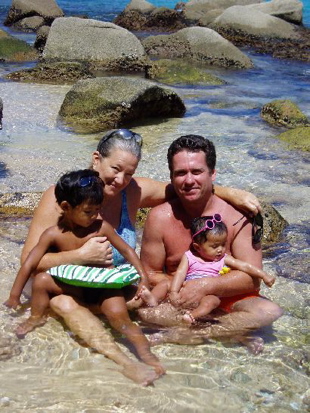
While hopping around other blogs this morning, I realized that I’d not yet posted photos of my lovely family. I’ll take care of that right now.

In case we’ve not yet met, I’m Sandra, aka Mom, the adult male is Mark, often called Dad. The kids are Sam and Cj. At the moment, I’m 55, Mark is 40, Sam is 4.5 years old and Cj is 25 months. We live on Mahé, the biggest island in Seychelles … big being 4 miles wide and 17 miles long … near the village of Baie Lazare.

Beach familyBox o’ kids
Happy Cj
Sam makes cookies

Now that that’s done, I’ll get back to writing.

Read Full Post »

Due to popular demand, this post has moved to the International Adoption Blog.

Read Full Post »

It was a week of events … sort of … in Cambodia, starting on Monday the 14th with King Norodom Sihamoni’s 54th birthday. The party went on for three days, the public holiday part of it anyway, and the papers were full of birthday wishes.

He looks great, too. Must be that dancer’s body thing. Cyd Charisse is in her 80s and still has great legs.

And how about this lalapalooza of a Phnom Penh celebration? Norwegian National Day.

Right. Bet that was a real blow out.

For a look at the film “Sentenced Home”, the story of three Cambodian refugees facing deportation from the US, see the Independent Lens site.

The information they give on how immigration law works is most interesting.

If you’re planning a trip to Cambodia via Thailand, a new route is being talked about.

A major battlefield during the peak of border conflicts with Cambodia in the 1970s, Ta Phraya has now turned into a potential gateway for tourists to visit Thailand’s neighbouring country. Ratri Saengrungrueng, chairwoman of a tour operators club in this eastern province, said the route to Cambodia from Ta Phraya, which is an alternative to the Aranyaprathet checkpoint, has gained popularity with tourists wishing to visit the famous Khmer temple ruins of Banteay Chhmar _ a gigantic 12th-century Bayon sanctuary housing a four-faced monument and a magnificent bas-relief depicting a 32-armed Bodhisattva lokeshvara.

Don’t try this at the drop of a hat, however, as border regulations are an obstacle, even for the Thais.

Cambodia has a Minister of Tourism. Hun Sen fired the last guy last week saying the “reshuffle was made to address some irregularities at the ministry to strive for further development of the mushrooming industry.”

The new minster, Thong Kon, says he’s ” … determined to strengthen the tourism industry by enhancing cooperation with the private sector.”

You know what that means, don’t you? More hotels, big development, probably a lot of golf courses. Ack! Progress. I hate it. Development! I spit in the eye of development. I am, obviously, in the minority on this.

Some big American companies are looking at doing business in Phnom Penh.

GE, ConocoPhillips, Oracle, Fed Ex and ITT Defense have all sent reps as part of a delegation that met with “senior Cambodian officials”.

Does the word “boom” ring a bell?

No? Well, how about “land grab”?

Koh Kong Sugar, one of at least 57 ventures awarded “economic land concessions” since 1992 under a plan to turn fallow fields into export crop plantations, is a glaring example of how Cambodia is being parcelled out to politically connected companies, land rights advocates said.

Land title is a mess in Cambodia, and has been ever since the Khmer Rouge turned almost the whole country into a giant collective. Records were destroyed and people were shifted all over the place. Afterwards, farms and homes took root wherever without much thought to legal deeds or claims.

In 2001, a law was passed allowing people to keep any land that they’ve worked for five years, but very few have the paperwork to prove it’s theirs.

Now, the country is looking like prime real estate in the making, so land value is skyrocketing.

Speaking of skyrockets … and that’s about as cheesy a segue I’ve ever manufactured … this story from zmag is fascinating.

In the fall of 2000, twenty-five years after the end of the war in Indochina, Bill Clinton became the first US president since Richard Nixon to visit Vietnam. While media coverage of the trip was dominated by talk of some two thousand US soldiers still classified as missing in action, a small act of great historical importance went almost unnoticed. As a humanitarian gesture, Clinton released extensive Air Force data on all American bombings of Indochina between 1964 and 1975. Recorded using a groundbreaking IBM-designed system, the database provided extensive information on sorties conducted over Vietnam, Laos, and Cambodia. Clinton’s gift was intended to assist in the search for unexploded ordnance left behind during the carpet bombing of the region. Littering the countryside, often submerged under farmland, this ordnance remains a significant humanitarian concern.

Going on from there, it details American bombing actions in the 60s and 70s. It’s astounding.

The data released by Clinton shows the total payload dropped during these years to be nearly five times greater than the generally accepted figure. To put the revised total of 2,756,941 tons into perspective, the Allies dropped just over 2 million tons of bombs during all of World War II, including the bombs that struck Hiroshima and Nagasaki: 15,000 and 20,000 tons, respectively. Cambodia may well be the most heavily bombed country in history.

And tragic.

Also tragic, the death of Kate Webb, on of the world’s true heros, and one of the few people on the planet I would have given a lot just to meet once.

Everything that a reporter should be, Kate was what every young woman with a dream of a life in journalism should aim toward, although very, very few will have the guts to do that.

Covering every major Asian conflict of her time, she put herself on the line over and over. Imprisoned by the Vietnamese army in Cambodia in 1971 and coming very close to death in Afghanistan more than once, she also worked in Indonesia, Pakistan, Philippines, Sri Lanka and Hong Kong after years in Viet Nam, and covered the Gulf War in 1991.

“She was a pioneer for female reporters and a role model for all foreign correspondents. She was one of the legends,” said veteran Agence France-Presse journalist Chris Lefkow, who covered the 1991 Gulf War with her.

The world is one Kate Webb poorer now, and that’s a crying shame.

Not gone, contrary to scientific thought for the past few years, is one of the meanest, scariest sounding creatures I’ve heard of in a long time, the Cantor’s giant softshell turtle.

What’s scary about a turtle?

Well, this one grows up to 6 feet long, buries itself in mud so no one can see where it waits, has a strike faster than a cobra and a bite that can crush bone. This in a country where no one wears shoes!

It may look like roadkill, but if you see one before it sees you, get the hell out of its way!

And that’s all I can do today.
Canot’s giant soft shell turtle

Read Full Post »

Due to popular demand, this post has moved to the International Adoption Blog.

Read Full Post »

« Newer Posts