Feeds:
Posts
Comments

Archive for the ‘Religion’ Category

My friend Paul Sandstone over at Café Philos has a thread going now that ties in … a bit … with that World Ends Next Saturday nonsense I wrote about a couple of days ago.

Beginning with the the question, “Belief in God is Natural?”, Paul sites early reports on a Cognition, religion and Theology project at Oxford, and carries on from there with what I consider appropriate skepticism.

There are, at this hour, a handful of early reports that the Centre for Anthropology and Mind, which is associated with the prestigious University of Oxford, has concluded its Cognition, Religion and Theology Project — and that the Project has found it’s natural to believe in God.

But I doubt those reports are true. I cannot be certain and this in only a hunch — but it seems like the early reports have misinterpreted the Project’s findings.

The reports are saying such things as, “Human beings have natural tendencies to believe in God…“, and, “Religion comes naturally, even instinctively, to human beings…“, and, “Holding religious beliefs may be an intrinsically human characteristic…“.

Curiosity drove me to dig into the roots of the Oxford study which revealed it is funded by the John Templeton Foundation, an organization whose slogan is “Supporting Science — Investigating the big questions”.

Okay.

So, who was this Templeton dude? Seems an apt question, since getting an idea of the roots of what are considered “the big questions” may have a lot to do with whatever answers come out of the project.

Well … turns out Mr. Templeton just may have had an agenda when he set up his foundation.

He was a lifelong member of the Presbyterian Church. He served as an elder of the First Presbyterian Church of Englewood (NJ). He was a trustee on the board of Princeton Theological Seminary, the largest Presbyterian seminary, for 42 years and served as its chair for 12 years.

Meanwhile … back at Café Philos …

Now, let’s return to the early reports of the Project’s findings. When those reports say things like, “Human beings have natural tendencies to believe in God…”, they might be subtly misinterpreting the findings. That is, I would not at all be surprised if the Project found a natural human tendency to see agency behind events. But, for a number of reasons, I would be greatly surprised if the Project actually found a natural human tendency to see God behind events. Or even a natural human tendency to see any deity — let alone the deity that gets capitalize as “God” — behind events.

Paul goes on to make many valid points and interesting observations on humans, religion and gods of all shapes and sizes, which brought me to thoughts about apes. (Go figure … )

In the world of brilliant science and big questions, I have a few heroes, one being Frans de Waal, professor of Primate Behavior at Emory University and all-around smart guy.

Dr. de Waal was recently interviewed by a publication called “Religion Dispatches”, during which the subject of religion was raised … or religion as a moral dictate, guidebook, whatever.

Dr. de Waal’s take differs from, say, that of well known atheist … and smart guy … Richard Dawkins … another Paul refers to at the café … addressing the “big question” of tending toward religion as an offshoot of an evolutionary mandate toward compassion. (Waters that have been considerably muddied by what calls itself religion.)

Regarding Dawkins:

Atheists—some of them, at least—have talked themselves into a corner and they don’t know how to get out of it, because we need to find a way of explaining where morality comes from. I think the way to do that is to return to Darwin. Darwin tried to place morality within human evolution. And that’s what I’m trying to do, at least with my primate studies. I’m trying to say, look at the behavior of other primates—there are enough indications that they have what Darwin would call the social instincts needed to get to morality. They don’t exactly have it, but they’re close enough for me to see that there’s a continuity. I think that’s the way out of the dilemma. Talking about whether God exists or not just really doesn’t do any good for that problem.

Exactly.

A study at Oxford may come up with all sorts of illustrations of why humans believe in god, subscribe to religions, drink the Kool-aid, but unless some redefining is done when it comes to either what is god or what is human or what counts where how, what good does it do, and what does it mean?

Frans de Waal:

Where everything started for me was maternal care. It’s advantageous for female mammals to be sensitive to the mood states of their offspring, so they react when their offspring are distressed or in danger. That also explains why empathy is more developed in females than males in many species, including humans. From there it spread to other areas of social life. It’s contagious: if you have a cooperative society, you need to be concerned about the well-being of those you depend on.

If I live in a society where I depend on others, I need to be concerned if those others are doing well, and that’s where empathy and altruism come in. It’s also why we think you find empathy in all mammalian species. It’s not limited to humans, and it’s not limited to primates. It’s probably universal in mammals.

It seems if there is A God guiding Earthlings toward altruism through whatever means, it might be hairy. After all, there were Monkey Gods B.C..

Do we need them, though? Until a chimp waves from a balcony in Rome, I’m thinking … not …

Read Full Post »

During a long and pleasant conversation with Tom yesterday, we covered a bit of the territory involving the latest palaver over the … dumb da dumb doomend of the world, which according to some nut case in Oakland should be rolling around a week from Saturday.

May 21, 2011, is the latest attempt to get a jump on Judgment Day, courtesy of Oakland, Calif.-based Family Radio, a nonprofit evangelical Christian group.

Apparently, this particular flavor of nut has cracked before, but this time is really sure.

Family Radio, whose president, Harold Camping, predicted the End of Days before: Sept. 6, 1994. Camping had been “thrown off a correct calculation because of some verses in Matthew 24,” a company spokesman told ABC News this month.

The Christian radio broadcaster is apparently more confident this time around, spending big bucks on 5,000 billboards, posters, fliers and digital bus displays across the country.

And why not? Spend, spend and spend some more, I say, as what the hell else would one do on the last days?

Really. What?

Say the end really is nigh, there’s a week or a month or a year left before the planet explodes, implodes, offloads … whatever … and we somehow know this to be fact.

What?

What do we do differently?

Okay, we spend time with our loved ones, touch all the bases that need touching, convey all the emotions as best we can. Depending on the time allowed, perhaps we watch the sunset from a pyramid or ride to the top of the Eiffel Tower or swim the English Channel or otherwise check off bucket-list items.

Some might choose to get in all the get-backs they’ve been venomizing over for years. but the idea of taking an enemy out loses impact when we’re all in for it, dunnit? Why do some asshole the favor of an early checkout?

And there’s the point … we ARE all in for it. Sure, probably not at the same time under the same circumstances in the same conflagration or whatever, but the fact o’ the matter is, none of us get out of this alive so we might as well live as if we’ll die someday, somehow, somewhere.

That, of course, is hardly the point of the predictors of pending extinction, however, and maybe … just maybe … they’ve got the better handle on the big picture: End of the World = money in the bank.

Those who buy into the idea might very well run up their credit cards in what they are convinced is a “live for today” frenzy, but there’s hell to pay if they’ve been sold a bill of goods that doesn’t deliver.

For some, though, it delivers well enough …

Edgar Whisenant didn’t get it right the first time, either, when he predicted a mid-September 1988 Rapture, even publishing the books “88 Reasons Why the Rapture Will Be in 1988” and “On Borrowed Time.” No Apocalypse, no problem. The former NASA engineer simply pushed his predictions off to three subsequent years and wrote books along the way, none of which reportedly sold as well as the first two.

Interestingly, there’s no little advice on stuff you should have on hand to … and this I so don’t get … survive the end of the world.

Here’s just one list:

# Canned food something that does not need refrigeration
# Canned meats, spam , chicken, tuna etc you need at least 3 ounces of protein per person per day.
# Water can be stored in the 2 ½ gallon containers with the pour spout which are sturdy and easily stackable. Other sources of emergency water are discussed in the water section.
# Blankets should be available for all
# Water filter Brita or pump type
# Sugar cubes for energy, breakfast bars
# Small grill , propane barbeque or camping grill ( power is likely to be out)
# Cash for purchases if the power is out using small bills because change may not be possible.
# Parachute cord 100ft 550 pound test
# Duct tape one roll to seal around doors and window, tape bags together for emergency shelter or rain gear, and general mending.
# Needles and thread just sturdy thread clothes will need to be mended and occasionly a cut will need to be sewn shut as well
# Survival manual one that has a lot of pictures and information in it several are recommended on this site
# Plastic tarps with grommets at least 2 of 10 ft x 10ft each.
# Plastic coated playing cards
# Battery operated radio preferably crank type rechargeable and two changes of batteries
# Dishwashing soap and clean dish towels 2 or paper towels water can be scarce
# Manual can opener either the ecko hand crank type or the smaller survival type
# Trash bags 30 gallon or larger two for each person with twist ties. They can be used as emergency ponchos, trash bags, emergency toilets ( the plumbing may not work)
# Buy a 3 gallon paint bucket, one cheap toilet seat $5 and use the seat on the bucket and deodorise with aqua chem, an RV tank sanitizer to control the smell. Otherwise twist tie the bag closed it will smell bad in a confined area.
# Some sturdy dishes metal plates work fine and can be found at camping stores. A family sized mess kit will have pots plates and cups inside along with some silverware usually but check it.
# One or more really good flashlights. The new LED lights use a lot less power and last longer than regular bulbs.
# Bug repellent larger size since bugs will come in out of the rain as well
# General medications like aspirin ibuprophen, pepto bismol, mouthwash,
# Deodorant you may be living cramped for quite a while and a couple of washcloths and towels.
# Air matteresses are good but blankets and bedding are a must for sleeping.
# Candles the power is likely to be out a long time and it gets real dark without it.
# Box of wooden matches in plastic with the striker so they do not get wet
# Butane lighter at least one more is better one of the long ones to light the candles and stoves
# Coleman lantern and Coleman stove
# Two gallons of the liquid fuel they are interchangeable and it can be used to start a barbeque pit or wood fire later if the wood is wet.
# Prescription medications at least enough for two weeks lots of times you can get a 30 day supply for travel etc and just rotate it out to keep it fresh.
# Towels and wash cloths with a bar of soap
# Diapers and extra trash bags if you have infant children any lotions or powders you may need and dry or canned formula.
# Several changes of clothing which are comfortable and right for the season
# Tooth paste and brushes
# A portable toilet seat and extra 20 gallon size trash bags with wire ties for your shelter if indoors.
# Handy wipes or baby wipes, water may make cleaning up difficult.
# Sanitary napkins for any women likely.

Well, that could push the edges of the credit envelope, but if the 22 of May dawns there’s always next year … Yikes! 2012! … to fall back on if MasterCard comes a knocking.

Think I might just put together a series of eBooks on fun stuff to do in those last 48 hours of Earth …

Amorous Armageddon: End of the World Sex That’s Out of This World ($9.99)

Ashes, Ashes All Fall Down: Entertaining Kids In the Final Hours ($9.99)

Sudden Death: Fun Games for Judgment Day($9.99)

… and an iPhone app that will send and manage goodbyes, last wishes, apologies and excuses in 4,000 languages. ($1.99)

Better get on this before the world ends, or I do …

Read Full Post »

Being I’m neither new nor a scientist, it could well be that I’m spending too much time reading New Scientist these days. I know the story about wind farms suggesting wind and waves are not renewable resources confused the shit out of me, and if anyone bothering to click on that link and read could please explain the content I’d be grateful.

There’s no doubt I like a challenge and trying to wrap my head around sciency stuff is a pastime I enjoy whether that be grasping toward black holes in efforts to understand dense gravity or trying to incorporate an inner clock to include time travel.

Something I did not expect to run across in my daily perusal of Stuff Science, however, was this article on religion.

What form would the ideal religion take? Some might argue that instead of redesigning religion, we should get rid of it. But it is good for some things: religious people are happier and healthier, and religion offers community. Besides, secularism has passed its zenith, according to Jon Lanman, who studies atheism at the University of Oxford. In a globalised world, he says, migrations and economic instability breed fear, and when people’s values feel under threat, religion thrives.

For starters, the unsubstantiated “information” contained in the piece feels decidedly un-sciency for New Science with few links and no backup. Attribution given to Mr. Lanman … who “studies” atheism … doesn’t cover the postulation that “religious people are happier and healthier and religion offers community”, so is therefor “good”.

A bowling league offers community fercryinoutloud, and manages to do so without prompting any genocides I’ve heard of. As for the “happier and healthier” … well, someone’s obviously never seen the impact of Catholic guilt.

I do get that this article is fluff even though quoted sources apparently attend Oxford … ooooooh! …

Today’s religions come in four flavours, according to Harvey Whitehouse, also at Oxford. First, the “sacred party”, such as incense burning, bell ringing and celestial choral music in Catholicism. Second, “therapy”: for example, the practices of healing and casting out devils among some evangelical Christians. Third, “mystical quest”, such as the Buddhist quest for nirvana. And finally, “school”: detailed study of the Koran in Islam or reading the Torah in Judaism.

Okay … a “sacred party” where all but a few are relegated to the sidelines, “therapy” that encourages people to grow even wackier, a “mystical quest” that could just as easily mean a search for Atlantis, and “school” where the only study is some really old books.

On what level does that make any sense, except perhaps to an undergrad needing to fill pages? The fact that the piece gets even more graphic lets down the side even more discouragingly:

Numerous festivals, holidays and rituals would keep followers hooked. “Rites of terror” such as body mutilation are out – although they bind people together very intensely, they are not usually compatible with world religions (New Scientist, 19 December 2009, p 62). Still, highly rousing, traumatic rituals might still feature as initiation ceremonies, because people tend to be more committed to a religion and tolerant of its failings after paying a high price for entry.

The everyday rituals will focus on rhythmic dancing and chanting to stimulate the release of endorphins, which Robin Dunbar, also at Oxford, says are key to social cohesion. To keep people coming back, he also prescribes “some myths that break the laws of physics, but not too much”, and no extreme mysticism, as it tends to lead to schisms.

So, body mutilation is out, but dancing and chanting lead to social cohesion? Can’t help but wonder what’s going on at parties at Oxford these days, but whatever is happening seems to have the effect of leading attendees to assume their thoughts have more merit than they do.

With many gods and great tolerance of idiosyncratic local practices, the new religion will be highly adaptable to the needs of different congregations without losing its unifying identity. The religion will also emphasise worldly affairs – it would promote the use of contraceptives and small families and be big on environmental issues, philanthropy, pacifism and cooperation.

Yeah … that’ll do it.

Of course, there are those fiddly bits concerning money and power that root religions before they flower, tax-free status and a whole bunch of non-negotiable rules, but if you attend Oxford and get your papers published in New Scientist, coming up with “Utopianity” must seem an accomplishment.

The thought that humans need a new religion is, in itself, an excuse not to have to think much further than the end of the block … upon which stands a church most likely … as developing more effective ways of fostering the human in humanity would take a lot more creativity.

Since science should be all about creativity, I will be sending a link to this post along with my subscription cancellation.

(Apologies: this post was slapped together during infrequent minutes of Internet access and while babying my computer. Conducive to good writing? Not so much …)

Read Full Post »

cognition
kägˈni sh ən
noun
the mental action or process of acquiring knowledge and understanding through thought, experience, and the senses.

It seems science is well on the way to proving that, yes indeed, thoughts actually are things, but not in ways many like to consider them to be. Creative visualization for example, the process of wishful thinking that is said to have the power to produce desired results, could now be touted as little more than a molecule doing the backstroke in chemical soup.

It’s this article titled “Evolution of cognition might be down to brain chemistry”, in New Scientist that’s stirring the chowder this morning:

“Brain metabolism probably played an important role in evolution of human cognition,” Khaitovich says, “and one of the potentially most important changes was in glutamate metabolism.”

Glutamate is the “brain’s main energy metabolite”, he says. “And as the main excitatory neurotransmitter it is responsible for virtually every possible cognitive task, including learning and memory.”

Apparently glutamate is not thought, but rather the chemical that “that energises brain cells and ferries messages between them” — the grease on the wheels, so to speak — but there’s no doubt a search is on for the chemical … a combo of chems, perhaps tweaked with a jolt of electro-juice? … that is ideas and concepts.

How much of who and what we are is simple biology — not “simple” in an it’s-easy-to-grasp way, but will someday be a cinch to quantify — is a question I ponder often these days.

David Kingsley of Stanford University in California was not involved in the study, but his team recently revealed genetic differences accounting for humans’ larger brains. “It’s clear that humans have accumulated some interesting differences in the thinking regions of the brain,” he says. “It will be interesting to see how such differences arise from changes in our genomes and those of our closest relatives.”

Are we nothing more than a link on an evolutionary chain with reactions dictated by a dollop of this and a drip of that? Do we fall in love because the smell of someone trips a switch that floods our brain with a feel-good bisque? Is art created out primal dictates to pass along DNA? Are dreams just random spurts in some electro-chemical tango that hears sleep as a beat? Is thirst for knowledge simply an inner empty road we’re primed to navigate for the heck of it?

If this is all we are, biological beings at the mercy of meat and related juice, then … well … the point would be … ?

As meat au jus with glutamate, and whatever else has yet to be identified … My Self Glutamate sounds tenderizing … perhaps all these thought things are merely distractions; jingling keys that draw attention away from the tedious process of living only to eat, shit and reproduce, the true mandates if there is nothing more to us.

What we are has longed seemed to me a waste of evolutionary energy, however. If a hummingbird developed speedy wings and a long beak to fit a niche … if mandrills grew glorious asses because dense jungle habitat favored those who could keep track of others … if hibernation preserved life in cold climates (and, yes, all that did happen) … then why, oh why, did humans become so over-engineered in the thoughts/dreams/creation department instead of growing thicker hair and perfecting the art of arboreal living?

Why must the chemicals in my head put words into verse? What is the evolutionary benefit in concertos and cubism? Where does a broken heart fit into the picture? And why is there any picture at all?

If all this thought stuff is just a series of shiny objects grabbing our attention for a while as we plod, perhaps they’re what keep us plodding. Maybe the chemical for ego is the difference between offing ourselves out of sheer boredom and sticking around long enough to eat, shit and reproduce.

Given the state of the world, however, that prospect seems an evolutionary shot that backfired since just about everything else on our planet would be better off were we not so wrapped up in what we think are our thoughts, and may very well result in us doing ourselves in.

Awash in MSG as I am at the moment, I can’t help but go back to the combo of chemicals that has me asking again:

And the point would be … ?

Read Full Post »

A jar of miracle ... make do

“All the tales of miracles, with which the Old and New Testament are filled, are fit only for impostors to preach and fools to believe”
~ Thomas Paine

Growing up as I did with spells of Catholicism constantly cast in my general direction, the idea of miracle cures seemed … well … reasonable for a while. The film version of St. Bernadette’s escapades at Lourdes did much to solidify images of the manifestations made possible by just enough faith to draw the attention of the Man Upstairs toward the suffering of those who jumped through the right hoops and deserved to be healed.

I was probably about ten when it dawned that such concepts pretty much left anyone unhealed in the shit pile of undeserving, a concept contrary to all those warm fuzzies created through the magic of Hollywood and the smoke and mirrors of Rome, and although I will to this day still acknowledge occasional unexplainable restorations of health and the sometimes-effective wonders of modern medicine the idea of miraculous cures seem nothing but more marketing of snake oil in various flavors for the obvious benefit of those collecting the profits.

I do understand the motivation behind the desperately ill, the hopelessly condemned; when there’s nothing left to do but grasp at straws the option can seem sensible, but since none of us get out of this alive, perhaps more than a bit futile or at most a temporary reprieve.

When a miracle can be bought at a reasonable price … a trip to France, maybe, or some set amount of hours on the knees while fingering beads X number of times … it’s a viable option for passing the time. Waiting for the magic to happen isn’t a bad way to spend that eleventh-hour, unless by doing so those last bits of life are sacrificed in the process.

When, however, attempts at intervention come in a jar labeled “Utter bollox at great cost”, the evil of canned hope becomes apparent, as evidenced in this article:

A Tanzanian pastor has asked people to stop going to his remote home for a “miracle cure” after thousands flocked there, causing chaos in the surrounding area.

Rev Ambilikile “Babu” Mwasapile, 76, says he does not want any new arrivals until after Friday 1 April, to let the crowds die down.

Local media report that about 52 people have died while waiting to see him.

A BBC reporter says the queues to see him stretch for 26km (16 miles).

Belief in magic and the powers of traditional healers are widespread in Tanzania.

Some witchdoctors say that the body parts of people with albinism are effective when making magic charms, leading to the killing of dozens of albinos in recent years.

The retired Evangelical Lutheran Church of Tanzania preacher is sick and tired of the crowds of people who are yanking loved ones out of hospitals and making the trek to his village … while dying both before and after spending time and money … as “medical experts” investigate and debate the intrinsic value of his snake oil.

Yeah, sure … this is Africa and such mumbo-jumbo is part of the culture in many areas, but it’s not the only place claptrap flies to the detriment of others.

Although Africa is presently one scene of devastation in the name of remedy, that’s only because one cornucopia of crap has been virtually wiped out in the parts of the world that insist there’s a cure in them thar hairs.

Rhino populations in Africa are facing the “worst poaching crisis for decades,” say conservationists.

Over the past three years, gangs are said to have killed more than 800 rhinos for their horns, which can fetch £22,000 per kilo on the black market.

Experts fear the rise in poaching could undermine recent efforts to stabilise black and white rhino populations.

… t is estimated that 333 rhinos were killed in South Africa alone last year, with a further 70 being shot dead so far this year.

Conservationists suspect that most of the illegally harvested rhino horn are destined for the traditional medicine markets of South-East Asia, and the growing demand and high prices are fuelling the sharp rise in poaching.

We’re not even talking hopeless desperation here, since murdering a magnificent animal seems a fair enough tradeoff for comfort:

Rhino horn is a time-honored component of traditional Chinese medicine (TCM). For thousands of years, TCM has credited rhino horn with the potency to cure an unusually wide array of maladies, from headaches to pus-filled boils–and even devil possession.

… Rhino horn has been an essential ingredient in traditional chinese medicine for centuries. An unfortunate proximity to China explains why the combined total of the three Asian rhino species (Javan, Sumatran, and greater one-horned rhino) is still smaller than Africa’s critically endangered black rhino population.

Despite China being a signatory to the Convention on International Trade in Endangered Species (CITES) and banning trade in rhinoceros horn and its derivatives in 1993, current rhino poaching levels suggest that the use of rhino horn continues unabated in traditional medicine markets.

According to Bernard Read’s 1931 translation of Li Shih-chen’s 1597 materia medica Pen Ts’ ao Kang Mu, rhino horn was prescribed for nearly everything: “To cure devil possession and keep away all evil spirits and miasmas. For gelsemium poisoning. To remove hallucinations and bewitching nightmares. Continuous administration lightens the body and makes one very robust. For typhoid, headache and feverish colds. For carbuncles and boils full of pus. For intermittent fevers with delirium. To expel fear and anxiety, to calm the liver and clear the vision. It is a sedative to the viscera, a tonic, antipyretic. It dissolves phlegm. It is an antidote to the evil miasma of hill streams. For infantile convulsions and dysentery. Ashed and taken with water to treat violent vomiting, food poisoning, and overdosage of poisonous drugs. For arthritis, melancholia, loss of the voice.”

Since rhino horn is made of the same stuff as fingernails … agglutinated hair … hiring nail biters to spit shards into a collection plate would make as much medical sense and perhaps save a species.

Of course, it seems our species … we furless bipedal wimps that we are … calculates our worth in profit-per-head, and it matters little if it’s grinding up albinos, raping child virgins or ridding the world of rhinos … tigers, bears, whatever … that generates income as long as someone can make a buck and others are so easily convinced to hand over their money for snake oil.

Perhaps there’s a way to turn this inborn stupidity to the advantage, however …

How about we try pushing the notion that powdered brain of greedy people will make one rich?

Read Full Post »

Karmageddon

A portmanteau of “Karma” and “Armageddon.” References “shit hitting the fan” in an extreme way while acknowledging one’s contributions to that event.

Specifically, when all the (usually unpleasant) stuff you’ve done comes back to you at once.

And ain’t that a bitch?

A recent spate of aspersions cast toward me and whatever karmatic debt I face has me contemplating, and … You know what? … I’m pretty okay.

More than okay, actually, since the scale has been rather more heavily weighted on the “reap” side than the “sow” of late, so I’m just waiting for that pendulum swing that has things leveling out, if not lucky enough at the mo to do more than stock away some karma points for future use.

As she has planted, so does she harvest; such is the field of karma.
~Sri Guru Granth Sahib

There are those, however, for whom the Four Horses Asses of the Apology have yet to all arrive at the stable for their big shit, so Karmageddon looms. Shame.

The karma game is not one of holding and folding, even though the element of knowing when to walk away and when to run may be part of it. It’s more Monopoly than poker, but where investments in goodness have bigger payoffs than houses on Park Lane and consequences can be more dire than landing in gaol until the next roll of the dice. (And, yes, it’s the British version I’ve seen for years, so can’t recall the Atlantic City board.)

Of course, goodness doesn’t always happen and even the sweetest of us will sometimes sour the mix, but the karma-conscious can manage pre-geddon maneuvers … sincere apologies, compensatory gestures, explanations that don’t include excuses and the like.

In a bit of interesting timing, Superhero Bobby posted a Bruce Lee quote on his facebook page this morning that ties in nicely:

Mistakes are always forgivable, if one has the courage to admit them.

Yes … that “admission of guilt” thing goes a long way toward sidestepping Karmageddon, and it does take guts.

As we all know, Bruce Lee was no wimp, so one would have to assume that in seeking forgiveness he would have been courageous enough to admit mistakes, not only to those perhaps wounded by them, but also to himself, and since karma is all about lessons, that would seem to be the salient point.

Although justification may come easily to one who’s wronged another, it too often lands on the “this is going to bite you on the ass someday” side of the karma scale, and regret, being an internal manifestation … and frequently self-serving … doesn’t tend to tip things toward the reward side, either, unless it is strong enough to keep one from screwing up so badly in the same way ever again.

No, it’s all about the lessons learned and, although there are some who appear to get through life avoiding the morals and messages, Karmageddon awaits. In one way or another paybacks happen, shit hits fan and messes are made, and it matters not if you throw in your hand and run like hell, you’re still going to end up with shit all over you.

Personally, I prefer to keep things clean from the get-go, and failing in that, to tidy after myself as I go.

My actions are my only true belongings. I cannot escape the consequences of my actions. My actions are the ground upon which I stand. ~Thich Nhat Hanh

Read Full Post »

Victoria's "Gift"

On yet another day that sees the news filled with horror stories and images of destruction, I hunt for a bit of diversion from the real-life world that shakes and screams and hurts and hates, something to let my head go in directions necessary to make progress on present work. In other words, to lift the clouds of gloom and feel the sunshine with little nagging guilt over just how bloody easy I have it at the moment.

History can provide quite the perspective, so finding this story on Queen Victoria’s much younger man has caused quite the reroute in thinking on world reports through the mirror of time and more than a little sweetness.

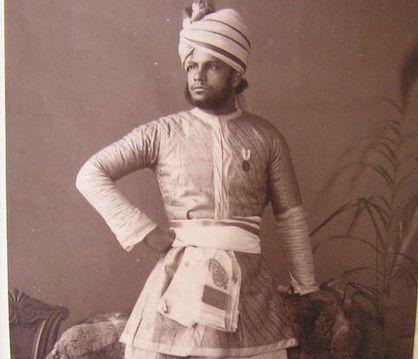
Mr Karim was just 24 when he arrived in England from Agra to wait at table during Queen Victoria’s golden jubilee in 1887 – four years after Mr Brown’s death. He was given to her as a “gift from India”.

Within a year, the young Muslim was established as a powerful figure in court, becoming the queen’s teacher – or munshi – and instructing her in Urdu and Indian affairs.

Mr Karim was to have a profound influence on Queen Victoria’s life – like Mr Brown becoming one of her closest confidants – but unlike him, was promoted well beyond servant status.

“In letters to him over the years between his arrival in the UK and her death in 1901, the queen signed letters to him as ‘your loving mother’ and ‘your closest friend’,” author Shrabani Basu told the BBC.

“On some occasions, she even signed off her letters with a flurry of kisses – a highly unusual thing to do at that time.

“It was unquestionably a passionate relationship – a relationship which I think operated on many different layers in addition to the mother-and-son ties between a young Indian man and a woman who at the time was over 60 years old.”

Ah, the advantages being Empress brings a girl, heh? (And just in case anyone is wondering what to get me for my birthday in July, such a “gift from India” would not be scorned!)

Apparently, Karim was not on the Top Ten list with the rest of the clan, as he was given the royal boot out the palace doors within just a few hours of Victoria’s funeral, but although attempts were made to wipe the castle clean of all reference to him he had spent ten years with the woman, and he did keep diaries.

Those diaries are on their way to becoming a book, and a fascinating read it’s bound to be. Not only do we have that cougar thing going, but the fact that the Supreme Governor of the Church of England was taking daily advice from a Muslim back in the days India was still part of the Empire is very interesting.

No doubt, Victoria was one smart monarchial cookie, as under Karim’s tutelage she learned to speak, read and write both Urdu and Hindi, and I enjoy imagining the range and depth of conversations they conducted as they shared days, traveled the world and passed time in her remote highland cottage in Scotland.

He was, of course, not the first younger man the “Widow of Windsor” had a thing for, the Scotsman, John Brown, having been her “personal servant” from shortly after Prince Albert’s death until the time of his.

Victoria’s children and ministers resented the high regard she had for Brown, and, inevitably, stories circulated that there was something improper about their relationship. The Queen’s daughters joked that Brown was “Mama’s Lover,” while Edward Stanley, 15th Earl of Derby wrote in his diary that Brown and Victoria slept in adjoining rooms “contrary to etiquette and even decency.”

Well, what the hell? If you’re the Queen of the United Kingdom of Great Britain and Ireland and Empress of India, you’re going to pay attention to what others have to say about where your boyfriend beds down? I don’t think so … at least not in the days before tabloids and Twitter.

I’d never considered Queen Victoria a woman I’d relate well to, but seems I’ve found some commoner ground, and although I know it’s not only more than 100 years too late, but also something she would never have registered on her radar, I’d still like to say:
YOU ROCK, GIRL!

Read Full Post »

Tasting Ashes

It’s a gray dawn in Seychelles, appropriate for Ash Wednesday and the beginning of Lent.

As a child, I dreaded this day, as it usually meant an early Mass on an empty stomach in a very crowded church that more than once resulted in passing out cold as I waited in the long queue to get ashed. Of course, it also meant the giving up of something I’d deemed of great value for all of 40 days.

This year, Mass is out, as I no longer deal with those issues and canceled my subscription many years ago, so don’t need those ashes.

Oh, no. I have my own.

The taste of ash is strong in my mouth today, as I’ve been spending too much time lately learning just how thoroughly I was raked over the coals, but this has dictated my Lenten sacrifice.

Yep. I’m giving up men for Lent.

From now until Easter I will not allow a thought of romance, a flash of attraction, a longing for touch, a regret over lost love to linger for more than the instant it will takes to wipe it from my head. I will waste no time missing any man from my past nor holding hopes of future connections. I will satisfy myself by and with myself, and I will take comfort only from those whose link to maleness in my regard is either nonexistent or inconsequential.

I will expect no reward of bounty when Easter arrives, but rather hope that by then my cravings have been tamped down to the point that only the most vigorous … and deserving … blast will bring on even the slightest explosion. In other words, I hope to gain something approaching temperance.

“Temperance is moderation in the things that are good and total abstinence from the things that are foul.”
~ Frances E. Willard

I’m not saying I’ll be avoiding men, as that’s simply not a possibility in life outside a convent, and I have no intention of substituting one habit for another, and I will continue to interact with, and appreciate members of the gender … that would be those who sport a member, but I’ll be ignoring that fact … with deep respect as fellow humans. Maleness in general, however gets a complete pass.

So, with ashes on my tongue I begin a Lenten season of dedication to self combined with acts of penance and charity that will include the giving of my time to others whose ashes taste much like mine.

Yes, on a gray Ash Wednesday morning, I throw off the shackles of a much-enjoyed compulsion and look forward to 40 days of prayer and peace.

Read Full Post »

Marriage masks?There a whole lotta blah, blah going on about marriage, its “holy bonds”, traditional roles, legal entanglements, etc., and I’ve done my share of blathering.

Yesterday’s post on infidelity, for example, was at least partially about pondering on the whole monogamy issue, the skirting around that happens to the tune of millions of bucks for modern-day cyber pimps and some offered thoughts that adultery dulls divorce tendencies.

Yes, marriage and partnerships of all sorts are a hot-button topic these days as many struggle to rearrange everything from expectations to laws. Although there is a strong tendency to hold to tradition, it’s harder to do that every year as society shifts radically.

Historically, it wasn’t all that long ago that ending a marriage by any method but death was almost unheard of. No matter the circumstances, marriage was a life sentence, and although that conveyed some stability the price was often higher than many wished they’d signed on for.

It wasn’t until 1979 that the USA shit-canned the last of the Head and Master laws, an appalling mandate based upon the “legal definition of marriage” that, “delegated the husband’s role as supporting the family and the wife’s as housekeeping, childrearing, and providing sex.”

“Head and Master” laws were a set of American property laws that permitted a husband to have final say regarding all household decisions and jointly owned property without his wife’s knowledge or consent, until 1979 when Louisiana became the final state to repeal them. Until then, the matter of who paid for property or whose name was on the deed had been irrelevant.

They meant the wife had no say over where or how a family lived, and a woman who refused to move at her husband’s demand could be sued for abandonment.

Some are still pissed off about the movement Betty Friedan started back in the ’60s with an article in “Good Housekeeping” shockingly titled Women are People, Too, blaming the women’s movement for the disintegration of the American family, but anyone with a firm grasp of the history … not just “Leave it to Beaver” episodes … in their head understands the costs at which families were held together before there were options.

The voices of tradition and the voices of Freudian sophistication tell us that we can desire no greater destiny than to glory in our role as women, in our own femininity. They tell us how to catch a man and keep him; how to breast-feed children and handle toilet training, sibling rivalry, adolescent rebellion; how to buy a dishwasher, cook Grandmother’s bread and gourmet snails, build a swimming pool with our own hands; how to dress, look, and act more feminine, and make marriage more exciting; how to keep our husbands from dying young and our sons from growing into delinquents.

They tell us — the psychologists and psychoanalysts and sociologists who keep tracing the neuroses of child and man back to mother — that all our frustrations were caused by education and emancipation, the striving for independence and equality with men, which made American women unfeminine. They tell us that the truly feminine woman turns her back on the careers, the higher education, the political rights, the opportunity to shape the major decisions of society for which the old-fashioned feminists fought.

Now a thousand expert voices pay tribute to our devotion from earliest girlhood to finding the husband and bearing the children who will give us happiness. They tell us to pity the “neurotic,” “unfeminine,” “unhappy” women who once wanted to be poets or physicists or Presidents, or whatever they had it in them to be. For a woman to have such aspirations, interests, goals of her own, the experts keep telling us, impairs not only her ability to love her husband and children but her ability to achieve her own sexual fulfillment.

That was written in 1963.

Of course, we still have many issues to deal with … domestic abuse, infidelity, unequal divisions of power and money, to name just a few … but the stranglehold of traditional values has loosed its grasp.

We don’t have to marry at all if we’d rather not, and not marrying no longer means a life of chaste spinsterhood. If we do marry, and marry badly, divorce is a viable option, much to the chagrin of those who see the option as the cause. (Often the same people who see sex education as the motivating factor in making teens horny … yeah … right … )

When we commit to a relationship we now have bargaining power, the result of which can be healthier, more productive partnerships.

Some will argue that children suffer under an opt-out system, but those who grew up in abusive and/or dysfunctional family units glued together by dictates outside the front door could present their suffering and scars for examination. Sure, a two-parent cohesive family is cool, but how many of those are there?

Laws have changed. Women have changed. Families have changed. Traditional roles have changed.

Good.

And while we’re on the topic of marriage, tradition, laws and change, same-sex marriage gets a mention, as well.

One argument against same-sex marriage arises from a rejection of the use of the word “marriage” as applied to same-sex couples, as well as objections about the legal and social status of marriage itself being applied to same-sex partners under any terminology. Other stated arguments include direct and indirect social consequences of same-sex marriages, parenting concerns, religious grounds, and tradition.

Sounds like the same load of shit that kept those “Head and Master Laws” in place for a ridiculously long time.

Read Full Post »

Thinking is fun and good for you, but … OY … does it make me dizzy! Good thing I’m a long-time fan of dizzy. I have a scar to prove it, too … the result of a gash on my forehead sustained at about age four when living room twirling to achieve total dizziness set me plummeting toward the sharp corner of an end table.

I no longer twirl much, but can achieve the same desired state by reading lots of news. The present situation in Egypt, for example, sets me spinning, and throw in a suicide bomber or two and I’m well confused over wtf peeps are thinking.

Those aren’t fun rotations, although interesting and necessary meanderings for anyone feeling the need to keep abreast, but there are no few coils presenting opportunities for attempted unraveling that are a total hoot.

It’s science and technology that can always get a mental pirouette going in my head, and the faster it goes the dizzier I get and the more I like it.

Yesterday’s post on the new iPhone app for seeking appsolution from the god-of-practicing-catholics set me off down a line of thought that cracked me up all day.

And this morning what to my wandering eyes did appear but this story about an NYU professor who sports a “head-cam”!

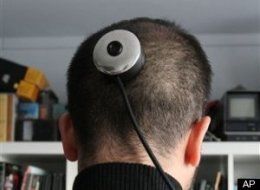
Late last year, Bilal had the digital camera inserted into a two-inch hole drilled into the back of his head. According to The Chronicle of High Education, the body-modification artist who performed the surgery also installed three posts between Bilal’s skin and skull to root the setup in place.

Bilal intended to wear the camera around for a year as part of an art project, titled “The 3rd I,” commissioned for the opening of the Mathaf: Arab Museum of Modern Art, reports the AP.

Just the thought of spinning with two eyes toward the front and a camera eye implanted into the back of my head creates dizzy hilarity I can’t stop smiling over, and when I let myself swivel around the questions over why the fuck anyone would be so into where they’ve been or who’s talking behind their back I go positively vertiginous.

YeeeHaww!

Not done yet, however, as a read through a story in Time Mag ramped up the speed on my internal whirligig exponentially, and I’m sure I’ll never look at life in quite the same way I did before this go-round.

The topic is Singularity. From the Wiki:

A Technological singularity is a hypothetical event occurring when technological progress becomes so rapid that it makes the future after the singularity qualitatively different and harder to predict. Many of the most recognized writers on the singularity, such as Vernor Vinge and Ray Kurzweil, define the concept in terms of the technological creation of superintelligence, and allege that a post-singularity world would be unpredictable to humans due to an inability of human beings to imagine the intentions or capabilities of superintelligent entities.

It’s Kurzweil the Time article features, and oooh, do I like it when a science guy gets me going in circles, even when the spin is uncomfortable.

The difficult thing to keep sight of when you’re talking about the Singularity is that even though it sounds like science fiction, it isn’t, no more than a weather forecast is science fiction. It’s not a fringe idea; it’s a serious hypothesis about the future of life on Earth. There’s an intellectual gag reflex that kicks in anytime you try to swallow an idea that involves super-intelligent immortal cyborgs, but suppress it if you can, because while the Singularity appears to be, on the face of it, preposterous, it’s an idea that rewards sober, careful evaluation.

According to Kurzweil, we’re not evolved to think in terms of exponential growth. “It’s not intuitive. Our built-in predictors are linear. When we’re trying to avoid an animal, we pick the linear prediction of where it’s going to be in 20 seconds and what to do about it. That is actually hardwired in our brains.”

Here’s what the exponential curves told him. We will successfully reverse-engineer the human brain by the mid-2020s. By the end of that decade, computers will be capable of human-level intelligence. Kurzweil puts the date of the Singularity — never say he’s not conservative — at 2045. In that year, he estimates, given the vast increases in computing power and the vast reductions in the cost of same, the quantity of artificial intelligence created will be about a billion times the sum of all the human intelligence that exists today.

One result of these vast increases, according to Kurzweil, is immortality, the reason he takes daily doses of supplements in an effort to last stick around long enough to transfer the him that is him from an aging body to a “sturdier vessel”.

I don’t quite get the desire to live forever, but relate well to the W.B. Yeats description of man’s fleshly predicament as a soul fastened to a dying animal.

Questions coming to mind are entertaining, too.

Kurzweil admits that there’s a fundamental level of risk associated with the Singularity that’s impossible to refine away, simply because we don’t know what a highly advanced artificial intelligence, finding itself a newly created inhabitant of the planet Earth, would choose to do. It might not feel like competing with us for resources. One of the goals of the Singularity Institute is to make sure not just that artificial intelligence develops but also that the AI is friendly. You don’t have to be a super-intelligent cyborg to understand that introducing a superior life-form into your own biosphere is a basic Darwinian error.

It seems obvious that we’re heading toward things truly dizzying, and it’s not only head-cams and downloadable sacramental apps …

Five years ago we didn’t have 600 million humans carrying out their social lives over a single electronic network. Now we have Facebook. Five years ago you didn’t see people double-checking what they were saying and where they were going, even as they were saying it and going there, using handheld network-enabled digital prosthetics. Now we have iPhones. Is it an unimaginable step to take the iPhones out of our hands and put them into our skulls?

Already 30,000 patients with Parkinson’s disease have neural implants. Google is experimenting with computers that can drive cars. There are more than 2,000 robots fighting in Afghanistan alongside the human troops. This month a game show will once again figure in the history of artificial intelligence, but this time the computer will be the guest: an IBM super-computer nicknamed Watson will compete on Jeopardy!

Now I’m wondering if Watson picked that nickname.

“The cosmos is a gigantic flywheel making 10,000 revolutions per minute. Man is a sick fly taking a dizzy ride on it.”
~ Henry Louis Mencken

Hop on!

Thanks to Dania for sharing the Time piece!

Read Full Post »

« Newer Posts - Older Posts »