Feeds:
Posts
Comments

Archive for the ‘Family’ Category

I haven’t written about adoption in a rather long time … Heck! I haven’t written about much of anything … but an article in today’s BBC sets wheels to spinning and fingers to keyboard.

Hundreds of parents in Nepal are struggling to come to terms with the fact that their children have been adopted by Western couples without their consent.

The article goes on to say that there are “about 20, mostly female, agents operating in Kathmandu, obtaining children for orphanages …”, and I don’t doubt the accuracy of that estimation.

Reactions from the gut happen … my gut, too. The photo looks fake, the girl in it a faded insert, and the copy states the woman had just one female child yet the caption reads: Sarita Bhujel says that she is devastated that her baby daughter appears to have ended up in Italy.

Horrible. Rotten. Dirty tricks played on illiterate parents in poor countries and hopeful adoptive parents in more affluent lands that must be addressed.

Yep.

At the root of the problem … ?

Adoptive parents pay thousands of dollars in fees and “donations” to orphanages and government officials who process their cases, creating what many observers describe as an incentive for widespread abuse.

Many observers say that, heh? I’m sure they do, and to a certain extent they’d be right to do so.

But …

The root of the problem has nothing to do with potential adoptive parents; it goes so much deeper than that, deeper than the roots of the Himalayas themselves.

The issue is poverty, poverty compounded by corruption, a global circumstance of real life for many of the world’s people.

What happens to children in poor countries? Well, let’s take a look at Nepal, shall we, since this is where this story is set?

– Statistics shows that of about 7 million children between 5-14 years old working in Nepal

– The number of bonded children is estimated as 33,000

– It is estimated that at least 1 million children in Nepal are working as child labourers in difficult circumstances, often as slaves in carpet factories, brick kilns, domestic service, agriculture, plantation, construction, transportation, stone quarry, mines and as migrant workers.

– Available data suggests that approximately 7,000 girls between 10 -18 are lured or abducted into prostitution each year. In many cases, parents or relatives sell young girls into sexual slavery.

– As an illustration, it is believed that 200,000 of the prostitutes in India are Nepalese. 20% are thought to be under 16.

– Half of 100,000 girl prostitutes between 10-14 in Bombay are from Nepal and are kept in brothels against their will.

– Poor, uneducated young women from Nepal’s rural regions are trafficked to India to work as prostitutes and for bonded labour. Nepalese citizens also are trafficked to Hong Kong, Thailand, and countries in the Middle East. Government officials suspect that organised crime groups and “marriage brokers” are the primary traffickers in Nepal and state that parents and other relatives of trafficking victims are sometimes complicit.

– A survey done in Kathmandu on 52 commercial sex workers by the Department of Research and Planning suggests that out of the total commercial sex workers surveyed, 13% were between 13-17 years.

– The NGO CWIN alleges that 2000 brothels exist in Nepal and a high percentage of the prostitutes working were children.

– Notorious in their own right for appalling working conditions, Nepalese carpet factories, where 50% of the workers are estimated to be children, are common sites of sexual exploitation by employers, as well as recruitment centres for Indian brothels.

It has longed seemed that outrage aimed at adoption is a red herring. Sure, shit happens and it should stop and those who profit in any way through corrupt practices should be strung up …

BUT …

wouldn’t it be more helpful to take on the bigger issues of real life?

No. I’m not suggesting adoption should not be subject to examination, controls, effective protocol or that it’s the be-all-end-all-warm-fuzzy-fix, just that it’s too damned easy to slap “Adoption (insert negative emotive word here)” into a headline and prompt a diverting knee jerk that shifts focus from the shit that is our world, no matter how far from our neighborhood where everyone’s heard stories about bad adoptive parents who sent their kid back to Russia.

Countries that conduct business under a layer of sleaze are crooked on all levels and those making money selling kids aren’t picky about who they sell them to … not even biological parents more often than most would like to think … so how about a global push to chop the balls off any man who has sex with a child? That seems a much better use of time and funds and energy, seeing as how the bottom would fall out of the kiddy sex industry pretty fuckin’ fast if there was a real chance they’d be separated from their testicles … not to mention all the extra duck food around.

Of course, some will argue that such drastic action would rob girls of a way to make a living, and in far too many circumstances that’s exactly what child prostitution is, so there would have to be provisions made, but perhaps a population lighter in the scrotum might find ways of being more creatively concerned with methods of living better suited to the welfare of all.

As this in The Independent suggests, the turn against adoption has not been the answer to the needs of children.

Only 60 babies were adopted in England last year – startling evidence of how Britain’s system for adopting children is grinding to a halt despite record numbers being taken into care.

Thousands of children are being held in limbo in care homes, secure units and temporary fostering because so few adoptions are being signed off by social workers. Their guidance has been to try to keep families together, which has also led to some children being left with negligent or abusive birth parents for too long.

Sadly, I can almost hear the standing ovation inspired in some by the news of adoption “grinding to a halt” and hope they read far enough to get to:

Three-quarters of the children in care, or about 48,000, were placed with a foster family. Twelve per cent, almost 8,000, were cared for in residential accommodation. A third of young adults who left care were not in education, employment or training last year.

The world is not a fair place. Bad things happen to good people, and many of those people are children.

Adoption is not a perfect solution, nor is it an evil foisted on the world. It is nowhere near the scale or condition of the sale of children into prostitution, yet one could be led to equate the two and with adoption far less a challenge to halt making that focus an easy rant.

And a BBC headline that shouts, “NEPAL COMES TO TERMS WITH FOREIGN ADOPTIONS TRAGEDY” misses the point that Nepal … for one … needs to come to terms with corruption and the sale of its children to pimps, that children in Britain languish for years in foster care and institutions and that a lot of men will pay money to have sex with kids.

By the way, writing about this again after all this time has brought to mind why I don’t often have adoption as a topic any more …

It just fucks with my head.

Read Full Post »

An end-of-year update from one of the most effective organizations on the ground in any country …

Dear friends and partners,

Today is the last day of our program year and what a year it has been. We had so many goals – so much we wanted to do. We had so many dreams we wanted to achieve – dreams that each of you made happen.

Let me share some of our highlights.

This year our goal was to work with and reach out to 42,545 families with 340,228 dependents – we ended the year with 43,546 families with 348,368 dependents – we worked with another 358 families in cottage industry. It is a remarkable achievement.

Our goal for our New Year starting this week is to reach out to 59,140 families with 473,120 dependents. Together we can do it.

The core of our program is savings: 90% of acute poverty is attitudinal – a mindset created by any number of factors – for our families it has been 40 years of war and genocide. It results in despair – an inability to think ahead – to plan for the future – what is the use – I will lose all anyway. It results in an often heard slogan from our families – we are bad – a statement that reflects
their inability to grasp the loss of so much in their lives.

Savings breaks down the attitude for savings involves people starting dreams – achievable dreams – it involves saying they are worth something – no matter how insignificant we think that something is. It involves action, for the people must give of their own money – it involves people standing with them, cheering them on – it involves achieving those dreams and making new ones.

Their initial savings isn’t much – usually .25 cents a week – but those little bits of money grow into big money – our families saved $2,037,313.90 this year but what is the miracle is the purchase and life changes brought about – they purchased $10,919,450.00 worth of goods and services. Savings works – for families pull together all their resources to make a positive change in their lives – we as Tabitha staff are cheerleaders, encouraging and celebrating each achievement.

The families say to us – you helped us to think again. The attitude has changed. It is so very good.

We talked about our impacts on families – we always start with basic necessities of which eating better food is a key marker – in our newest expansion areas people eat only once a day – rice and whatever insect’s people can scavenge from the fields. This year 27,907 families were able to achieve better food. I asked the managers what that meant – it means people are eating two to three meals a day which are balanced with vegetables and fruit daily and meat and fish at least twice a week. As we were talking, I asked how much do you think that costs a day say for a family of 8 – the universal answer was $5.00 a day – we started multiplying the numbers – families eating
times day times cost in a year and the end figure boggled our minds -over 50 million dollars worth – it is teaching all of us about the micro economics of food.

13,129 families are moving towards food security with their ability to purchase 3 months supply of rice. All of our families were able to purchase basics such as clothing, sleeping mats, beds, tables and chairs, pots and pans, mosquito nets and much more.

Water and its life giving strength – we were enabled to install 2015 sources of water – with over 1000 hectares of land put under year round cultivation – earning our families an average of $500.00 US per month – or $6,000.00 per year up from the low of $300.00 per year.

In Income generation, especially in agriculture and fishing – 18,728 families were able to raise animals such as pigs, chickens, ducks, cows, etc.. Another 18,893 families were able to grow crops such as rice and vegetables year round – it is so very good.

We talked about the number of school aged children in our program- in the communes where we work – and how many got to attend school this year. We had a dream to build 7 schools and we ended up building 14 schools. We talked about the impact it has on the children in our program. In our new areas, an average of one child per family is able to go to school – in areas where we are in mid – program – the average is 3 out of the five – in the areas where we built our schools – it is 4 out of the 5 children. This year we enabled 120,878 children to attend school for the first time.

Our dream this past year was to have 55 teams come and build 950 houses – we had 97 teams come with 2,425 volunteers come and help build 1,182 houses for our families. It is so very good – The volunteers become friends and supporters – people who have a deeper understanding of poverty and its impact on people.

It has been an amazing year – a year of being blessed and giving blessings. I thank my God for this privilege. I thank my God for the staff and for each of you who have made so much happen this year. I pray that our dreams for the next year will bear much fruit for those whom we serve.

Janne

Tabitha USA was established in 2003 to provide funding and support for Tabitha Cambodia, a humanitarian NGO in Cambodia. Our mission is to improve the lives of people living in poverty in Cambodia. We seek to raise funds to support Tabitha Cambodia’s community development efforts, which include a savings program, house-building, digging water wells, and building schools. Tabitha USA is an official IRS 501 (c)(3) non profit organization that grants all donations tax-exempt status.

Read Full Post »

Ten years ago today I was on a sofa in North Carolina staring into the beautiful eyes of my granddaughter who had just passed her first month on earth. My daughter had handed her into my care so she could get a bit more sleep and I was about as content as I’ve ever been with perfect, tiny fingers grasping one of mine as the baby girl dozed in my arms.

I lunged for the phone when it rang, hoping my daughter wouldn’t be disturbed, and was surprised, yet happy, to hear my son’s voice on the other end. It was very early in California, an unexpected time for him to be calling the East Coast.

“Mom,” he said, interrupting my queries as to what the heck had him up at the crack of dawn. “Turn on the TV.”

Tucking the phone under my chin and the baby against my chest, I fumbled for the remote to the huge set and clicked.

Of course everyone saw what I saw.

“What the fuck is happening?” I asked Jaren.

“We’re under attack, Mom.”

The second plane came in before I’d managed to absorb anything but terror, and like the rest of America the only words that came to mind were: Oh my god!

The juxtaposition of realities … the new life in my arms, the new horror in New York … could only compound the distress.

“What sort of world do you have now, Baby?” I asked.

Part of the answer I knew then: her world was one in which people drove planes into buildings full of other people.

In efforts to try to gain perspective, I conjured an image of another woman at another time holding another newborn as a radio announced the attack on Pearl Harbor, that woman asking the same question I just had just posed to the cosmos.

The specter rising from that was World War III.

Over the 10 years between then and now that has not happened. We have not experienced mass conscription or concentrated conflict inflicting colossal damage across great swathes of the developed world or food rationing or bombs dropping on our beds or that-country-against-this-country, but rather sporadic terrorist attacks and religious fanaticism and fear.

Civil wars and oppression and human rights abuses continue as they always have, people starve and fight and kill and rape and poverty breeds the hungry, the uneducated and the dangerous while wealth motivates those hungry for power and equally dangerous. While many strive to survive, others do what they can to protect, to inspire, to effect change for the positive to varying degrees of success and failure.

The world of my granddaughter turns out to be not much different, in human terms, than the one my mother, grandmother, great-grandmother … and so on … and I were born into — a world where people perform deeds of great kindness and acts of almost unimaginable horror.

No, my granddaughter will not be able to sling on a backpack equipped with a Swiss army knife and a couple of pints of contact lens solution then board a plane like I did. She’ll learn to travel without belts in slip-on shoes and allow 3 hours for check-in. She’ll probably never sip a cocktail in a rooftop bar overlooking a major city without at least some trepidation. She may look askance at those who dress and worship differently and choose to surround herself with the familiar for illusions of safety.

History will show her that paradigms shift, that deadly enemies, the evils incarnate, eventually become familiar trading partners no matter how dissimilar they may be in look and faith and culture and background as it absorbs the dead and those imprinted with images of fire and smoke and collapsing monoliths full of humanity pass along.

We no longer tremble at the thought of Japanese or Germans, no matter the price they exacted from the world only a bit more than half a century ago in their bids to accomplish their goals, but have contextualized the horrors and moved beyond as we comprehend new evil, new enemies,

This is how we humans do things. This is how we have always done things, and it’s history that dictates wrong from right as it divides winners from losers.

What will be far different for the children born with the rubble and toxic dust of the Twin Towers in their path are the impacts of events less dramatic in the making but much more in outcome and harder to live with — the results of the relentless attack of man on the planet.

There is no template for putting the climate back together after an onslaught, for negotiating a truce between rising seas and inundated land. No reconciliation can be won once patterns of weather are so drastically changed that the seas no longer function as Earth’s lungs.

Reparations will be futile and even discussion of them will set human against human, as will attempts to share out slices of the ever-diminishing pie. Once again, wars will be waged and many will die, a circumstance that will relieve a bit of Earth’s burden, but when she’s too wounded to carry on we’re done and all fights are over.

Read Full Post »

Pierre Lachaise Cemetery, Paris

On the blog no topic is ever really dead, so no surprise at today’s resurrection of overpopulation of this planet by humans as issue du jour again.

A recent reference to Soylent Green as a menu item that would reduce burdens created by more mouths to feed on fewer resources brought recycling into the discussion. What the heck, heh?

As this article in today’s BBC points out, we’re quickly running out of room for storing all the empty containers we will all drop …

Resting beside our loved ones when the time comes is a reassuring notion for the living. Families pay thousands of pounds for land where generations can rest in peace together for eternity.

But in the UK at least, the ground is filling up.

Should I wish to, I could not be buried near to my relatives at Yardley Cemetery in south Birmingham. Space there ran out in 1962.

Similarly, I would struggle to find a place near another strand of my family in Halesowen. There is no room left underground there and other facilities at nearby Lye and Wollescote are expected to run out in the next four years.

What if I head south? I lived in Brighton once and a seaside burial sounds quite nice. But four of the seven cemeteries run by Brighton and Hove Council are already full, and of the three remaining, one is for Orthodox Jews only.

Yes, the days of great whopping tombs constructed over the illustrious dead are about done, and even the standard single 3’x7’x77″ plot is only a short term stopgap measure in some places.

Some countries use a “double decker” approach to avoid overcrowding.

In Germany, graves are reused after only 30 years, the existing remains usually being exhumed and cremated. In Australia and New Zealand, “dig and deepen” is carried out in urban areas as a matter of routine.

Tim Morris, chief executive of the Institute of Cemetery and Crematorium Management, says it is time to change tack.

“It’s a no-brainer,” he says. “Re-use is common in lots of other countries, and was common practice in the UK until the 1850s. I’ve spent some time with some German gravediggers and there the limit is 30 years, but people aren’t happy with that, they want it lowered to 20.”

With my son buried between my father and my grandfather within feet of my great-grandparents, the idea of breaking up the family appalls me, but I do understand the need to free up space in areas more populated than the tiny town in Northern California where they lie. Even there the population of dead outnumbers the living by about 300%.

Those laid to rest in one spot in perpetuity add up over the centuries, after all, and even though the real estate per occupant may be no bigger than a broom closet acres can covered in just a couple of generations. Where habitation has been continuous for hundreds of generations … well … a visit to Pere Lachaise Cemetery in Paris gives a clue to what crowding looks like.

Cremation, of course, is not only an option but a societal dictate in some cultures. There’s no doubt it leaves more land available for the living, but it’s not everyone’s idea of an appropriate exit strategy.

With death being such a huge part of life, traditional methods of dealing with our dead are almost hardwired, and although some of us couldn’t care less what happens with our form once we shuck it those we leave behind usually react with strong feelings and attachments to one comforting protocol or another.

Even the realm of the dead is changing, however.

With space for the living growing more spare and precious and increasing concerns over our impact on our Earth, another method of dealing with the dead has been invented … and patented.

Promession may just be the way to go in future.

Promession is different from all other alternative burial methods because it is a gentle and clean process which uses vibration to reduce the body remains.

The method is based on three steps:

— Reducing the body of the deceased to a fine powder, thereby allowing subsequent decomposition to be aerobic. This is achieved by submerging the body in liquid nitrogen, making the remains so brittle that they shatter into a powder as the result of slight vibrations. The powder is then dried, reducing the deceased remains to around 30% of their original body weight.

— Removing and recycling metals within the powdered remains.

— Shallow-burying the powder in a biodegradable casket.

It is clear that to produce liquid nitrogen or LN2 on its own would be relatively costly, however this is offset by other factors when it is used to replace environmentally hazardous alternatives; Nitrogen is a by-product of the essential oxygen industry and for every 1 part oxygen, there are 4 parts of nitrogen produced; therefore the Promession method effectively recycles this waste product which otherwise is released back into the atmosphere.

Sweden, Great Britain and South Korea are already close to opening Promatoria (facilities for Promession-based funerals) that will fill the bill environmentally and legally.

The volume of remains left is about a third of the original body weight; the advantages include avoiding the release of pollutants into the atmosphere (for instance, mercury vapour from dental fillings) and the rapid decomposition of the remains (within 6 to 12 months of burial) and the return of the body to life’s cycle. Promession allows for families to be buried in the same plot without disturbing previous remains and meets the requirements of new European Union pollution laws.

It is yet to be seen if Promession will catch on, but I suspect some will sign up to have liquid nitrogen with their obsequies. It is more palatable than ending up on a cracker.

Read Full Post »

Sam and Cj on the eve of Raksha Babdhan

Today is the 13th of August, but it is also, according to the Hindu lunisolar calendar, Shravan Poornima … the full moon day of the month of Shravan … time to celebrate Raksha Bandhan.

Raksha Bandhan (Hindi: रक्षाबंधन, Punjabi: ਰਕਸ਼ਾਬੰਧਨ, Urdu: رکشا بندھن the bond of protection), or Rakhi (Hindi: राखी, Punjabi: ਰਾਖੀ, Urdu: راکھی), is a festival primarily observed in North India, which celebrates the relationship between brothers and sisters. The festival is observed by Hindus, Sikhs, and Muslims. The central ceremony involves the tying of a rakhi (sacred thread) by a sister on her brother’s wrist. This symbolizes the sister’s love and prayers for her brother’s well-being, and the brother’s lifelong vow to protect her.

I have to wonder why such an important occasion hasn’t managed to spread more widely, as a celebration of the bonds between brothers and sisters is noticeably lacking in most of the world, a reality that undervalues a relationship that should be extolled, rhapsodized and encouraged toward its great potential.

As a thread in the fabric of society, the tensile strength of the tie linking sister to brother has the capacity to weave a structure than can stand strong against much that will rip the loosely knitted to shreds, but today the apparent impetus is to sever this particular attachment.

Too often it seems competition between siblings is created as a tool in families where divide and conquer props a power base or love and acceptance are doled out in doses. Pitted against each other, weakness can be manipulated, strength may morph into bullying and an every-child-for-himself mentality can result contributing greatly to the ME, ME, ME issues discussed in yesterday’s post.

Sibling rivalry has become an accepted component of family life in many cultures, an expected reaction …

David Levy introduced the term “sibling rivalry” in 1941, claiming that for an older sibling “the aggressive response to the new baby is so typical that it is safe to say it is a common feature of family life.”

Is there a question as to why brother/sister relationships aren’t celebrated in an atmosphere of anticipated conflict? Not according to this article in Psychology Today:

Western culture has an obsession with sibling rivalry that began with the story of Cain and Abel and was elaborated by Freud, who labeled and dwelt on the competition between siblings for parental love and attention. It’s colored our perception of sibship ever since. Therapists and lay people alike tend to view the relationship largely as one of struggle and controversy. We have no rituals that make, break, or celebrate the sibling bond. And family experts have underemphasized the sibling relationship, instead concentrating on parents and children and husbands and wives. Small wonder that sibling rivalry is accepted as the normal state of affairs.

More than a world apart are the views of western culture –Cain and Able and Sigmund — from the roots that celebrate the connection:

Raksha Bandhan was a ritual followed by Lord Yama (the Lord of Death) and his sister Yamuna, (the river in northern India). Yamuna tied rakhi to Yama and bestowed immortality. Yama was so moved by the serenity of the occasion that he declared that whoever gets a rakhi tied from his sister and promised her protection, will become immortal.

How incredibly sad it is that so many of us were never shown the path that was wide enough to walk together, but rather steered toward a harder, lonelier road where independence was valued over attachment to those who should be our closest allies, the sharers of our history, fellow inmates in the involuntary incarceration a family can represent.

Could it be that something as simple as incorporating a ceremony into our culture, a commemoration of the value of brothers and sisters, might teach us to treasure the ties and accept the significance of very real bonds?

It certainly couldn’t hurt.

With that thought, we’re observing Raksha Bandhan and encouraging others to take advantage of the day to celebrate threads too often forgotten.

Our brothers and sisters are there with us from the dawn of our personal stories to the inevitable dusk.
~ Susan Scarf Merrell

Read Full Post »

CCTV imageMy attention spans a couple of topics today I find related, although the tie might be a stretch for some.

Beginning with the recent spate of riots in the UK

There’s been no little finger pointing going on as London burns and sparks spread to other cities. As there seems little at the root of the “unrest” other than greed and boredom being acted out by some with no other agenda apparent, nothing less than a breakdown of society is cited as a major factor.

As my Yorkshire friend A.j. put it:

A few highly educated idiots got together and rewrote the book on parenting…and now we are reaping the results, nobody dared burn down the village before… This is the first of many. Kids have always pushed the boundaries to see what they can get away with, well now they know…

This was in response to an African proverb posted on Facebook that addressed the situation from an interesting angle:

If the young men are not initiated into the community, they will burn down the village – just to feel its warmth.

While some may consider the masked youths overusing their Zippos and grabbing everything they can marginalized, disenfranchised, others would argue the reverse; that they have been MAXinalized and franchised to within an inch of their lives, spoiled and pampered, steeped in excess with no requirement to contribute.

In trying to look from both sides, I have to admit to a problem with the first take. Of course there are issues of poverty, racial tensions, employment problems, the unequal distribution of wealth and goodies. Yep. Life is much harder for some than for others.

In a country where education and health care are free and food, clothing and shelter are provided with very little work required, endless bitching about how tough things are is disingenuous at best, and those who feel marginalized … and react violently to their plight … because they don’t have the very latest version of BlackBerry should be slapped.

The should-be-slapped contingent is well represented at the moment, as evidenced by the these charmers arrested in Manchester …

An 11-year-old girl, a woman with 96 previous convictions and the daughter of a successful businessman were among hundreds of defendants appearing before magistrates on Thursday in the wake of the recent riots and looting.

Add the ” … university graduate who had been pursuing a career in social work …” who boosted a TV, a ” … a 21-year-old law student … ” who trashed a restaurant …” and this brat …

On Wednesday undergraduate Laura Johnson, 19, was granted bail by magistrates in Bexley, south-east London, on five counts of burglary in connection with the theft of goods from stores in south London.

The former grammar school pupil achieved four A*s and nine As at GCSE and is the daughter of a successful businessman who owns a large detached farmhouse in Orpington, south-east London, according to reports.

and the idea presents that an opportunistic lack of sense and morals pops up pretty easily in the don’t give a shit minds of far too many.

But, then again, why wouldn’t it?

Giving a shit is something that must be learned, and to be learned it must be taught. If the reason for education is getting a high-paying job so one can buy all the goodies one could wish for, what’s to stop a university grad from the snatch and run? If the lack of such goodies is considered a personal failure, how can it matter where the plasma screen, the iPad or the BlueRay player came from? If one’s position in a community is determined by the amount of cool stuff one collects and respect is conveyed by accumulated property, what possible difference can it make if the wardrobe and gadgets were filched?

No more, of course, than it matters if a media tycoon lies and cheats or a powerful leader violates the human rights of his people.

In a ME, ME, ME world there’s no need for thoughts for the good of US, of the society, the community, but it’s not sustainable, not on this planet. It’s too small and there’s too many MEs, and, as we’ve seen, when that ME wants what another ME has things can get ugly.

The need for community is real, and it is strong. We’re not a solitary-living species, but programed through our DNA to live in societies. It seems, however, that we’re losing the knowledge of how to do that well, and it may be worth the time to rethink some of the methods of bonding as a community we’ve lost.

The initiation idea appeals, but does not mean some sort of group hug.

Initiation is a rite of passage ceremony marking entrance or acceptance into a group or society. It could also be a formal admission to adulthood in a community or one of its formal components.

A rite of passage … hm.

No mutilation, please, but humanity would not suffer from a training and testing ground between childhood and assuming the rights of an adult.

As Mircea Eliade put it when listing reasons and functions of initiation, they are …

“this real valuation of ritual death finally led to conquest of the fear of real death.”

“[initiation’s] function is to reveal the deep meaning of existence to the new generations and to help them assume the responsibility of being truly men and hence of participating in culture.”

“it reveals a world open to the trans-human, a world that, in our philosophical terminology, we should call transcendental.”

“to make [the initiand] open to spiritual values.”

In other words, it teaches the rules, the reasons for rules, and makes sure those who go through the process understand. If they don’t, they don’t get to play.

In most non-human primate societies, sub-adults … teenagers … are the most repressed, ignored and controlled group. Males that haven’t shown their worth don’t get sex and have the crap beaten out of them when they get out of line. If they’re mean to the little ones … which they rarely are knowing the consequences as they do … they’re in big trouble. Their mothers brook no shit, their fathers keep them in line and they learn to find their own food, make their own nests, form alliances, share, and generally prepare to be contributing members of their group.

They may be as big and strong as adults, but they’re not as smart, and until they learn what must be learned they are cut no slack at all.

Sounds sensible.

Which brings me to my second thought of the day … a meeting of the Committee on the Use of Chimpanzees in Biomedical and Behavioral Research happening now in D.C..

Spurned by a Congressional request last year, the National Institutes of Health (NIH) asked the IOM to form a committee that would evaluate the current and future need for federally funded research on chimpanzees – increasingly controversial in the public eye and legal in only one other country, Gabon. The committee held an introductory meeting in May, but got to the heart of the issues today, the first of the two-day meeting.

I have no doubt there will come a time when using chimps in research will be considered as much an abomination as the “studies” conducted on concentration camp inmates by the Nazis, and have hopes meetings like this will move that scenario forward.

“We wouldn’t be having this meeting if ethics wasn’t an issue,” said primate researcher Frans de Waal of Emory University in Atlanta, Georgia, who detailed his behavioral research. Goodall enthusiastically described her field research and its benefits for the health of wild chimpanzees. But she does not support the use of chimpanzees held in labs, which she says are like prisons to them.

Like us, chimps have social living programed into their DNA. Like us, they’re meant to live in communities. Unlike us, they don’t run the show. Unlike us, their kids don’t foul the nest.

It will serve us well to remember that our community is our planet, that we share it with many others … and that everything isn’t about ME, ME, ME. We knew this once, but seem to have lost the wisdom somewhere between being part of something bigger and thinking life isn’t worth living without that new BlackBerry.

Read Full Post »

“If you must hold yourself up to your children as an object lesson, hold yourself up as a warning and not as an example.” ~ George Bernard Shaw

On this day in 1969 I gave birth to my first child. I had just turned 18 a few days before and although I had managed pregnancy and birth quite well my first face-to-face with my beautiful daughter was daunting.

After counting toes and fingers and conducting all the perfunctory checks new mothers feel compelled to perform since no one’s word will do until perfection has been established for oneself, I knew I had to fess up, and straightaway.

Holding her closely, I gazed into her lovely, aware eyes and declared: I have no idea how to be a mother, will probably screw up miserably and often … but will do the very best I can.

I have frequently repeated a version of this that insists she has grown into the woman she is — successful, happy, secure, sensible, beautiful, smart, funny and so much more — not because of, but in spite of me.

She agrees with that in some fashion, deciding long ago not to follow in any of my staggering footsteps, but rather forge a determined path of her own, one that intentionally avoided the pits I toppled into, scrabbled over obstacles and built bridges rather than burned them.

Her efforts have been rewarded. She is amazing, and she is happy.

The gift I gave the world this day 42 years ago was a contribution significant enough to validate my existence, and is the gift that keeps on giving as her daughter carries it forward.

Happy birthday, Pooh.

Read Full Post »

Wiki Image

A bit of backseat kid talk overheard by Gay as she drove them home from school the other day:

Cj: Do you know about phones with circles? There are places for your finger, and you spin the circle around.

Sam: Yeah. Those are from the olden days.

Cj: How did they work?

Sam: I have no idea …

Seems time has been passing.

While I’ve been spending recent years surrounded by kids and kidults, water has been flowing rapidly under my bridge and the damned dam designed to deny the dribbling drip of days into decades has apparently sprung a leak and allowed splashes of senescence to wear the bloody thing away.

In other words, it’s now dawning on me that I’m old. Good timing, I suppose, since I have a birthday looming, but I could do without all the reminders.

Rotary phones, TVs that required a trip across the room to turn on and off, handwritten letters, Thomas Guides in spiral-bound form are all items that may now require explanation and illicit comments about the “olden days” when dinosaurs roamed the earth and the only way to see a photo without a trip to a lab and a wait of a week was with a Polaroid.

Living where I do I am limited to how much of the modern world I’ve actually seen and still find myself wondering “What the heck does that doohicky do?” when confronted by many items others take for granted already.

Yes, the speaking GPS in cars puts me in mind of HAL … we don’t have those here, as that would just be silly on an island 17 miles long and 4 miles wide … and I’ve not yet come around to loading some of the apps available for my iPad that might make life easier, but can’t be bothered to learn how to use.

I can be comforted by how much hasn’t seen some of the predicted changes we’d been led to believe would leave us in the dust. Since flying cars, robot maids, beds that pop you up like toast and other Jetsons / Carousel of Progress stuff haven’t been incorporated into daily life, we aging Boomers do manage to get along.

Although Sam and Cj may find it had to believe, airplanes, vacuum cleaners and televisions are all pretty much what they were when I was a kid. Blenders still blend the way they did, dentists continue to pull teeth out with forceps, babies come out of mommy’s tummies, cars move along on tires, and it still takes almost two days to get from LAX to Seychelles.

Heck! If I somehow instantly transported from my teen years to present day even much of my wardrobe would look like the latest thing …

Can we tell I still have more than a month before my calendar clicks over to a new decade? Yes … we can.

Read Full Post »

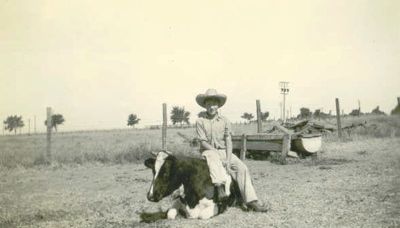
Dad on a cow ... 1930

Amos M. Hanks
1924- 1992

I miss him most days.

Here’s something I wrote for his funeral:

I’ve known, I think since birth,
that my father knew everything.
Not that he cluttered his mind with sports scores
or directions to places he didn’t go often.

To the contrary, he knew only the most vital of bits
and these he shared with me generously:
how to load and use a rifle safely,
proper application of a semicolon,
operation of a motor vehicle in a drive-in parking lot,
the ability to identify seven different breeds of cattle,
the definition of the lyrics of Waltzing Matilda,
self-reliance,
an appreciation of the world’s great literature (and the KIngston Trio),
how to use my mind,
to turn in a badly dealt hand and demand new cards,
a sense of history,
HIS history,
how to properly cook a turkey, a white sauce and French pancakes,
how to swear well and effectively,
the paths of the constellations,
a connection a with the earth and with time,
the merits of good sense and honesty,
and so much more.

I am, I think, one-fourth him, one-fourth my mother and half what I have accumulated on my own.
The divisions are not apparent.

He has said he fathered recklessly.
His recklessness is only one aspect of the man.
I love them all
and all of him.
He’s my dad.

The part of me that writes is a gift from him …

A Song of a Chela

I began to be when time began
And the Wheel of All began to spin
I am one the the One that has always been

I have lived my way through the seven worlds,
Coming, going, returning again,
In shapes and forms man cannot know
And in all that this world has seen come and go:
In the bodies of things in the slippery muck
And slime of the sea and the swamp,
In reptilian things with leather wings,
In sharp toothed, heavy limbed, truculent,
Dim brained beasts of the steamy lands
Before the Wheel had turned to man.

I have lived in trees and caves and castles,
An eater of berries, a killer of mammoth,
Slave and prophet, poet and king,
Harlot and hunter and priestess and warrior –
Whatever the Wheel in turning might bring.

I helped in creating Jehovah and Allah,
Brahma and Baal and those of Olympus;
I served in their temples and bled on their alters,
Tortured their martyrs and died in their names.

I have helped in the building of civilizations
And fought in the wars that returned them to dust.
I have learned all the wisdoms and done all the labors
And seen all the beauties and known all the lust.

I shall still be when time shall end
And the Wheel of All shall begin again;
I am one with the One that will never end.

~Amos Hanks, 1947

Read Full Post »

Tonight's sunset.

I think of my son often, and on evenings alone on the veranda watching the sunset he comes to mind in a way that always makes me smile.

The opening line of one of Jaren’s songs, “Swedish Nutball”, resonates as the sun sinks way too fast into the western sky.

I can feel the rotation of the earth …

I pretty much stop right there, as the rest of the lyrics aren’t exactly conducive to contemplating a lovely end to a day, but there is no doubt I do … feel the rotation of the earth.

Those who’ve never seen the face of Sol plunge at speed into that end of the ocean called Horizon near the Equator are missing one of our planet’s best thrill rides.

From the first kiss of sun to sea to the last wink of brightness over Horizon’s lip all of about 4 minutes pass … the sucker drops like a stone, so fast there is no question or quibbling over just how fast this globe we’re stuck to spins. Whooooooosh!

I own a vast amount of E tickets for this ride and try not to miss it as it comes around almost exactly every twenty-four hours, year in and year out. Being four degrees south of the North/South dividing line, the time varies by no more than a few minutes. Rather than longer days and shorter nights, or vice versa, we in the middle just see the sunset swing from one area of ocean to another, then back over the course of the year. (Google “Declination” if you’re interested, as for some reason the link won’t post.)

Most days I sit and watch, either a cup of tea or glass of wine at hand, but sometimes I do choose to stand for the event. Staring at our star as it does its dip, the beautifully illustrated awareness of how bloody fast this planet spins, can almost make me dizzy.

I live on the west coast of Mahé, a situation I love since it gives me this drama rather than the early morning show of the sun doing his impression of a Pop-Tart emerging from a toaster.

I tend to avoid the bugger as much as possible during that chariot ride it takes across the sky, seeing as how fried is not my best look, but when I see him heading toward the high dive to prepare for the plunge I will drop what I’m doing to watch the form, the style and the amazing ovation the sky and clouds give once he’s gone and the way that echos across the ocean.

That the show is all mine is special, but sharing the ride makes it even better.

Here’s Jaren NOT singing about sunsets …

And, yes, what I’m thinking now, he thought of first.

Read Full Post »

« Newer Posts - Older Posts »