Feeds:
Posts
Comments

Archive for the ‘Adoption Advocacy’ Category

Every so often I need to blow off some steam, to vent, to let myself step away from controlled reason and take a swipe at some of those who’ve made a quest out of trying to slap me down and shut me up.

Today seems like a good day for it.

Anyone who has been reading here for a while has seen posts from Kim, kimkim, reunionwritings … whatever she choses to call herself on any given comment … and may have noticed that she and I don’t agree on much.

She’s a birth mother, I’m an adoptive mom, so different perspectives are to be expected. I have been under the impression that coming to my blog indicated that Kim is at least somewhat interested in what I have to say, but it seems that is not the case.

Apparently convinced that she is not only smarter than I am, but prettier, too, taking issue with my writing had become a bit of a mission, but setting me straight, or her version of straight, rather fell apart at the seams.

In a fashion I’ve seen before, Kim’s comments degenerated quickly, falling from the lofty “Nice to ‘dialougue’ with you” (sic) posted here, to drive-by slappings dished out on other peoples’ blogs.

The straw that did in my make nice camel today … being the second slap from Kim in one morning … appeared on Nicole’s blog, Paragraphein.

Nicole had written a lovely post to a fifteen-year-old pregnant girl, April, detailing the process and pain of her own relinquishment, her regrets, and her conviction that parenting is the right choice for most.

Much in the post resonated with me, since I, too, had an unplanned pregnancy. I was 17 at the time, and although younger and with different issues, went through very much the same mental and emotional processes. Also like Nicole, I have a long-term brain chemistry issue that I have lived with for years … hers is bi-polar, mine clinical depression … and there was a time when my illness was not controlled as it now is, so I understand what it is like to suffer in some of the same ways.

So … what did I do? I posted this comment:

We walked such similar paths. I’ve offered to share mine with April, too.

Kim responded with this:

I want to poke fun at Sandra’s outrageous comment but will refrain since it’s your blog.

It seems no matter how respectful I am, how hard I try to bridge these gaps, these Grand Canyons, between my note on the triad chord and others, how much effort I put into educating those new to adoption on the vital necessity of building and maintaining respect, honor, ethics … blah, blah, blah, because that seems all it is when it hits deaf ears … some bloody birth mother will try to knock me back, invalidate my POV, erase my contribution and dismiss my experience.

I’ve written before about how reticent I am to pin “Birth Mother” on attacks, but it’s getting very hard not to call a spade a spade.

I am very sorry that people have pain and for those who never manage to crawl out of their hole of suffering, but I’ve not yet seen it dictated that relinquishing a child for adoption relieves one of the social responsibility of respect for others. And as for carte blanche for nastiness, well, that’s only good on your own turf. The rest of the world expects better manners.

Read Full Post »

The following comment on yesterday’s post has me doing more contemplating on loss, mulling the many ways life deals it out, and pondering the many practices of coping.

I think that is why many adoptees feel torn, as if they have to choose to feel either one way or the other, but not both. This seems dangerously similar to the idea of having to pick sides/loyalties, with feelings of loss and sadness and loyalty to birth parents on one side, and feelings of luck, happiness, rejoicing and loyalty to adoptive parents on the other side. Although many adoptees do make this choice and choose one or the other, it doesn’t seem like a particularly healthy one to have to make.

I have, of course, given much thought to adoption-related loss. My kids are reason enough to delve deeply into the issue, study the research, listen to voices of experience, read, discuss, question and more. Writing on adoption every day has presented a more academic motivation that has added a layer of understanding I may not have found otherwise.

Yes, years have been spent grasping for greater comprehension.

But is wasn’t until Sang-Shil posted the comment partly quoted above that I made a connection between loss in my own past and adoptee loss.

Here’s my reply:

What you describe sounds very much like the process for children of divorce. Since that also often manifests as loss, especially for the kids involved, it seems a fair comparison and is one I have experienced personally. Being placed in the middle of a sometimes rancorous situation is certainly not healthy, and children will always take on the pressure of feeling a need to side with one parent over the other. Issues of loyalty, concerns about the welfare of the absent parent, guilt over assumed responsibility for the turn of events, a sense of powerlessness over circumstances and such arise constantly.

My parents divorced when I was ten. My brothers were eight, five and one. All of us suffered, although the impact of the loss manifested differently in each of us.

We not only lost the wholeness of our family through an absent parent, we siblings were split up and my youngest brother grew up only knowing us older three through holiday visits.

Although I won’t assume to speak for my brothers or reveal the effects they experienced from the breakup, I would guess that my parents’ divorce had more than a little to do with my choice to become sexually active as a teen, a decision that led to me getting pregnant when I was seventeen.

So, having shared some of the meat of my own loss, I’m asking … How close have I come to feeling the same sort of loss adoption conveys, of knowing the pain? Am I miles away, or is there common ground?

Read Full Post »

How many times have you heard it said, seen it written, written yourself perhaps, that adoption is as much about loss as it is about gain? In admonitions to potential adoptive parents, it’s a litany I’ve used, even putting the words in bold type in the introduction to the book I wrote on US infant adoption. (Don’t bother buying the book, as the money goes to Adoption.com, the company that has already screwed me badly. Just about the whole thing is available online, so you can read it for free if you’re interested.)

It is vital that people coming to adoption understand this simple truth and acknowledge the loss even while their focus may be on what they, themselves are gaining.

It’s that “and” that seems to be a sticking point in discussions on any stage in the adoption community, and while LOSS is so often shouted loud and clear and repeatedly to assure its being heard in all corners and way up into the third balcony, “gain” often barely rates a stage whisper.

Does this mean, then, that the ratio of loss to gain is so much higher than the other way around? Some, most certainly, would insist that is exactly the case; that adoption is founded in loss and that loss overrides any gains that may drift along in its wake.

For many, this is true … for birth mothers, for example. Lifelong suffering from adoption loss is rarely even remotely compensated by gains in many cases, and those who relinquished in the days of secrecy and lies are some of the most vociferous voices on loss as the most important aspect.

Some adoptees, but most certainly not all, focus almost exclusively on what adoption cost them, as well, going as far in a few cases to insist that anyone would be better off dead than adopted.

Adoptive parents are often set out as the big gainers, the reapers of the little that can be right about adoption, the most likely to put the positive spin on the story, and in some circumstances, that’s accurate.

That assessment, however, ignores a big part of the picture.

Adoption does not only happen in middle-class America where expectant women are making choices between parenting and going off to college and infertile couples are praying for a newborn they can catch on its way into the world. Even in that scenario, however, there can be gain all the way around. The gains may not outweigh the losses for everyone involved, but that does not negate those gains.

Contrary to much of what is conveyed in blogs and forums, there are birth mothers who are glad they are not parenting, who feel comfortable with their decisions and who go on to lead rich, full lives with no more regrets than the usual adult human carries around on a daily basis. They’re not found lingering on adoption-related websites, but they do exist, and in some numbers.

Adoptees by the thousands … by the hundreds of thousands … not only accept the circumstances of their upbringing, but rejoice in their families, and revel in the lives that found them.

Somewhere between 50 – 200 million children in the world have been orphaned by AIDS alone. Very few of these kids are available for adoption due to politics, geography, religion, custom and other reasons not always having anything at all to do with the welfare of children, and some cite that as a good thing, but those that do find safe and loving families experience gain.

As I said in a reply on a recent post:

When a child who needs a family gets one, that’s a gain. Yes, the loss of family in the first place is a factor, but that being the reality for millions puts it in the “way things are” category, not filed under adoption. Adoption is a correction, a remedy. (Not the only one possible, certainly, but a darned good one, nonetheless.)

There are more than half a million children in foster care in the US, and for many of them adoption is a hopeful dream. Kids coming out of abusive families and in serial placements long for family … real, permanent family … and for them adoption is a solution — it is gain.

Loss and gain may not equal out in every case or for every person involved, but in the big picture … the one that believes that every child is entitled to a family and the more that find one, the better … adoption is as much about loss as it is about gain, and vise versa.

Anticipating some of the fallout that is sure to come, I’ll add that by family in the above paragraph I don’t mean a desperately poor grandmother trying to raise 18 orphaned grandchildren on less than a dollar a day. Yes, I understand that many feel those sorts of blood ties trump everything and that only elitist thinking would suggest a child is better off in a rich, Western country, but when the reality is that the grandmother will often have to make ends meet by selling her grandchildren into slavery and prostitution I do see the gain side of adoption quite clearly.

Read Full Post »

Some interesting conversations are going on at the moment, and rather than attempt to summarize, interpret or spin, I’ll just give the links and let everyone decide for themselves.

Privilege, Choice, Entitlement, and Minority Rule

http://afamilyaffair.wordpress.com/2007/12/12/adoption-ramble/#comments

http://paragraphein.wordpress.com/2007/12/16/cant-get-through/

Read Full Post »

Our almost-daily power cut today went on for hours, so the long and heartfelt post I was planning won’t get done. Although candlelight is soft, gentle and romantic, I’ve come to rely on juice and an Internet fruit bat with a pulse and feel my day incomplete without.

Today is Friday, the day T was scheduled to leave the country. Unless something very unexpected happened, he’s gone by now.

Do I need to talk about how grateful I am for the time we had with him last weekend? No. But I will post a few more photos.

I’m trying very hard not to focus on the wrongs this boy has suffered, but it’s hard when I know that his mother left him for the month since she and her boyfriend left the country in the “care” of people who call him “ass hole” instead of his name and encourage him to lock himself in the guest room with a GameBoy for days on end.

She so easily could have made different arrangements. What a whole month with him would have meant to all of us.

What’s ahead for him is frightening, and I have no faith at all that anyone will be putting him even near the top of any agenda. I have seen it all before, and have no doubt that nothing has changed.

Can I mention here that this experience, like others, has a lot to do with coloring my views on the sanctity of motherhood? Far too often in real life there ain’t no such thing.

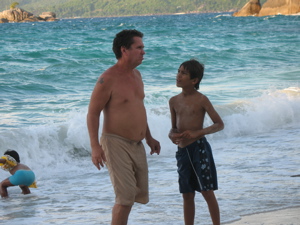
T and S swm
Sam and T in the sea … like brothers

Cheeky
Cheeky monkey!

Discussion T & Mark
A discussion, Mark and T, while Sam plays

Dinner at HOME
Dinner at HOME

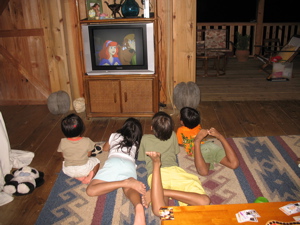
TV time
Relaxing with Scoobie, 4 kids!

Read Full Post »

As long as I’ve been writing about adoption, I have occasionally suffered pangs of … well, not guilt, per se, but an almost guilty relief for the fact that my kids came to me undamaged.

Following blogs of parents whose children live with an alphabet soup of lifelong and often life-shattering issues — RAD, FAS, FAE, PTSD — flings me to my knees in gratitude for the circumstances that allowed my children to be born reasonably healthy and pass the thirteen weeks between that miracle and the one that put them in my arms without any horrors.

It’s those 13 weeks I’m thinking of today, and although I will always regret and resent every minute I didn’t have with Sam and Cj, it seems amazing now that they had only a little more than three months of orphanage life.

That three-month time period is dictated by law in Cambodia to allow birth parents to reclaim children if they changed their minds about surrender. Fair enough for the birth parents, but does that sort of consideration for adults justify the setting of a term a child must serve? And if the time allowed would be six months? A year? Longer?

Aside from some in domestic private infant adoptions, adopted children are all sentenced to some duration in what is at best limbo, and at worst hell. As the focus on adoption skews ever more toward concerns about birth families and processes, the length of the sentences stretches out, and with the increase, now often years in the case of international adoptions from many countries, the children are ever more likely to be negatively impacted. Some countries forbid even referral before a child is six-months-old which all but guarantees a year or more of interim, stopgap living.

I am always surprised by the fact that there has not been a huge uproar over increased wait times, not because of the torture months of anticipation, stress and worry bring to hopeful adoptive parents, but on behalf of the children … our children … that are forced to pass month after month in temporary care.

If the care is top notch, safe and loving, the longer the child spends in those caring arms, the more wrenching and damaging the loss will be when the parents claim the child, and the more difficult the adjustment. If it is not wonderful … well, we know what can happen to children neglected and abused as infants.

It seems parents, agencies and governments are so concerned about the process, and so careful to thoroughly and precisely navigate an ever-growing list of ins and outs, that the fact the children are languishing, often dangerously, is chalked up to an inevitability that can’t even be mentioned, much less addressed.

Of course, precautions must be taken and checks made, but it seems there must be a way to alter the process so that children can come home before enough time passes for wounds to be created and scars to form.

It is, after all, all about the children. Right?

Read Full Post »

It’s the 11th of December … ack! … and it might as well be July for all the festive, criscringle, deck-dos-halls-itis I don’t have even a touch of.

Just the thought of digging out my three-foot-tall, rotating, fake Christmas tree sends my mood south and pins me to my office chair while visions of “later, maybe” dance in my head.

With the month starting off with a nasty cow canning my ass from my blog job, refusing to give any reason whatsoever, and then scurrying into her dim little hidey-hole to keep from having to account for her actions, then learning that my darling of a foster son will soon be moving far beyond any observable distance, my mood isn’t exactly in sync with any jingling bells on bob tails ringing.

(And, yes, I’m still bitter and angry over the treatment I got from Brandy and her masters at Adoption.com. If you miss reading me there … or if you’d simply like to annoy her … here’s an email address where you can mention my name, and call her a few if you like: 4802865086@cingularme.com)

Not that I have really been overcome with Christmas cheer since moving to the tropics; temperatures in the upper 80s just aren’t conducive to conjuring a feeling of walking in a winter wonderland.

It’s amazingly hard to build happy holiday traditions and memories in this heat and glaring sunshine for Sam and Cj … I have to accept that their ho-ho-hos will be all about barefoot Santas and tinsel on coconut trees … when the holiday is so loaded with me missing my other kids and the rest of my family.

I can almost capture the smell of freshly cut pine, my mother’s kitchen and the smoky frigid air of the Northern California December … well, right up until the time that I need to crank up the aircon in my office to keep the sweat pouring from my fingers from freezing up my laptop.

Like most holidays in Seychelles, for a big part of the population this one is about drinking to excess and hanging around. Attempts at wrangling up Christmas spirit are weak, at best, and I can’t help but think I’d handle the holiday a bit better with fewer stabs at decking the halls. (See photos.)

I have twelve days to pump myself up for the holiday, but quite a few less to begin, middle and finish the prep that needs doing.

Yikes! What am I doing sitting here kvetching. I need to get in gear, order some gifts for family in the US, break out the tree, find some wrapping paper somewhere on this island, put together a menu for our obligatory Christmas Eve open house, and on and on and on.

This will be a great time for Sam and Cj, and I will enjoy the holiday through their eyes. I will, however, still be glad when it’s over.

Sam with the village Christmas decor … sigh
The village Christmas decor

A local shop in full Christmas mode. Yep. That’s it. Isn’t the razor wire a nice touch?
A shop decorated for the holidays … sigh, again

Read Full Post »

A comment left on this post on a blog I’m contributing to these days has raised a concern I am amazed has evaded me for all this time I’ve been reading and writing on adoption. It comes from a reader named Julie who claims psychological testing for prospective adoptive parents as her agenda in the adoption world, and I must admit this is a new one on me.

I would agree with you if prospective adoptive parents were psychologically tested. Unfortunately, this is not the case except for a tiny handful of agencies across North America.

Having done my research on the psychological caliber of adoptive parents – particularly those who suffer from infertility – I have learned that your presumption is dangerous one.

Until psychological testing becomes a standard in the adoption industry, I will worry far more for adopted children than I do for those being raised by psychologically challenged biological parents.

Adoptive parenting requires far more skill and empathy than parenting one’s natural children.

Wow.

I’m temporarily at a loss.

Okay. I’m over it.

Being that I’m often accused of spewing … although most often by people for whom spew is a lifestyle … I might as well strap on that lather (or leather?) for a minute here:

RAD! FAS and FAE! ADD! PTSD! “A parent is the perpetrator in most homicides of children under the age of 5” … and that is almost ALWAYS a bio parent! therapeutic foster care!

Whew.

Oh, wait. There’s more … but don’t take it from me, check out the day-to-day of some adoptive parents who will spend their lives trying to make up for the damage done to their children by institutions and bio families.

Any yet, someone actually worries “far more for adopted children than I do for those being raised by psychologically challenged biological parents.”? Now, that’s a new planet inhabited that doesn’t look much like this one.

The “psychological caliber of adoptive parents”? Excuse me? Let’s see the research that indicates that the “psychological caliber of adoptive parents” is in question in any but the most miniscule of numbers, then compare that to the millions of children in the world in need of families.

And, do da word “homestudy” ring a bell?

Infertility hasn’t been considered an indication of insanity, a punishment for sins or a personal failing for a very long time, and I am concerned by the thought that any of those old chestnuts could be once again finding fertile soil for roots.

Break out the kindling and tie that barren woman to the stake, boys! According to our test, she’s low in the psychological caliber department, so damned well don’t deserve to live … or parent!

And the last statement: Adoptive parenting requires far more skill and empathy than parenting one’s natural children.

Does anyone really believe that parenting one’s “natural children” comes naturally to all parents? That a wondrous bounty of love and caring pours forth from some genetic fount that guarantees each child a special place in the hearts and minds of their biological connections that protects them throughout childhood and provides for everything necessary for a healthy and happy life?

That parenting biological offspring is a breeze, while being mother and father to an adopted child is a task that demands skills and empathy so much above and beyond the need of “naturals” that ever more tests must be passed and bars must be raised so that only the most perfect should be allowed to add a child to a family? And what is perfect?

Not only does any walk around the Real World block reveal that biological parents do terrible damage to their children in big numbers on a daily basis while adoptive parents tend not to, one idea of psychological perfection might scare the bejeezus out of someone else, while the quirks in a family could suit an equally quirky child to a T.

I’ll get to UNICEF, trotted out with pride in another comment, later.

Read Full Post »

A couple of interesting articles in today’s news take a bit of a different slant on familiar themes, and I’m thinking both will be getting a good look here.

First, this opinion piece out of Des Moines has inspired an unsurprising backlash of comments, all immediately recognizable in intent and history.

Open records for adoptees is the opening volley in the piece, but it’s anti-adoption pure and simple that is the target.

Fair-minded and informative, the piece has the temerity … and that is the first impression when such thoughts are actually written down and published … to take Concerned United Birthparents, Bastard Nation and the American Adoption Congress to task and suggest that much of their raison d’etre has less to do with registries, being opposed to the very thought of mutual consent, but rather nothing less than working to force an end to adoption completely.

Media sensationalism has led many to conclude that all parties in adoption are searching. Yet statistics in states with registries tell the opposite story. A study out of the Annenberg School of Communications found that the media exaggerated by 18 times the number of actual “searchers.”

The anti-adoption forces have enjoyed far greater success on the social/media front due to the unwillingness of reporters to dig beneath the surface and explore the agenda of these search advocacy groups. The one notable exception is Lucinda Franks in her New Yorker article around the time of the “Baby Jessica” case, when she exposed the role of these groups in the case. In addition, stories emphasizing grief, loss and pathology due to so-called identity confusion make far more interesting copy than those of content, secure adoptive families.

Bastard Nation is singled out as an organization the promotes, “the portrayal of adoption as a deceptive, hurtful and even pathological institution,” and the point is made that the “emphasis on adoption as setting in motion a lifetime of grief and loss has had a profound effect on adoptive placement in the United States.”

Call it as you see it, certainly, but a take like this, written together by an adoptee and an adoptive parent, feels like a breath of fresh air. The mainstream media running anything that hasn’t been ground to a miserable pulp by those invested in misery may be taken as a sign that the public eye has not yet been totally blinded or blackened.

From Canada, this story on an upcoming TV documentary takes a look at views on gay parenting in that country, and follows the efforts of a lesbian couple to adopt.

One hurdle in their process led the couple to file a human rights complaint with the Quebec Human Rights Commission that is still pending, but the government did change its policy on adopting from the US in 2006.

And a couple of important bits from blogland …

Here is some serious information on kids with Fetal Anti-Convulsant Syndrome (FACS), or Fetal Valproate Syndrome (FVS), so called, “Depakote babies”, from a mom who has spent years trying to figure out what her child was suffering from. She has a follow-up here.

And if you’re interested in open records laws, here’s an update from North Carolina on what’s happening there.

And, for what it’s worth, I am not against open records. In fact I’m all for everyone being open about everything and doing away with secrets altogether. With this POV, I wish there was a heck of a lot more honesty involved when it comes to specific issues.

Marley of Bastard Nation makes no secret of the fact that she’s not big on adoption … or children in general, for that matter … and although she’s not someone I’d want to spend a weekend with (and I’m quite sure the feeling would be mutual if she ever gave it any thought), I respect her non-namby-pamby-ness. It’s those who dress their negative stance on adoption as “reform” or “family preservation”, and yes, “open records” wooly rhetoric that shouldn’t be trusted.

Read Full Post »

I’ve been working today on an article about the reduced number of international adoptions in the world in 2007, so when this from the BBC popped up, it demanded some attention.

Powerful visuals were created when kids orphaned by AIDS in Mozambique were given cameras and asked to photograph their lives. Subject choices are always so interesting when children are given a chance to pick representational bits of their world, and these shots prove that all over again.

As is far too often the case, there is so little possibility of the option of international adoption ever reaching kids in Maputo or any part of Mozambique that hope of such a cicumstance must never trickle down to kids like the ones involved in this project.

According to the US State Department’s site on international adoption, there have been only eight children from Mozambique adopted by Americans in the last five years. This is, no doubt, at least partially due to the residency requirements the country imposes that rule out any family that can’t relocate and become residents for the duration of the adoption process.

That’s one way to make sure the children remain trapped.

For more on the drop in adoption numbers, this story from the Daily Herald of Chicago sums things up, as does this AP story that ads quotes from one of my personal heros, Dr. Elizabeth Bartholet, Professor of Law and Faculty Director of the Child Advocacy Program (CAP) at Harvard Law School.

And speaking of international adoption, Ethica has released a pdf of their comments on DHS’s regulations for the Hague. It’s well worth a read, and I’ll be most interested in thoughts you might have on their take.

Read Full Post »

« Newer Posts - Older Posts »