Feeds:
Posts
Comments

Archive for the ‘Adoption Advocacy’ Category

How many mornings start off with a sense of despair as I open my computer to learn what has happened around the planet as I slept the night away peacefully in the bosom of my beautiful little family? Far too many.

The world is for more people than not a terrible place of unimaginable pain and suffering where each day brings yet another hurdle to jump or cross to bear … one after the other until there is no more jumping or bearing to do.

The headlines give indication of misery enough, but my mind always wanders a bit further down the road and often ends up dwelling on whatever impact the attention-grabbing event that leads a report has on the children caught somewhere way down the story and living the consequences of religious fanaticism, ethnic intolerance, political unrest, greed, corruption and all the other horrors self-imposed by the human race upon itself.

Occasionally, a news item addresses the effects on innocents directly, as was the case in this article. Although designed by the United Nations propaganda machine for self-perpetuation and circulated through IRIN, the UN’s “humanitarian news and analysis” branch of the Office for Coordination of Humanitarian Affairs, the report does manage to pass along information without too blatant a tooting of its own horn … mainly because there is absolutely NO reason to credit the organization with anything positive under this circumstance … or make a begging plea for additions to its bulging coffers.

The story is on how the unrest in Kenya is impacting the vulnerable in the country, widows and orphans.

When the violence broke out immediately after the election, at least two of the people we support were killed by rowdy youths in their homes. One of our widows was attacked and her home was torn down to the ground; she was very lucky to escape alive. One child-headed household had their home invaded – they were chased away and when they came back everything had been stolen.

This, of course, is one tiny example in a country where millions are at risk any time the boat is even slightly rocked, so precarious is the semblance of stability.

Kenya has long been held up as a positive example of democracy in Africa, a model for other countries more obviously in danger of a rapid downward spiral into chaos. But Kenya has been corrupt as hell for years, and no one with the slightest knowledge of the place could pretend not to notice that the average Kenyan has been getting screwed by their government for decades while the powerful are creaming off the top and living like royalty.

With Zimbabwe just down the road a piece getting a complete pass from the “global community” on everything from its flagrant violations of human rights to blatant corruption, where could impetus possibly come for rising above?

Does the world care? Face it, folks, the answer to that is: Not really.

Pretending otherwise appears to be an unhelpful practice that works pretty well to keep the levels of hell stable for the majority while the minority takes expensive vacations.

Think about this …

At the moment, the population of the USA is somewhere around just over 300 million. Although numbers are hard to come by, USAID estimates that by 2010 25 million children in the world will have been orphaned by AIDS alone (Some suspect this number is a low guess, with estimates up to 200 million circulating.), and although that pandemic does take a hefty toll, added to numbers of children losing parents to other diseases, alcoholism and drug abuse, grinding poverty, famine, violent conflict, the total global population of children forced to fend for themselves could easily approach the number of people living in the United States in any given year.

Orphans, of course, aren’t the only people suffering … billions of children with parents suffer alongside their mothers and fathers … yet no small number of humans blithely go through their lives under the illusion that life is relatively fair … and is meant to be so … and that for the most part justice somehow prevails. Decisions on everything from product purchases to elected official to laws addressing adoption tend to be based on the false sense that happiness is a logical consequence of life for everyone finding the wherewithal their own bootstraps should provide, so consequences are slow to come to those living off the backs of the downtrodden … and that is often not only an expression, but a reality … and remedies too often have more to do with alleviating the little guilt that comes with plenty than actually addressing the real issues others face every day.

Forcing ourselves to wake up and smell the toast is a first step to taking the problems on full frontally, as we will never come to grips with something we have refused to see in all its naked ugliness.
Read Full Post »

The Guttmacher Institute released its latest report on abortion numbers in the US last week, and because they are down to the lowest rate since 1974, the report is getting press.

The latest figures are from 2005, and the study found a 25 percent drop from an all-time high of 1.6 million in 1990, although still adding up to more than one in five pregnancies being terminated.

A convoluted issue that has long been hijacked by various factions looking to provide traction for wider agendas, abortion is, to say the least, a contentious topic.

Having experienced an unplanned pregnancy in the days before Roe v. Wade, I feel I have more than a little right to my own take on abortion, and I have aimed some writing at it in the past, albeit in tandem with work on adoption.

I am always made very uncomfortable when a direct link is drawn between adoption and abortion, as the hot potato of the first can’t help but be backlit by flame throwers targeting the second, and adoption burning to a crisp in the crossfire is far too dangerous a potential to let the connection weld without comment.

The idea that adoption is a likely consequence of restraint against abortion feels intuitive to many, but is very shaky ground and seems unhelpful in the extreme when trotted out before someone in the dire circumstance of a crisis pregnancy.

Unlike the stereotypic picture of the clueless knocked-up teen … that was me in 1969, thankyouverymuch, when birth control was illegal for anyone under 18 … 61% of women who have abortions in the US are mothers, half have two or more children, and additional children may be considered a cause for compromising care for existing kids.

Without being asked directly, several of the women indicated that adoption is not a realistic option for them. They reported that the thought of one’s child being out in the world without knowing if it was being taken care of or by whom would induce more guilt than having an abortion.

I’m guessing that explaining a full term pregnancy not resulting in a new addition to the family would be an issue, as well.

Clearly, the answer is to prevent as many crisis pregnancies as possible, and education and availability of contraceptives are the keys to this goal.

For those interested, I freely admit that had abortion been a legal option for me in 1969 I would not have chosen it, just as I did not choose to relinquish my daughter. Both facts relate only to me personally and neither are laudatory, but rather simply a reflection the cumulative process that made me me at that given point in time.

If I had found myself pregnant in 1974, the last time the rate of abortions was as low as it was in 2005, I would have carefully considered and very possibly opted for an abortion. At that time I was a divorced 23-year-old struggling to raise two kids on my own, working three jobs to make ends meet, taking classes as I could. Luckily, I dodged that bullet.

I will not get into the abortion fray here, as I have more to address on this blog than leaves time for that endless loop, but I will mention a couple of niggles I can’t keep my mouth shut in front of …

Speaking authoritatively on abortion takes a uterus.

Beethoven was not the third or fifth or whatever offspring of a syphilitic tuberculin.

The more power women have, the better the world gets.

Read Full Post »

Starting with Guatemala and the ever-shifting adoption sands there, Kelly from GuatAdopt is reporting that the new government has already commenced replacing some members of the Central Adoption Authority with new appointments.

Good? Bad? Neutral? Who knows? But you can follow the story on the site.

I have not before seen news on issues of women and children coming out of Yemen, so this story from the Yemen Observer drew my interest and held it.

Illustrating poverty, the low status of women, and the lack of legal backing and support, the report offers a peek into some very difficult lives:

“My husband died, and he left me a substantial inheritance, but my older brother took it and refused to even give me money to feed my daughters,” said Sameha Ahmed … “

Also from the Arab world, this on a case of child abuse in Saudi Arabia that is horrific, and with horrific consequences.

A Saudi couple, convicted of murdering a nine-year-old girl in 2006 after torturing her for a year, were executed here yesterday.

What a world we have …

And another story that proves just what a mess it is, this on trying to send a kid to school in Zimbabwe.

Thousands of parents also got a rude awakening this week as they tried to buy new uniforms for their kids. Primary school uniforms are Z$56 to Z$70 million. Socks alone can set you back Z$15 million. The cost of a secondary school uniform can be as much as Z$130 million. The addition of a blazer costs Z$500 million. This in a country where only about 20 percent of people have formal employment, bringing in an average income of about Z$15 million a month.

You’d think someone might suggest that uniforms may be one bit of the burden they could jettison for a while, but that thought doesn’t seem to be occurring to anyone.

For a look at treatment for the mentally ill in China, if you can stand it, click here.

“I kept my son in an iron cage for more than six years,” says 53-year-old Zhang Meiying, in Gaomi City, Shandong province. Ms. Zhang earns about $1.60 a day working at a small factory that collects scraps of fabric and resells them to factories as cleaning rags. She couldn’t afford to hospitalize her son, who is around 25, at a cost of about $500 a month. So, when he grew increasingly violent, she decided to build a cage at home to restrain him.

Neighbors donated iron rods. When the cage was ready, Ms. Zhang asked three young men to tie her son up as he slept and put him inside. She remembers his screams. “I was afraid to see it, so I left,” she says.

And also from China, this report on the Christmas Eve arrest of orphans who were living with an “underground Protestant leader”.

According to a secret document of the Chinese communist party of Hubei province, which was leaked to the West last November, there is a campaign underway in China to “normalise” the underground Protestant Churches by offering them two possibilities: either join the Movement of the Three Autonomies (the Protestant communities led by the patriotic associations) or be suppressed.

And finally … and I am sorry about the tone of today’s news, but it’s not my fault so much in the world sucks … this about a 44-year-old adoptee who has slapped a $500,000 law suit on her 71-year old adoptive mother, claiming that her adoption was fraudulent and that she “suffered emotionally and financially.”

Ah, if only all adoptions could be to the wealthy, heh?

Read Full Post »

Although I’m excited as anything about the climate of cooperation here between individuals as representatives of the various views and opinions on adoption … and fully intend to keep this up all the way through the Adoptee Rights Protest in July and beyond … I have been neglecting some threads I was covering weekly when doing the three blogs I did daily on that dying site that will remain linkless, a most important, close-to-my-heart one being happenings in Cambodia.

With rumors now rife that something is bubbling in the pot that’s had Cambodian adoption stewing in its in own juice since since December 2001, it seems a good time to dedicate a post to the birth country of two of my children and let people know some of what’s happening on the ground there.

First, the rumor … and that is that there may be some end in sight for the suspension on adoptions that has kept Cambodian children from American families for going on seven years. The latest grist has it that the government is working toward Hague compliance and that meetings with orphanage directors were conducted last month.

We can hope!

Some of the most exciting news … in terms of real news, not rumor … comes from the fact that Kari Grady Grossman, author of the wonderful “Bones That Float: A Story of Adopting Cambodia, a book I highly recommend to any and all, even those with no connection to the country at all, which is why it’s featured in the sidebar of this blog, is spending a chunk of time in the country and getting some great stuff done while she’s there.

Kari’s book and efforts fund a school in the Cardamom Mountains that in turn supports a forest, and she and her family are now there working for a month to set up projects, promote others and generally toil ’til the cows come home, and are loving every minute.

Please take a moment to check out her blog, “Be the Change Network” and read all about this trip, the school, the place and the country. If you’re at all tempted to buy a book or donate, you’ll have her thanks and the joy of knowing you’ve helped a great cause.

Today’s post is about making briquettes from scrap and throwaways, giving the local people a way to make their own fuel without having to cut down forest. Like all of Kari’s work, it makes SO MUCH SENSE!

More dangerous scrap is discussed in this story from the Earth Times.

It seems the government has managed to confiscate … get this … more than 6,000 bullets and 1,000 bombs and grenades from scrap metal dealers near the Thai border. It’s dangerous work retrieving the small amount of copper and such from unexploded ordinance, but well worth the risk to some.

The sad truth is that UXBs are as much a “natural” resource in Cambodia as tropical hardwood … and easier to come by for many.

The dengue fever outbreak that had us postpone our Cambodian trip last year has taken an “official” toll of 407 people dead and more than 40,000 hospitalized for treatment.

Having had dengue twice, and with a son who has experienced febrile seizures, we let the misery combine with a couple of other factors and send us elsewhere for a vacation. (I know. I’m a wimp.)

For news of another kind of plague, this about a South Korean construction company ready to plop skyscrapers and build “new cities” in Phnom Penh and Sihanoukville pretty much tells the story.

Sry Thamrong, advisor to Hun Sen, said that the firm will begin constructing a 53-storey international financial building in mid-2008 on nearly seven hectares of land near the Russian Embassy in Phnom Penh’s Tonle Bassac commune and the construction is scheduled to be completed in 2012.

For how much longer will this sort of global homogenization toward uniform big and ugly and whatever-happens-to-be-trendy-today be considered “progress”? Sustainable development, my ass! If this keeps up, there will be no difference between Phnom Penh and Burbank, and the fact that some see that as a good thing is very scary.

Here’s another story along the same lines, but this one has Japan paying for highways. Has no one noticed that highways are not necessarily a good thing, and that perhaps plowing them through jungle has some nasty side effects?

And how about this look at some ancient development?

Radio Australia has reported that a 1000-year-old water system could be the answer to preventing the nation’s Angkor temples from sinking.

Cambodia welcomed two million tourists last year and with figures expecting to reach three-million this year, authorities are growingly concerned with the area’s underground water reservoir. Scientists also believe that if unregulated pumping of water from beneath the temples continue, the ancient ruins could be destroyed forever.

Cambodia’s Minister for Commerce, Cham Prasidh said that by reviving the ancient water system, pressure from the temple’s underground water supply could be alleviated.

Seems that they had that “sustainable” thing down 1,000 years ago …

Read Full Post »

The story I wrote about yesterday out of the UK on one consequence of inaccessible birth information has prompted much attention across the adoption world.

While my contribution to the discussion prompted by this story in the Telegraph was short and general, one made by Robin Harritt, a British adoptee who has been working for adoptee rights in the UK for a long time, is longer, specific and extremely informative on the fight for open records in Britain.

With Robin’s permission, I am cutting and pasting a comment he posted on a UK adoption group, a close version of which also appeared on the alt.adoption group.

Isn’t it the case that problem with incestuous marriage and inherited health problems tends to be more of an issue in endogamic communities or groups where it happens over and over again within the same family, e.g. the European Royal families?

In exogamous cultures such as ours the problem is the social stigma that traditionally surrounds incest even when it is accidental incest as a result of the parties involved, not knowing that they are within the
prohibited degree of consanguinity

That adoption is still set up in such a way that it is possible for people to marry not knowing that they are brother and sister is an absolute disgrace in modern Britain. I wrote to Alan Milburn the then Secretary of State for Health and Social Services about this via my MP, at the time of the Adoption and Children Bill. He signed the Bill off as conforming to the Human Rights Act, which of course in this respect, it does not. We did not get an answer from Milburn. Jacquie Smith the health minister overseeing the second Bill was equally unconcerned at the time.

The problem with issues such as this and getting the law changed is that it needs more than just a few people at a time to express their concern.

In the recent Sexual Offences Bill some people involved in the post adoption field tried to get the law changed so that it would no longer be a criminal offence where incest took place between two people who had a relationship as result of unknowingly being of the prohibited degree of consanguinity. I believe their attempts at changing the law were unsuccessful and that incest between adoptees is still criminal offence once they become aware of their relationship. Though quite unlikely to be prosecuted, it seems

Under the 1956 Act

10 Incest by a man

(1) It is an offence for a man to have sexual intercourse with a woman whom he knows to be his grand-daughter, daughter, sister or mother.

(2) In the foregoing subsection “sister” includes half-sister, and for the purposes of that subsection any expression importing a relationship between two people shall be taken to apply notwithstanding that the relationship is not traced through lawful wedlock.

11 Incest by a woman

(1) It is an offence for a woman of the age of sixteen or over to permit a man whom she knows to be her grandfather, father, brother or son to have sexual intercourse with her by her consent.

(2) In the foregoing subsection “brother” includes half-brother, and for the purposes of that subsection any expression importing a relationship between two people shall be taken to apply notwithstanding that the
relationship is not traced through lawful wedlock.

So therefore although they may have lived a normal married live and have perfectly happy healthy children, not knowing them selves to be brother and sister, once they discover their genetic relationship, any kind of normal married life between them becomes a criminal offence!

At least this case and the publicity that it has attracted in the media across the world may help to get the adoption laws changed and the necessary amendment to Sexual Offences Act to ensure that no one is ever
prosecuted for accidental incest.

So from the point of view of legality, if you are a couple in that situation, in many ways it’s best not to know.

However if you were born to a mother or father who is a carrier of an inherited disease, it is quit important that you do know. You can then at least have a chance to have early foetal tests to decide whether to
continue a pregnancy. If you have religious or ethical objections to termination of pregnancy you can be tested yourself and avoid having children if you are positive and don’t want to risk having a child who
is affected.

Of course what is so for adoptees in this respect, is also so for those born as a result of gamete donation. We all need to know who our genetic parents are, that is surely a basic human right.

My sincere thanks to Robin for passing along this info, and for allowing me to reprint it here.

You can learn more about the wrangling for rights in the UK on his site here, read some of his story on his blog … although it’s not been active for quite a while … and learn about his search for birth family here.

Read Full Post »

The discussion on open records and demanding that birth certificates are not only available, but also unaltered and containing the truest information available has be ratcheted up a notch with this story out of the UK about twins who’d been separated at birth meeting as adults, falling in love and marrying.

When Mark and I met, one of the strongest emotions I experienced was a feeling of recognition, an instant awareness that this person was important to my life, that a part of me I hadn’t even realized was missing had finally been found … I felt whole.

Having experienced the intensity of that love-at-first-sight connection, I can imagine how amazing the attraction would be if the soul mate had actually been a womb mate back when the soul was first forming. Coming to that relationship with none of the filters society and biology preps us with … and even non-humans react to the “incest taboo”, a fact I’ve seen for myself in populations of captive non-human primates and one that Darwin observed and wrote on … including not even the basic knowledge of the bio connect is a recipe for … well, for stuff that isn’t supposed to happen.

Some of those commenting on the Telegraph’s version of the story are suggesting DNA testing for all marriage applicants, but it seems a much easier, less costly and less intrusive addressing of the issue could be done by providing everyone with the information of exactly who they are.

DNA tests should not be trotted out as the modern form of identification unless we really want a world where people get into the practice of picking future spouses only after checking out that their genes prove them to be free of anything that could complicate matters someday in the future.

Frankly, folks, I find the thought of marching down the aisle into the arms of the love of my life with a report letting me know that he has a genetic propensity toward bowel cancer and baldness in hand just a bit less romantic a notion that I would like to embrace on my wedding day.

I would, however, be very happy to know if the man giving me away is biologically connected to me and assured that the one he is giving me to most certainly isn’t, and that seems a right as basic as any.

A couple of notes to readers:

I had almost three-quarters of a long post written when my computer did something fishy and ate everything on my desktop. The post was in response to Joy’s response to a comment on a blog from last week. I was in the process of thanking her for an amazingly heart-felt lesson on how adoption impacts her life with vivid descriptions of the physical manifestations she has suffered.

I am sorry not to give this the space it should have, but I spent all my energy on the first draft and I’m too wrung to reconstruct. I’ll hit the salient points, however …

Her writing went a long way toward bridge building, and I am very grateful for the time and energy she spent educating and informing those of us who have come to adoption from other angles. I am also hopeful that through such conversations as this … and it most certainly is a conversation people are listening to … progress will be made toward the day when everyone approaching adoption will be armed with ALL the information.

I do not see any readers here taking issue with Joy’s demand that no child should ever come to be adopted unnecessarily.

I hesitate to ask Joy if she thinks her adoption was unnecessary, since that would be voyeurism in the extreme, but do not doubt that many adoptees suspect that to be their case or know this as fact after reunion.

By sharing her story, she has taken great steps to help build a world where it becomes more likely that potential adoptive parents, understanding better her own personal pain, will demand that any child coming to them have absolutely no other option, and where birth mothers have a deeper understanding of more consequences of relinquishment. The more we all know and understand, the more power we have, and the less manipulation is possible. Education is the key.

Thank you, Joy.

The other note:

For those ready and willing to increase involvement in the run-up to the Adoptee Rights Protest, Gershom will be providing some direction for us as soon as she’s cleared the decks, and her desk, and can devote a bit of time giving us some guidance.

Read Full Post »

There are some bits and pieces of international news that I need to pass along today, so that’s where the focus will be …

If Guatemalan adoption is of interest, please see the Guat Adopt Blog for information on the new Central Authority on adoption. They have an address for the office.

If Cambodia holds your heart, check out Beth Kanter’s birthday project … a challenge to raise money for The Sharing Foundation, which is tied to a larger fundraising effort.

The Sharing Foundation is an amazing organization that serves Cambodia’s orphaned and disadvantaged children. They run an orphanage, a Montessori preschool, language programs (Khmer and English), scholarship programs for high school and college, and lots more. Read all about it. If nothing else, give a little that goes a seriously long way with some kids who really need some care and support.

Here’s a story about a New Jersey girl who’s been honored for setting up an organization that helps Rwandan orphans, and another about a Welsh guy building orphanages in India.

There is a fascinating look at adoption from a Russian perspective here that offers up a lot of history with the present circumstances. Written by a Russian adoptive mom, the POV is not one often seen or heard, and well worth a read.

Two stories out of Africa continue to highlight the needs on that continent.

This from Nigeria looks at teen motherhood, and how society influences the consequences:

There is hardly a month when a government hospital does not record a case of teenage pregnancy. The standard of living of many teenage mothers show clearly that they have bitten more than they can chew. Many of them do not have money to purchase the needed materials for delivery, most are seen in tattered clothing looking forsaken and emotionally laden.

What many in the South Western part of Nigeria consider a thing of shame, is however actually an issue of tradition and an act of pride in another part of the country. In the Northern parts of Nigeria, girls are forced into marriage by tradition even before some enter the teen years.

Many become overnight wives and later mothers quite early in life. In this part of the country, not only tradition but also religion, play an important part in the early journey into motherhood by the teenage girls. Instead of being disowned or punished mercilessly for getting prematurely pregnant and distrupting their parents’ future plans for them as common in South Western Nigeria, young girls are encouraged and led into marriage even before many start ovulating in the North.

The whole article makes for compelling reading.

This one from Zambia is disturbing, and states that: Nothing short of a Herculean effort is required to help the growing legion of orphans in Zambia to lead normal lives.

There is, sadly, no consideration of international adoption in the mix of approaches suggested for addressing the needs of any of the children of Zambia, although UNICEF figures are trotted out that say one in four Zambian kids is an orphan … to the tune of one-and-a-quarter-million of them … and half are under the age of nine.

Children, both girls and boys, turn to the streets in search of a better life but the reality that confronts them can only be described as grim. Street life creates extreme vulnerability to violence, exploitative and hazardous labor, sex-work and trafficking.

In fact, internal trafficking of children has become rampant in Zambia.

Talk of a “holistic approach” that takes in “provisions for nutrition, health and cognitive development, and educational and psychosocial support” sounds good enough, but it won’t be taking even one kid off the street any time soon, and given the reality of Zambian life it sounds like just another case of serving up that pie-in-the-sky that fills newspaper space, but not bellies.

Those who disagree with my thoughts on international adoption as part of a solution for some of the world’s kids may be happy to hear me admit to how clueless I can be on events in America these days … after all, clueless in one area must mean I’m an idiot all the way around, heh? …but until I read this article on pregnant teenagers and how they are no longer news, I had no idea that the Jamie Lynn Spears I’ve been skimming over the name of for a while now is the sister of Britney.

Oh, my. Perhaps there should be a rethink on icons …

Read Full Post »

Being a Tuesday and all, I’m thinking it’s time I published a post my mother will read. This is, after all, still my personal blog, and I’ve been ignoring readers who don’t happen to live and breathe adoption and its related issues, but rather think my little kids … who just happen to be adopted … are adorable and worth spending time gazing over in cute holiday shots, and who like hearing about what’s happening in my life.

Those who couldn’t care less about me, my life or my family are excused from today’s blog.

Mom gets some bragging rights, as I was informed yesterday that I won First Place in the Answers.com Creating Writing Challenge. This was the third time I’d participated in what has been a fun practice in brain flexing, and coming in First has me right chuffed. I was pleased with what came from the list of “must use” words, and am happy enough that someone agreed that it was good. So happy, in fact, that the “I Won” badge will be a sidebar feature for some time to come. Besting what must have been thousands of entries, you won’t catch me … or my mom … sneezing at this acknowledgment.

I’d recently read Irene Nemirovsky’s “Suite Française”, and that elegant tale of the horrors of occupied France obviously inspired “Sweet Polska”. (I write on adoption out of passion, but fiction is all love.)

With the holidays over, it’s time to post those photos I’ve been promising, so here are a few from Christmas and New Year Eve.

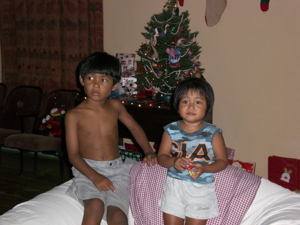
Sam and Cj Christmas Eve with the tree in the background …
Sam Cj and Tree

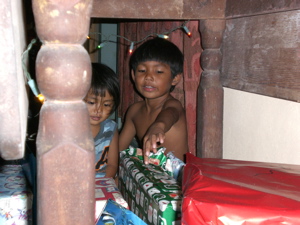
Checking out the gifts … notice that small rip in the wrapping paper?
checking gifts

Cj’s not happy about being discovered in the process of peeking …
Busted

Some of our Christmas Eve open house guests …
Guests

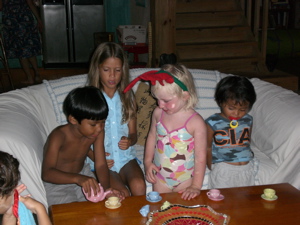
Kids on Christmas Eve
guest’s kids

Our youngest guest …
The youngest

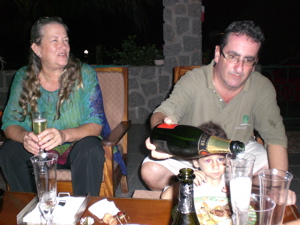
Mark had a good time!
Mark laughs

Sam served tea …
Tea

New Year’s Eve. Me with my friend, Michael …
Me and Michael

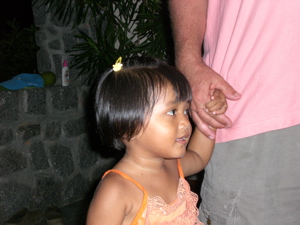
Cj holding hands with Daddy
Daddy’s hand

Sliding into the new year!
slide kids

Read Full Post »

A comment on yesterday’s blog from JA taking issue with birth parent names on birth certs started a thought process that once again grew out of the box and turned into a post.

Stating that “even if a married woman gives birth to a child fathered by someone who isn’t her husband, the husband’s name legally must go on the BC”, JA relates a number of thoughts that have me pondering …

I have no doubt that there are many, many people with birth certs that don’t reflect the reality of paternal genetic contributions, but that feels like a different issue.

JA does bring up an interesting point on the document in general, however, and that is its use as a commonly demanded proof of … what? … existence? citizenship? that seems outmoded in this day and age.

If, for example, I needed to prove identity, how far does a paper issued 56 years ago go to prove anything? I happen to still use my maiden name for part of my signature, but I could just as easily not, and the information on my birth cert is far from anything that could identify me now.

As a document of birth, it seems right to me that the details included should be about those involved in that process … although there is nothing to stop a mother from filling in the name of her husband even if she knows the child was fathered by another, so it is an imperfect process from the beginning.

But I’m drawn back to the question of the raison d’etre of the document in the first place. If proof of birth is the point, why would information such as the marital status of the parents need to be included? After all, a person is just as much a person … just as “born”, so to speak … whether or not their mother was a certain age or race or married to the father.

If, as JA suggests, a certificate of birth is “not technically about who the bio parents are”, what is it about? That there is any indication implied by a birth cert as to “who is responsible for the child” seems far fetched, and I wonder what the point is of having a legal document to show that someone was born when the person required to present the document so obviously has been.

If documentation is required for the reason of compiling a statistical database, why would the same doc need to be used as identification? If it is date or place of birth that needs to be established to determine if someone is old enough to drive or to obtain some of whatever citizenship conveys, does possession of a paper that says that at this time on such-and-such a day, so-and-so, weighing such-and-such, was born to so-and-so and so-and-so, who either were or were not married to each other, was delivered by doctor-fill-in-the-blank at this hosptial-that-no-longer-exists prove anything? I have yet to hear about any official agency asking someone to remove a shoe to compare the baby footprint to the size 12 wanting to drive in the state, but that seems it would be better proof that it’s the same person standing in front of you … a person who may very well go by a completely different name, as well as being much bigger than 6 lbs. 12 ounces … as the one mentioned on the paper.

There’s no question that many of the processes we go through in life require the sharing of information that could be considered private. Being required to produce tax returns, for example, seems intrusive considering how many people could peruse at their pleasure just because they’re in a position of access. Is it anyone’s business who you decide to support through charitable donations or what you spent on entertainment or medical care?

But to our issue here …

I agree that changes to the way birth certs work do need addressing all the way around. It seems one of those things that people assume will always be the way it is because it is the way it is, so little thought is put into challenging a status quo that appears so static.

As it is, however, when we’re talking about people born 20, 30, 40 years ago and more, it’s not changes to today’s birth certs that is at issue or the process of getting a driver’s license or a passport, but rather their right to know the names of the people who made them. I can’t speak for anyone, but it seems to me that a paper listing birth parent names presented to DMV wouldn’t bring even a glimmer of a blink to either the DMV employee or the person applying for a license or whatever, but it would serve to prove that so-and-so was born to so-and-so then and there, and when the so-and-so that was born is you, that’s a really big deal … and a basic right.

A couple of other random thoughts on this …

Suppose someone’s father, say, died of drink or a venereal disease or OD’d on heroin, and that person needed to present the death certificate to numerous people and agencies as proof of death for whatever purposes. Would that be reason enough to list something less controversial … or embarrassing or less likely to have someone make an assumption about that person or that person’s family … as the cause of death on the document? If so, there would be little point to “official” versions, would there? If not, then why should a certificate of death be any less malleable than a birth cert?

Another thought involves a woman I know who was married for a while and had two children with her husband. Eventually, she divorced and had another child by another man. She insisted, however, that her third child have the same last name as her first two kids, the last name of her ex-husband, and went to great lengths to make this happen.

Her reasoning? She didn’t want people to learn her kids’ names and think she had children by different men. The fact that this is, indeed, the case had no impact at all on her. By massaging her third child’s reality, she virtually wiped out his legal connection to his biological father, proposed a connection that doesn’t exist in anyone’s mind, as her ex knows perfectly well this is not his child, created a false relationship between siblings, set up a confusion that will last a lifetime for the poor kid, and perhaps stimulated some suspicion all the way around as to who is who to whom in that family.

I’m asking a lot of questions today, and hoping for discussion, enlightenment and answers … and while I’m here, I would like to thank everyone participating in this effort — and I know it is an effort — to create one little corner of the adoption-related world where one topic can be deliberated, one issue can be addressed, and perhaps one wrong can be righted.

Read Full Post »

My house is a mess, I’ve barely noticed that the Indian Ocean off my veranda has been like a swimming pool for two days, the novel I’d been enjoying hasn’t been touched, my kids have been having a great time at Grandma’s house and my husband has gone fishing, all because I’ve been grinding my eyeballs down to pellets in efforts to fill my knowledge bank with information on adoptee rights this weekend.

Because I don’t live in the US and because my focus has been primarily on international adoption, I have, I’m embarrassed to say, glanced over much of the OBC issue, considering it a “no-brainer” base of agreement. With this issue presenting as it has as a rallying point, a potential place of coming together that I am hoping will eventually be the foundation for a working consensus between triad members who have been spending far too much time pulling apart in opposition rather than joining for positive change, studying as many aspects as possible has been a necessary, and damned interesting, assignment.

Once again, we’re not taking on issues of the inherent right or wrongness of adoption at the moment, rather simply attempting to, first, find a level of trust we can all find comfortable in discussing open records and, second, lending support to the fight for adoptee rights if we individually consider the cause one to get behind.

As I said, a person’s right to their identifying information, OBC specifically, is to me a basic, and the more I learn, the more that seems so and seems a natural for adoptive parent support.

The history supplied by BN … and I urge everyone who hasn’t yet to read up on that to click here … gives valuable context and perspective, even though I’m still mystified over the morphing that has happened to end up leaving us the laws standing now.

BN’s section on “conditions” covers a lot of territory I’d not given much thought to, and addresses many of the questions and reservations that are being voiced here in the course of our discussion.

A big stumbling block for me has been wrapping my head around opposition to the basic right of real information on official documents. After all, it’s not like I could get driver’s license changed to make me appear younger or taller, so how is it that a birth cert could be tampered with? Anyway …

This section specifically looking at that opposition was very helpful, although because there has been so much shoveled into the sack, it’s not a simple matter of white or black hats.

A click over to the NCFA site shows how that hat thing can get confusing. Reading the “Adoption First Principles” touted, I found myself nodding in agreement, then furrowing my brow and tsk-tsking, then nodding again, and so on.

No one will find me disagreeing with statements like:

Adoption should serve the best interests of children: The fundamental purpose of adoption is to serve the best interests of children. It does so by providing loving, responsible, and legally permanent parents when their biological parents cannot or will not parent them. Serving the best interests of children should be paramount in deciding all issues of adoption policy and practice.

I’d tattoo that to my butt cheek if I thought it would help.

This, however … ?

Consistent with the child’s best interests, preference in adoption placements should be given to families that offer married mother-and-father parenting: Recent research has confirmed the teaching of centuries of historical experience that married mother-and-father parenting is most likely to produce the best outcomes for children. Because the goal of marriage is to be lifelong, married-couple parenting provides children greater security and permanence, and data show that adoptive parents divorce at lower rates than biological parents …

Well, the sentiment does come close to butt material, but in no way does that mean tattoo. It does, however, give a clue to the agenda of the organization, a clue that raises my suspicion radar and jives closely with what I’ve been reading elsewhere. (I have no tolerance for bigotry of any ilk.)

The NCFA page on privacy is written to be unchallenging, but one line tipped me off to a dodge:

In the context of the media’s fascination with openness in adoption, it is important to remember that the many who prefer privacy cannot discuss their views publicly without sacrificing the very privacy they desire to protect.

The suggestion of “media fascination” is a clear attempt to divert attention from the fact that it is adoptees urging change, and that’s a sleazy trick that puts me off and has me looking for more.

Their position paper pissed me off in the first sentence of the first paragraph:

The issue of “open records” has been hotly debated for decades and the National Council For Adoption (NCFA) has been active in opposing the unilateral and coercive nature of those proposals. NCFA does not oppose reunions or the exchange of identifying information between mutually consenting parties to adoption. What we oppose is the law empowering one party to adoption to force himself or herself on another.

The “unilateral” and “coercive nature” bits are classic disarming tactics designed to cut the legs off discussion without ever addressing the meat of an issue, and any honorable statement of position doesn’t come out swinging, but rather attempting to convince with real information.

They lost me right there and didn’t get me back. I could go point-by-point, but others have done that before, and better, so I’ll leave it to all to read for themselves and formulate their own thoughts on the matter.

I am far from finished with this homework. I’ve applied to join AAAFC, since Gershom recommends the group … I need an okay before I can read there … and I’m looking forward to learning more. (I’ve read Claud’s post once, but need a good sit-down with it before I’m taking it in. I’ve had to cut and paste it off the blog, though, because my aging eyes cross themselves like a St. Peter’s Square-full of Catholics at Easter when asked to read white copy on a black background.)

In the meantime, I continue to encourage readers to study up on this issue and think about actively supporting the adoptee rights push as it moves toward New Orleans in July.

We appear to have a platform here now which looks to be safe enough for questions, requests for information, exchanges and such, and if we can keep this up we might be getting somewhere toward positive cooperation in other areas of adoption, as well. It’s worth a try, heh?

My most sincere thanks to Marley Greiner for her part in compiling the information on adoptee rights issues presented so well by Bastard Nation. That pepper vodka looks better all the time, although joining me in a Chardonnay on my veranda might be nice, too.

Read Full Post »

« Newer Posts - Older Posts »