Feeds:
Posts
Comments

Archive for January, 2008

Being a Tuesday and all, I’m thinking it’s time I published a post my mother will read. This is, after all, still my personal blog, and I’ve been ignoring readers who don’t happen to live and breathe adoption and its related issues, but rather think my little kids … who just happen to be adopted … are adorable and worth spending time gazing over in cute holiday shots, and who like hearing about what’s happening in my life.

Those who couldn’t care less about me, my life or my family are excused from today’s blog.

Mom gets some bragging rights, as I was informed yesterday that I won First Place in the Answers.com Creating Writing Challenge. This was the third time I’d participated in what has been a fun practice in brain flexing, and coming in First has me right chuffed. I was pleased with what came from the list of “must use” words, and am happy enough that someone agreed that it was good. So happy, in fact, that the “I Won” badge will be a sidebar feature for some time to come. Besting what must have been thousands of entries, you won’t catch me … or my mom … sneezing at this acknowledgment.

I’d recently read Irene Nemirovsky’s “Suite Française”, and that elegant tale of the horrors of occupied France obviously inspired “Sweet Polska”. (I write on adoption out of passion, but fiction is all love.)

With the holidays over, it’s time to post those photos I’ve been promising, so here are a few from Christmas and New Year Eve.

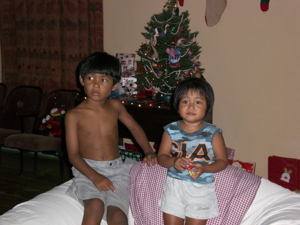
Sam and Cj Christmas Eve with the tree in the background …
Sam Cj and Tree

Checking out the gifts … notice that small rip in the wrapping paper?
checking gifts

Cj’s not happy about being discovered in the process of peeking …
Busted

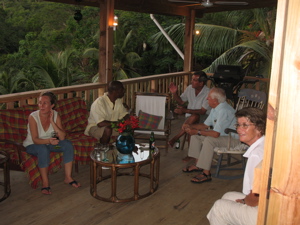
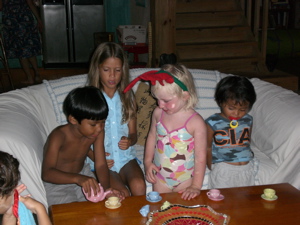
Some of our Christmas Eve open house guests …
Guests

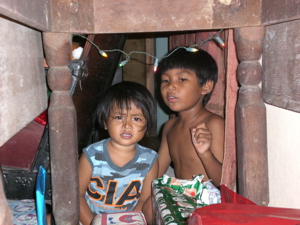
Kids on Christmas Eve
guest’s kids

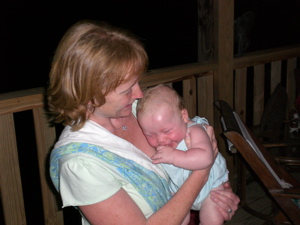
Our youngest guest …
The youngest

Mark had a good time!
Mark laughs

Sam served tea …
Tea

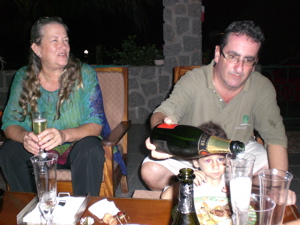
New Year’s Eve. Me with my friend, Michael …
Me and Michael

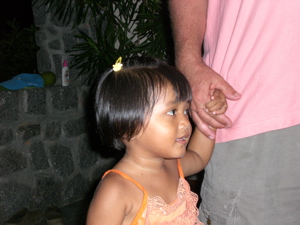
Cj holding hands with Daddy
Daddy’s hand

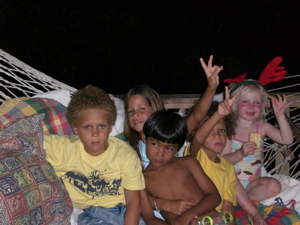
Sliding into the new year!
slide kids

Read Full Post »

A comment on yesterday’s blog from JA taking issue with birth parent names on birth certs started a thought process that once again grew out of the box and turned into a post.

Stating that “even if a married woman gives birth to a child fathered by someone who isn’t her husband, the husband’s name legally must go on the BC”, JA relates a number of thoughts that have me pondering …

I have no doubt that there are many, many people with birth certs that don’t reflect the reality of paternal genetic contributions, but that feels like a different issue.

JA does bring up an interesting point on the document in general, however, and that is its use as a commonly demanded proof of … what? … existence? citizenship? that seems outmoded in this day and age.

If, for example, I needed to prove identity, how far does a paper issued 56 years ago go to prove anything? I happen to still use my maiden name for part of my signature, but I could just as easily not, and the information on my birth cert is far from anything that could identify me now.

As a document of birth, it seems right to me that the details included should be about those involved in that process … although there is nothing to stop a mother from filling in the name of her husband even if she knows the child was fathered by another, so it is an imperfect process from the beginning.

But I’m drawn back to the question of the raison d’etre of the document in the first place. If proof of birth is the point, why would information such as the marital status of the parents need to be included? After all, a person is just as much a person … just as “born”, so to speak … whether or not their mother was a certain age or race or married to the father.

If, as JA suggests, a certificate of birth is “not technically about who the bio parents are”, what is it about? That there is any indication implied by a birth cert as to “who is responsible for the child” seems far fetched, and I wonder what the point is of having a legal document to show that someone was born when the person required to present the document so obviously has been.

If documentation is required for the reason of compiling a statistical database, why would the same doc need to be used as identification? If it is date or place of birth that needs to be established to determine if someone is old enough to drive or to obtain some of whatever citizenship conveys, does possession of a paper that says that at this time on such-and-such a day, so-and-so, weighing such-and-such, was born to so-and-so and so-and-so, who either were or were not married to each other, was delivered by doctor-fill-in-the-blank at this hosptial-that-no-longer-exists prove anything? I have yet to hear about any official agency asking someone to remove a shoe to compare the baby footprint to the size 12 wanting to drive in the state, but that seems it would be better proof that it’s the same person standing in front of you … a person who may very well go by a completely different name, as well as being much bigger than 6 lbs. 12 ounces … as the one mentioned on the paper.

There’s no question that many of the processes we go through in life require the sharing of information that could be considered private. Being required to produce tax returns, for example, seems intrusive considering how many people could peruse at their pleasure just because they’re in a position of access. Is it anyone’s business who you decide to support through charitable donations or what you spent on entertainment or medical care?

But to our issue here …

I agree that changes to the way birth certs work do need addressing all the way around. It seems one of those things that people assume will always be the way it is because it is the way it is, so little thought is put into challenging a status quo that appears so static.

As it is, however, when we’re talking about people born 20, 30, 40 years ago and more, it’s not changes to today’s birth certs that is at issue or the process of getting a driver’s license or a passport, but rather their right to know the names of the people who made them. I can’t speak for anyone, but it seems to me that a paper listing birth parent names presented to DMV wouldn’t bring even a glimmer of a blink to either the DMV employee or the person applying for a license or whatever, but it would serve to prove that so-and-so was born to so-and-so then and there, and when the so-and-so that was born is you, that’s a really big deal … and a basic right.

A couple of other random thoughts on this …

Suppose someone’s father, say, died of drink or a venereal disease or OD’d on heroin, and that person needed to present the death certificate to numerous people and agencies as proof of death for whatever purposes. Would that be reason enough to list something less controversial … or embarrassing or less likely to have someone make an assumption about that person or that person’s family … as the cause of death on the document? If so, there would be little point to “official” versions, would there? If not, then why should a certificate of death be any less malleable than a birth cert?

Another thought involves a woman I know who was married for a while and had two children with her husband. Eventually, she divorced and had another child by another man. She insisted, however, that her third child have the same last name as her first two kids, the last name of her ex-husband, and went to great lengths to make this happen.

Her reasoning? She didn’t want people to learn her kids’ names and think she had children by different men. The fact that this is, indeed, the case had no impact at all on her. By massaging her third child’s reality, she virtually wiped out his legal connection to his biological father, proposed a connection that doesn’t exist in anyone’s mind, as her ex knows perfectly well this is not his child, created a false relationship between siblings, set up a confusion that will last a lifetime for the poor kid, and perhaps stimulated some suspicion all the way around as to who is who to whom in that family.

I’m asking a lot of questions today, and hoping for discussion, enlightenment and answers … and while I’m here, I would like to thank everyone participating in this effort — and I know it is an effort — to create one little corner of the adoption-related world where one topic can be deliberated, one issue can be addressed, and perhaps one wrong can be righted.

Read Full Post »

My house is a mess, I’ve barely noticed that the Indian Ocean off my veranda has been like a swimming pool for two days, the novel I’d been enjoying hasn’t been touched, my kids have been having a great time at Grandma’s house and my husband has gone fishing, all because I’ve been grinding my eyeballs down to pellets in efforts to fill my knowledge bank with information on adoptee rights this weekend.

Because I don’t live in the US and because my focus has been primarily on international adoption, I have, I’m embarrassed to say, glanced over much of the OBC issue, considering it a “no-brainer” base of agreement. With this issue presenting as it has as a rallying point, a potential place of coming together that I am hoping will eventually be the foundation for a working consensus between triad members who have been spending far too much time pulling apart in opposition rather than joining for positive change, studying as many aspects as possible has been a necessary, and damned interesting, assignment.

Once again, we’re not taking on issues of the inherent right or wrongness of adoption at the moment, rather simply attempting to, first, find a level of trust we can all find comfortable in discussing open records and, second, lending support to the fight for adoptee rights if we individually consider the cause one to get behind.

As I said, a person’s right to their identifying information, OBC specifically, is to me a basic, and the more I learn, the more that seems so and seems a natural for adoptive parent support.

The history supplied by BN … and I urge everyone who hasn’t yet to read up on that to click here … gives valuable context and perspective, even though I’m still mystified over the morphing that has happened to end up leaving us the laws standing now.

BN’s section on “conditions” covers a lot of territory I’d not given much thought to, and addresses many of the questions and reservations that are being voiced here in the course of our discussion.

A big stumbling block for me has been wrapping my head around opposition to the basic right of real information on official documents. After all, it’s not like I could get driver’s license changed to make me appear younger or taller, so how is it that a birth cert could be tampered with? Anyway …

This section specifically looking at that opposition was very helpful, although because there has been so much shoveled into the sack, it’s not a simple matter of white or black hats.

A click over to the NCFA site shows how that hat thing can get confusing. Reading the “Adoption First Principles” touted, I found myself nodding in agreement, then furrowing my brow and tsk-tsking, then nodding again, and so on.

No one will find me disagreeing with statements like:

Adoption should serve the best interests of children: The fundamental purpose of adoption is to serve the best interests of children. It does so by providing loving, responsible, and legally permanent parents when their biological parents cannot or will not parent them. Serving the best interests of children should be paramount in deciding all issues of adoption policy and practice.

I’d tattoo that to my butt cheek if I thought it would help.

This, however … ?

Consistent with the child’s best interests, preference in adoption placements should be given to families that offer married mother-and-father parenting: Recent research has confirmed the teaching of centuries of historical experience that married mother-and-father parenting is most likely to produce the best outcomes for children. Because the goal of marriage is to be lifelong, married-couple parenting provides children greater security and permanence, and data show that adoptive parents divorce at lower rates than biological parents …

Well, the sentiment does come close to butt material, but in no way does that mean tattoo. It does, however, give a clue to the agenda of the organization, a clue that raises my suspicion radar and jives closely with what I’ve been reading elsewhere. (I have no tolerance for bigotry of any ilk.)

The NCFA page on privacy is written to be unchallenging, but one line tipped me off to a dodge:

In the context of the media’s fascination with openness in adoption, it is important to remember that the many who prefer privacy cannot discuss their views publicly without sacrificing the very privacy they desire to protect.

The suggestion of “media fascination” is a clear attempt to divert attention from the fact that it is adoptees urging change, and that’s a sleazy trick that puts me off and has me looking for more.

Their position paper pissed me off in the first sentence of the first paragraph:

The issue of “open records” has been hotly debated for decades and the National Council For Adoption (NCFA) has been active in opposing the unilateral and coercive nature of those proposals. NCFA does not oppose reunions or the exchange of identifying information between mutually consenting parties to adoption. What we oppose is the law empowering one party to adoption to force himself or herself on another.

The “unilateral” and “coercive nature” bits are classic disarming tactics designed to cut the legs off discussion without ever addressing the meat of an issue, and any honorable statement of position doesn’t come out swinging, but rather attempting to convince with real information.

They lost me right there and didn’t get me back. I could go point-by-point, but others have done that before, and better, so I’ll leave it to all to read for themselves and formulate their own thoughts on the matter.

I am far from finished with this homework. I’ve applied to join AAAFC, since Gershom recommends the group … I need an okay before I can read there … and I’m looking forward to learning more. (I’ve read Claud’s post once, but need a good sit-down with it before I’m taking it in. I’ve had to cut and paste it off the blog, though, because my aging eyes cross themselves like a St. Peter’s Square-full of Catholics at Easter when asked to read white copy on a black background.)

In the meantime, I continue to encourage readers to study up on this issue and think about actively supporting the adoptee rights push as it moves toward New Orleans in July.

We appear to have a platform here now which looks to be safe enough for questions, requests for information, exchanges and such, and if we can keep this up we might be getting somewhere toward positive cooperation in other areas of adoption, as well. It’s worth a try, heh?

My most sincere thanks to Marley Greiner for her part in compiling the information on adoptee rights issues presented so well by Bastard Nation. That pepper vodka looks better all the time, although joining me in a Chardonnay on my veranda might be nice, too.

Read Full Post »

The conversation with Gershom continues, and a plan may be forming to attempt unification among those with adoption in their lives by working together even though we come to this from different directions. Although she generously offered to liaise through email, I’m thinking a public discussion could prompt wider participation and some great ideas.

In her comment on yesterday’s blog Gershom mentioned that her focus for the next few months is on the Adoptee Rights Protest scheduled to take place in New Orleans in July. Since the adoptive parent block seems a likely group to be fully in support of rights for adoptees … adoptees being our kids that we’re willing to fight tooth and nail and walk through fire for on every issue … it occurs to me that this could possibly provide an opportunity to find out if olive branches can be construction material in bridge building.

I’m guessing that a casual observer, someone stopping by this blog looking for tips on tropical holidays or such, would assume an easy relationship between adoptive parents and adult adoptees … some for all the reasons many find infuriating, certainly … but Gershom and I won’t make that mistake. We both understand how shaky the ground is, especially after the sort of seismic activity that has been taking place recently and that treading cautiously is important to any walking together toward a common goal that is to be done.

In the early stages of thought on this … and I’ve not yet heard Gershom’s response, so may be completely off base by even beginning to consider a strategy … I’m thinking my contribution will begin with encouraging all adoptive families to make it a priority to investigate the issues surrounding open records, original birth certificates, access by adoptees to information on their identities and such, and to form an opinion; if that opinion agrees with those who fight for adoptee rights, join in the efforts to help them gain them.

If I could be so bold as to suggest a beginning step for Gershom, it would be to ask her to inspire adoptees to think about how they feel about accepting offered efforts from adoptive parents … if they want us in this fight in the first place. It won’t help a bit if our exertions are to be taken as attempts to step on toes, and since this is an adoptee-driven project they get to say who can climb aboard.

(I do know there are many, many adoptive families very involved on all levels of the open records fight, but I’m speaking here about those who may have been intimidated by, turned away from or turned off to adoptee issues by some of the more strident and aggressive, and those who have not yet begun to consider how the prevailing climate will eventually impact their children. Bastard Nation may just be missing a family or two with the message, after all.)

If there seems to be a consensus that joining forces for this event, this specific issue, is acceptable, then we all have to drop the rancor and get out of the habit of bitchy backbiting and “…but what about me?” ing. By beginning with this narrow focus, might we not filter out a lot of the miasma of misery that so often muddies the waters between us with “my pain is bigger or harder or more painful than your pain” contests, and simply accept the fact that all of us come to this table with a hunger for something gnawing at our guts?

(For those so compelled, the rancor and backbiting can still continue unabated as long as it’s kept away from this one issue. Does that sound fair?)

I can’t help but have niggling at the back of my brain the thought that someone reading this is ready to jump down my throat out of an assumption that I’m trivializing something somewhere, an idea that illustrates just how tentative steps may need to be, but we’ll get nowhere if we don’t start somewhere.

We don’t need to agree now on whether adoption is all or partly good or bad, if it should be banned or honored, if it helps more than it hurts or hurts more than it helps. We’re nowhere near ready to sit down at one table to discuss legislative improvements to the process or definitions of reform. BUT we can decide if we will or will not work together toward a goal that focuses on adoptees gaining the rights to their identity and a date in New Orleans in July that will highlight that goal.

If it turns out that we can, the chances of making progress on the other issues improves dramatically.

I am open to all suggestions … as long as they don’t involve impossible contortions for self-gratification. Ach! What the heck? I’ll take those, too, at this stage …

Read Full Post »

“My theory of evolution is that Darwin was adopted.”
Steven Wright

Steven Wright cracks me up. His droll delivery of distilled nuggets of simple, yet warped observation always strikes me as funny, and often gives an amused pause for thought. Getting to where he ends up requires strolling in from new and unusual directions, something that can be very good for keeping perceptions fresh and challenged.

The line above, of course, caught my eye and started me down a thought path that has led to a blog post. How handy, since a blog post was on today’s “to do” list.

Although “The Evolutionary Benefits of Adoption” is a ridiculously grand title that appears to claim one hell of a lot of ground this post never even begins to approach, it makes me laugh … striking me as funny on many levels … and reflects my morning ponderings prompted by Mr. Wright’s one-liner.

There are plenty of people who would never choose to put the words “adoption” and “benefit” in the same sentence, some even going so far as to suggest that adoption itself spawns nothing less than mass murderers, serial killers.

The website “Adopted Killers” … picture lurid, blood-red copy on a black background … that postulates this connection is high drama, courtroom photos and turgid bombast that in spite of supposed intent ends up making a pretty good case for adoption.

(Keeping with the theme of amusing lines, one from this site is a classic, although I doubt it was devised to entertain:

WHY are there twice as many Adopted Killers who are known to be in the category of Adoptees Who Killed Their Adopters?

Now, really … isn’t that one of the funnier lines you’ve seen in a while? Not only the spontaneous use of capital letters which is always a hoot, but the heart and soul –no mention of brain, of course — of this classic example of nonsense and illogic. I have to laugh ever time I see it … and it is fairly widely quoted by those who apparently don’t see the joke.)

As I read through the sketchy examples of adopted killers, I can’t help but notice the damaging effects of inappropriate kinship placements, foster care, mental illness and genetics, and it occurs to me that some of these people may have found less dangerous paths if adoption had been more a feature in their lives, rather than less.

As for evolving humanity, the examples of adopted people making huge changes for the positive in the world are impressive.

From way back in the 300s BC when Aristotle’s parents died … he wasn’t officially adopted, but raised by a guardian, then married an adoptee and adopted himself … and the basis of what we now call science was born, to the 1800s in America that saw George Washington Carver, one of this country’s most important inventors, adopted after the death of his mother, the evolution of our humaneness has been spurred by adoption.

Would I be writing or you be reading today without the contributions of Steve Jobs and Larry Ellison and who they became at least partly through their adoptions? Perhaps, but there would be long odds on the information age developing as it has had they not forged the trails they did.

So, perhaps there are some “evolutionary benefits” of adoption, after all, since the world has more than marginally improved through the efforts of adopted people who have passed along the positives.

If nothing else, I suppose, those opposed to adoption might take comfort in the idea (?) that twice as many adopted killers are adoptees who killed their adopters, therefore suggesting to anyone equating adoptive parents with evil incarnate that the result is fewer of those.

I wonder what Steven Wright would do with that …

(Here’s a list of famous people with adoption in their backgrounds.)

Read Full Post »

Continuing the conversation with Gershom from her response to yesterday’s post …

We do walk more common ground than divergent, and I suspect that’s true in more cases than people are willing to admit.

About the Australian system, it does offer options and food for thought. Keeping in mind the horrors from which it developed also gives some hope that processes can evolve from even the most hideous circumstances. (Although there is cause to worry about how bad things must get before coordinated action is taken … ) The intense shame of Australians over their deplorable history of domestic adoption — and few countries can lay claim to as despicable a bout of modern-day social experimentation — has prompted radical changes to the systems there. Some would suggest the pendulum has swung a bit wide in correction attempts, but that’s how these things work in the world.

How well government running and regulating works overall, however, is debatable, as is being proved now in Iowa and New Hampshire. Some think it’s great, and others see it as a root of evil. Most certainly, though, its manifestation in Australia is very different from what a similarly titled condition would look like in, say, Cambodia.

So, where do we go from here? You and I, I mean. After all, if you … the author of a blog you titled “Anti-adoption”… and me … a widely-besmirched advocate who many would like to gag … are finding we agree on as broad a base as we apparently do, is there a foundation here for bridging a divide and working together?

Obviously, we are both intent on educating and informing, and that is vital. From expectant women in crisis to potential adoptive parents to policy makers, information is the key to basing decisions and practices in ethical, fair and honest ground so any adoption journey that may be taken starts off on the right foot and leads in a positive, not negative direction.

You and I might choose to stress different aspects of the ethical the fair and the honest, but if in the general community less time and energy was being spent in argument for the sake of argument, bitchy slap fights, self-centered attention-seeking and demands for recompense for water long over the bridge, we could pass along more information to a wider audience than now attempts to breach the fray.

How much difference could it make if it became very, very likely that every scared and confused pregnant girl and every hopeful adoptive parent had access to the information just you and I could pass along, not to mention the wealth of knowledge and experience so many are willing and eager to share? What if everyone approaching an agency was well-informed and prepared to demand ethics and answers and knew the true costs involved?

That, for just a start, is what I see as possible if the bickering slowed down and people put aside their pettiness and accusations of evil or stupidity or whatever other insulting approaches they seem to find so comforting for some reason.

I care deeply and passionately about the fate and welfare of children. You care deeply and passionately about the fate and welfare of children. That would appear to indicate a consensus, and through consensus progress is so much more likely than without.

Read Full Post »

This post began as a reply to a comment from Gershom on yesterday’s post.

I didn’t mean to accuse Gershom of ignoring the suffering of children, but to point out this as one of the reasons for my strong advocacy.

Of course families can be “adopted”, and if everyone who could supported just one other than their own the world would be a better place. Millions of dollars are spent daily by organizations and governments who have been charged with the duty to care for the people they cover, and some actually do spend a portion of that money helping, yet every year the orphan numbers increase.

Adoption “as we know it today” is a very big umbrella, and to oppose everything under that umbrella seems simplistic and short-sighted to me … rather like that “throwing the baby out with the bath water” thing, especially with so many “babies” in the “bath”.

Changes to the various systems, reform, providing other options in addition … all are necessary and some are happening, albeit too slowly in many opinions. It seems arrogant, however, to demand immediate changes by developing nations when the foster system in the US is a train wreck that is ignored year after year. It’s real people lost in the lurch when programs close, and although some might consider them collateral damage, rest assured those taking the hits don’t look at it so cavalierly.

I also must add that not all bio families should be preserved, that biology does not a good parent guarantee, and that many more children than do would benefit from adoptive families. And contrary to some thought, not everyone who conceives wants to parent, and those that don’t deserve options.

I know this will rub many the wrong way, but in my view a world with more adoption, not less, would be a better world than the one we have now. If every child beaten, abused or neglected, every child victim orphaned by war, by AIDS, by famine or abandoned by need or greed could be placed in a safe and loving family … in my mind, the closer we get to this idea, the closer we are as a species to showing our worth.

Given the huge numbers of children in the circumstances described, however, reaching any more than a tiny fraction isn’t possible. It’s that tiny fraction I hold out hope for and argue in favor of.

World peace, an end to global hunger and grinding poverty, wiping out corruption and discouraging cupidity are all noble goals, and I support any and all efforts toward accomplishing these and more. Once again, however, holding out hope that any of this happens on a grand scale in my time rather disputes the lessons of history and ignores too much of the base nature of humans.

So, while striving to create a world that is fair and bountiful and loving, more than 200 million children suffer, and if a few thousand of those can be adopted by families who adore them hope lives and a few more resources are freed for others.

Adoption is so often an apples/oranges discussion … while I’m picturing five-year-old Cambodian sex slaves someone else has in mind a 20-something American woman being coerced into relinquishing. My favoring more adoption so fewer children are sniffing glue to keep warm under Romanian streets is interpreted as an encouragement to grab babies from loving mothers in crisis.

Conversely, when someone demands family preservation, what comes to my mind are children ending up dead because a bio family was given one more chance too many. Insistence that reform means governments take control of adoptions has me thinking of deeply imbedded corruption that has and will continue to blithely sacrifice children in favor of political milage and blatant greed.

Calls to end the option of adoption for the children of the world rarely come from the uninvolved, and usually sound very much as if they issue from those with an axe to grind. When such calls come from adoptees, and especially strident calls that sometimes go as far as to claim anyone is better off dead than adopted … this is not an unknown claim, although certainly not universal, as Gershom shows … it can appear as an attempt to capture some sort of higher ground that others aren’t entitled to. When it’s birth mothers making demands to end adoption, sour grapes are the most likely flavor suspected. The contingent of adoptive parents rallying forces to end adoption seem to many to be wandering around in those hair shirts I wrote about not long ago.

Although everyone is assuredly entitled to their opinions, attempts to impose those opinions on everyone else should not come under any perceived mandate, and a ban on adoption is one fell swoop of an imposition.

Those of us advocating for adoption would never presume to insist that everyone adopt a child or hint than any family who has yet to do so is intrinsically evil or stupid or selfish. We will never insist that every orphaned, abandoned or neglected child in the world be adopted, and that the failure to make this happen is a criminal act of global proportions, and it is difficult for us to understand the vociferousness of those for whom the opposite is a strong enough urge to create the sort of venom that is so often injected into what should be reasonable discussions about the welfare of children.

Once more, the apples/oranges conflict comes into play, and a conversation that begins in one mind as a levelheaded approach to serious social issues translates to an attack on all that is sacred in the American family.

It seems that the key to many of the closed doors that separate the adoption community from itself should be the children. Sounds simple enough, but when one take has it that the corrupt practice that tainted their adoption experience is reason enough to halt all adoptions while others point their focus toward the huge numbers of children for whom adoption has been or could be wonderful, the conversation tends to break down. Add voices of those considering themselves permanently damaged and others longing more than anything for a child to love and the resulting cacophony puts the kibosh on any but the loudest and least equitable confabulation.

So, where does all this leave us?

Unfortunately, for as long as we are here we’re stuck with the world we have; a world in which war and poverty and hunger and cruelty are facts of life for many, rather than few, where my view gets preeminence on my blog just as Gershom’s does on hers, because we are humans and humans are a contentious species that more often than not self-focuses to the exclusion of anything not within personal apertures.

At least those of us popping in and out of discussions on adoption are coming to the table … even when it all ends in messy food fights, still something has been exchanged … although I am as convinced of my rightness as others are of theirs, as conflicting as those may be.

Since this is the first day of a new year, I find myself wondering how 2008 will unfold regarding adoption. I’ll admit to being less than starry-eyed with optimism … after all, the 6th anniversary of the suspension on Cambodian adoption passed just a bit over a week ago … but concern for the present and future of children in the world will continue to bring me to this table. Preserving the option of adoption is one of my passions, as putting an end to it is for others.

As long as we continue to spin … and I’m talking about the planet here, not attempts to control information … some people will disagree with other people; some will take those disagreements far enough strap explosives to their bodies and blow themselves and anyone unlucky enough to be within shrapnel range to smithereens, or drop bombs, or commit genocide.

When all that is taken into account, the name-calling and snideness on adoption blogs seems pretty tame, and when the irrevelant, the fringe, the just-plain-nasty, is ignored … on those occasions where real dialogue does take place … hints of consensus do present. If that will ever lead to triad-wide warm fuzzies, I doubt, but that isn’t really the goal, is it?

Read Full Post »
« Newer Posts