Feeds:
Posts
Comments

Archive for November, 2010

Before anyone weighs in with comments about how what follows is based on faulty logic, I’ll start the post off with a full disclosure: it makes no sense at all, has ’bout nothing based in science or fact or undisputed info and I don’t even end up agreeing with myself completely.

Okay?

This is simply a morning diversion, since, after all, I love to go a pondering along strangely convoluted tracks before I settle my brain down before the anvil and commence pounding away.

Today’s journey began at this article on sugar addiction.

One study out of France, presented at the 2007 annual meeting of the Society for Neuroscience, showed that when rats (who metabolize sugar much like we do) were given the choice between water sweetened with saccharin and intravenous cocaine, 94 percent chose the saccharin water. When the water was sweetened with sucrose (sugar), the same preference was observed — the rats overwhelmingly chose the sugar water. When the rats were offered larger doses of cocaine, it did not alter their preference for the saccharin or sugar water. Even rats addicted to cocaine, switched to sweetened water when given the choice. In other words, intense sweetness was more rewarding to the brain than cocaine.

But this isn’t about sugar, or cocaine and addresses addictions only peripherally. No, it’s about one of the big questions in life:

Why are all the good things so bad for us? And if they are so bad for us, why are they so good?

(Well … that and some other stuff …)

Those are two different questions, and it’s actually the second that interests me this morning since health professionals have no trouble reeling off reasons sugar, fat, alcohol, tobacco, drugs, casual sex and narcissistic men are bad, and we’ve heard them all; include them in your life at your inevitable peril.

My wander is more about why we’re so deeply attracted to shit we know will kill us, and in my wander I wonder if there’s a reason as primal as our ancestral genetic mandate to collect calories when we can.

Back in the early days of humans, life was a short prospect. Breeding started at puberty when hormone secretions kicked off the process that made sex desirable and babies possible, and anyone managing to live past thirty was considered either a burden or a deity. Feeding the clan took more effort than a stroll to the fridge and people were considered snacks-on-the-hoof by some of the neighbors. Yes, we lived fast, died young and … well … pretty is as pretty does.

Some of that fast living included a predilection for a tipple and a partiality for getting high, so there’s nothing new about our fondness for altered states.

Of course, the ancients didn’t know they were playing with their health.

We do.

We’ve made a slew of changes in the way we spend our time on the planet … we moved out of caves, traded our pelts for Prada and prefer Merlot over mead … so many so that our ability to conceptualize the way our ancestors lived has been greatly influenced by Fred and Wilma. These changes have resulted in extending our lives many decades beyond what would have been even remotely conceivable, but to date we have yet to unload the baggage that is a hankering for some stuff our species has been craving since Day One.

Again with the Why?

I’m guessing here one reason may just be that somewhere under our modern veneer, a place deep in our most primal of being, we actually understand that we will someday be dead.

Yeah, yeah … I know that’s a stretch. After all, we’re constantly getting messages about how if we reduce this and give up that and forego the fun of whatever we can cut the death rate (Funny how often that pops up.), giving some the impression that living forever is an option if rules are assiduously followed and enough sacrifices are made.

Okay … much is actually focused –in intent, if not in words — on dying younger than the average death or on being healthier in old age. Fine. I get that. But until there’s a way to stop the cycle — you’re born, you live, you die — there are only two options available; you die, or you get old.

Back in 1960, Maurice Chevalier summed up his ideas on the options when he said: Old age isn’t so bad when you consider the alternative.

Allow me to point out that Monsieur may now have a better base of comparison.

Actually, there are three options, the third being you live as best you can, and John Mortimer nails that point to the wall:

There is no pleasure worth forgoing just for an extra three years in the geriatric ward.

Could it be that we carry remnants of our Paleolithic selves — those beings we once were who knew for fact that life is short and then you die — that prompt us to go for the gusto?

An aside:

At this moment I have three friends engaged in fights against cancers of various types. All are significantly younger than I am (two in their 30s), none ever smoked, all followed reasonable dietary plans, drank in moderation and did not partake in illegal substances.

Back in the 80s I worked with a group of people who, although bound by certain interests, varied widely in lifestyle. My dear friend Robbie and I were the oldest of the bunch and by far the most debauched. Two of those people, perhaps the cleanest livers amongst us then, have now been dead for a number of years. Robbie and I are still kicking … and debauching.

I’m not afraid of death. It’s the stake one puts up in order to play the game of life. ~Jean Giraudoux, Amphitryon, 1929

Toss those dice … and while you’re up, can you pour me another glass of the white, please?
Read Full Post »

I am blessed/cursed with a prodigious memory in both the modern and archaic senses of the adjective. My head is stuffed with stuff … including my grandmother’s recipe for stuffing even though I so rarely cook … and although this provides a deep well when looking for a bucketful of references to, say, common experiences with toothpastes, do I really need to carry around, “Crest has been proved to be an effective decay preventive dentifrice that can be of significant value when used in a conscientiously applied program of oral hygiene and regular professional care … ” and a 40-year-old jingle from Ipana commercials, both of which I can conjure in an instant at any given time? (And just did … sigh … )

This is why I almost didn’t bother looking at this article, titled, “A Novel Way to Improve Memory”. After all, why the hell would I want to get any better at stacking more useless crap between my ears?

But I did … read it, that is … and although finding it peripherally interesting, it doesn’t fit.

The most amazing thing about memory is how precisely we forget. Our brain retains only what it predicts will be important in the future and forgets the rest. There is no point in remembering where you parked your car at Wal-Mart last February — unless it was stolen. That would be unforgettable. Scientists have long known how the brain predicts which experiences to retain in long-term memory and which ones to let fade away. But now they have made a new discovery: why we often remember useless stuff.

The first rule of learning is repetition. Repeating something over and over, as you did to learn your multiplication tables, moves memory from temporary short-term storage into permanent long-term memory. This is because the brain views something that is encountered repeatedly as more likely to be important to the person (or animal) in the future.

The second way events get seared permanently into memory is if they are associated with extremely strong emotional reactions, as would happen if, upon emerging from Wal-Mart with your shopping goodies, you were to find your car gone. This is because, in evolutionary terms, an organism shouldn’t risk repeating a stressful, potentially life-threatening experience to remember it.

Okay … so why do I still not have access to the multiplication tables, but know the name of the dog that played the dog on Topper? The first were repeated ad nauseam year after year in my childhood while the second may have have been noticed a couple of times as the credits rolled at the end of a TV show that went off the air when I was about 7.

Did my brain reject 14×7 as not important to this person’s future. Was I more traumatized by the ghosts of George and Marian Kirby that I realized?

In the last 15 years, neuroscientists have determined the cellular and molecular mechanisms for how these two kinds of experiences are moved from short-term memory into long-term memory. But memory researcher Richard Morris of the University of Edinburgh noticed something about memory that is not explained by these well-accepted rules and molecular mechanisms of memory. Our minds are filled with scraps of completely irrelevant information. This includes snippets of experiences that were neither repeated nor associated with a traumatic event. Indeed, they are useless and would be better forgotten, but they persist nevertheless. How these remnants of trivial memories are retained cannot be explained by the detailed molecular mechanisms that have been carefully worked out in studies of memory in laboratory animals.

Well … no shit, and isn’t that not helpful.

According to the article, a third pot of memory glue has more recently been illuminated:

The answer is found in another factor that helps the brain predict whether or not an experience should be saved in long-term memory: novelty. When our daily routine is suddenly disrupted by an experience that is truly novel, the mind “perks up.” It makes good sense to activate the long-term memory mechanism in this case, because a new experience is likely to provide important new information that will be useful to an individual in the future, and so the experience should be added to the long-term memory store. In the brain, novelty is signaled by neurons that use the neurotransmitter dopamine. Dopamine circuits do not code sensory perceptions; instead they rev up the level of activity broadly across neural networks in the brain.

Hm. So, Bucky Beaver and the Buck (the dog who played Neil) kicked off dopamine production in my head? I doubt it, no matter how impressed rats have been in experiments on memory.

The rats, of course, are remembering where to find food, not the lyrics from the opening sequence of Mr. Ed, so do nothing to, ” … explain how “useless” scraps of information in your mind might have gotten stuck there.”

They could have been surrounded by some truly novel experience that had nothing at all to do with the memory.

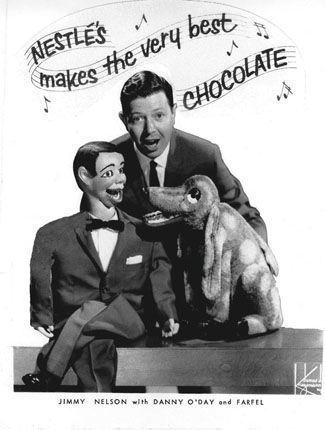
Like what? What could possibly have been the truly novel experience in late-50s suburbia that leaves me with full access to the name of every dog on our block and the inability to see Nestlés Quick without thinking of Farfel?

So, I have a head full of useless crap that gives the occasional advantage when trivial knowledge is tested … I was kick-ass at Jeopardy back in the days I had access to such programming … makes me hell to argue with, being able to replay exact conversations without having taken notes, allows me to sing along with every song by the Beatles and lets me identify Paladin’s holster in less than two seconds. I remember my very first telephone number … YEllowstone 50147 … could draw (if I could draw) the dashboard of a 1955 Ford and conjure the smell of the old lady’s house next door to where I lived for about two months at the age of 10. Whoopie.

And, apparently, science has yet to give me one good reason for any of this.

On the up-side, these new studies on memory are providing a prompt for educators to look differently at how children learn:

While the ancient methods of repetition and punishment to drum information into a school kid’s mind can be effective, so too should breaking up the doldrums of a lesson with a fascinating new experience that is completely unrelated to the lesson.

A point taken further in the vid here explaining how a shift in the paradigm is a bloody good idea …

Read Full Post »

Today’s topic is biocentrism … and, yes, I’m out of my fucking mind even beginning to go there on a Saturday morning in November, especially after an evening involving wine … and starts with its seven principles:

1. What we perceive as reality is a process that involves our consciousness. An “external” reality, if it existed, would by definition have to exist in space. But this is meaningless, because space and time are not absolute realities but rather tools of the human and animal mind.

2. Our external and internal perceptions are inextricably intertwined. They are different sides of the same coin and cannot be divorced from one another.

3. The behavior of subatomic particles, indeed all particles and objects, is inextricably linked to the presence of an observer. Without the presence of a conscious observer, they at best exist in an undetermined state of probability waves.

4. Without consciousness, “matter” dwells in an undetermined state of probability. Any universe that could have preceded consciousness only existed in a probability state.

5. The structure of the universe is explainable only through biocentrism. The universe is fine-tuned for life, which makes perfect sense as life creates the universe, not the other way around. The “universe” is simply the complete spatio-temporal logic of the self.

6. Time does not have a real existence outside of animal-sense perception. It is the process by which we perceive changes in the universe.

7. Space, like time, is not an object or a thing. Space is another form of our animal understanding and does not have an independent reality. We carry space and time around with us like turtles with shells. Thus, there is no absolute self-existing matrix in which physical events occur independent of life.

Got that? No … me neither.

I’ve been giving this thought since learning about that whole particles need observers to do much thing, chicken/egg/cart/horse thinking that shakes my brain like a rattle in the hand of Insane Demon Baby.

It’s this article in the Huff post that handed the noise toy to the toddler-from-hell-living-in-my-head this morning, luring me in by speaking directly to me in the opening sentence:

Why do you happen to be alive on this lush little planet with its warm sun and coconut trees?

Why, indeed.

Although the bit about the coconut trees is nothing but overkill, the Why are you here? question is one I ask often, although usually framed differently: What the fuck do you think you’re doing? … How the fuck did you end up here? … Now what?

Although those questions-posed-to-self are often self-focused, I do ponder the point of me in the greater sense … What is the point of me and him and her and them and those thingies over there? … and the article puts the little in little ole me:

How did inert, random bits of carbon ever morph into that Japanese guy who always wins the hot-dog-eating contest?

In short, attempts to explain the nature of the universe, its origins, and what’s really going on require an understanding of how the observer, our presence, plays a role. According to the current paradigm, the universe, and the laws of nature themselves, just popped out of nothingness. The story goes something like this: From the Big Bang until the present time, we’ve been incredibly lucky. This good fortune started from the moment of creation; if the Big Bang had been one-part-in-a-million more powerful, the cosmos would have rushed out too fast for the galaxies and stars to have developed. If the gravitational force were decreased by a hair, stars (including the Sun) wouldn’t have ignited. There are over 200 physical parameters like this that could have any value but happen to be exactly right for us to be here. Tweak any of them and you never existed.

Okay, so I’m a statistical probability as remote as my coconut tree sprouting legs and jogging on the beach … and so are you, neener neener neener.

Or not.

Indeed, according to biocentrism, it’s us, the observer, who create space and time (which is the reason you’re here now). Consider everything you see around you right now. Language and custom say it all lies outside us in the external world. Yet you can’t see anything through the vault of bone that surrounds your brain. Your eyes aren’t just portals to the world. In fact, everything you experience, including your body, is part of an active process occurring in your mind. Space and time are simply the mind’s tools for putting it all together.

So, we are all legends in our own mind?

Cogito ergo sum, folks.

In ethics, biocentrism puts us in our place:

Biocentrism states that nature does not exist simply to be used or consumed by humans, but that humans are simply one species amongst many, and that because we are part of an ecosystem, any actions which negatively affect the living systems of which we are a part, adversely affect us as well, whether or not we maintain a biocentric worldview. Biocentrists believe that all species have inherent value, and that humans are not “superior” in a moral or ethical sense.

There is no doubt my dog’s version of me varies greatly from mine, as does mine from hers, and since both she and I exist on the same plane … or veranda, as is the case at the moment … each reality is as valid as the other.

I find the notion of biocentrism in both cosmology and ethics more than interesting, but it falls short for me, lacking just a bit of the imagination it would take to move it just a smidgen beyond the biology that gives the theory its name.

It’s consciousness that seems the point, the indefinable, unmeasurable dimension of consciousness, and it’s biology that limits our capacity to fully grasp what must be accessible when the biojar that contains consciousness is eventually jettisoned.

As Einstein put it:

“A human being is part of a whole, called by us the Universe, a part limited in time and space. He experiences himself, his thoughts and feelings, as something separated from the rest a kind of optical delusion of his consciousness. This delusion is a kind of prison for us, restricting us to our personal desires and to affection for a few persons nearest us. Our task must be to free ourselves from this prison by widening our circles of compassion to embrace all living creatures and the whole of nature in its beauty.”

Although there are plenty of peeps whose consciousness is suspect … yeah, they watch Fox News … it’s still the elephant in every room — the invisible, densely-packed-empty-vacuum, infinitely there-and-not-there-always-never powering the deus ex machina life inserts to cause all to lose the plot, yet save the day after day after day.

In the case of that ‘particles need observers’ deal, it’s not the fact that eyeballs are aimed in the general direction, it’s that consciousness is, and as Ray Charles proved beyond doubt, functioning eyes are no requirement for soul.

Much like a tortoise is not the shell, yet defined by it … since without a carapace it’s either dead or not a tortoise … we are not our biology. It does define us and, like the tortoise, it also CONfines us.

Einstein again:

“My feeling is religious insofar as I am imbued with the consciousness of the insufficiency of the human mind to understand more deeply the harmony of the Universe which we try to formulate as “laws of nature”.

It’s the limiting nature … biology … of the human mind that makes so illusive the far reaches of consciousness, not the other way round, and it’s the consciousness that makes everything else, including the biology. It follows, then, that we are more than our physical form. We’re like tequila … whether it be rotgut or nectar de dioses … most of our potential is wasted while in the bottle.

Read Full Post »

A discussion over on Café Philos serves up blog fodder this morning, resulting from a jab-in-jest meant for someone else sideswiping me.

Okay. Okay. I’d had a not-great day, so assumed a snarky posture … one of my best looks, actually … from which I lobbed a few grenades, but — really now! — would anyone knowing me at all not have expected a bitch-slap out of this:

… Sandra. You belong to Paul Sunstone’s harem and I always respect male friends.

Hold the phone!

Yeah, I spat a few nails … good thing I have a plank floor and thereby avoid the ricochet … gave a bit of thought to why this comment grated, took some ideas out for a spin, then came up with this comment:

Excuse the interruption here, guys … but I’m not part of anyone’s harem and, quite frankly, I find the whole idea insulting and arrogant.

Not to take this too far off the path, but I do think there needs to be some reality check going on. I have come to the thought that one reason so many of the men in my life have been significantly younger has a lot to do with a certain mindset that seems to solidify in men of a certain age that pigeonholes women in ways they’re not aware of … an arrogance, as it were. I don’t think it’s intentional … in fact I’m guessing backlash against comes as quite a shock, since most think themselves quite “liberated” in their thinking, but I’ve seen this time and time again.

Any idea how tedious it gets having guys expressing apparent surprise that I’m smart and funny, and how fucking condescending it is to hear congratulations on the fact that I have the capacity to think circles around them?

This isn’t a shocker to men under 40 for some reason … not that they don’t have their own issues.

It seems a bad habit, this mindset, dudes … and something worth examining.

There’s been dialog since, both on Paul’s blog and in my life, so I’m processing as I compose today, checking the vaults of my memory’s bank for interest on deposits and wondering if I should make a withdrawal.

The fact that younger men have always been a feature in my love life doesn’t play into today’s focus; after all, I started that proclivity early and celebrating four 21st birthdays with guys I dated when I was 28 made no cross-generational statements, nor were there any revelations.

It wasn’t noticeable even when my now-ex-husband and I got together … he at 26, and me 41 … a relationship that thrived for a long time and brought us two great kids.

No, it’s only been the last few years that I’ve come up against the challenge presented by men over 50, my chronological peers ostensibly sharing boat space on the sea of singledom.

Finding myself newly single in my 50s came as a surprise, it’s true, sneaking up on me, then leaping from the clear blue without any time to prep, and although I had grown accustomed to sharing life with a 30-something, I was under the impression that age range was now behind me and my future would have a couple more decades under a belt.

I set my heading toward what seemed to be the more settled, but kept running aground on shoals more newly formed. (Yes, there was one 50-something guy who showed up for a while, but he was as close to lifeless as someone still drawing breath can get, so didn’t last more than a few weeks. I think I made him dizzy, and he bored the shit out of me and was terrified of bugs. Sheesh!)

Surprisingly, it’s been the 30-somethings that have wooed me and won.

Why the wooing? No idea.

Why the winning?

As mentioned in my comment response, younger men are neither shocked at the way my mind works, nor do they begrudge vacating the teacher’s chair and letting the class run amok. The very fact that I am older appeals and perhaps makes it easier to accept that along with the years of experience comes knowledge and wisdom and a perspective that may be different.

There’s a give-and-take, mutual learning, that is effortless over broad territory, and although maleness does rear its testosterone-powered head when it comes to who drives and washes dishes and such, few assumptions are made in discourse.

This seems to present quite the challenge to men over 50, and I’m trying to figure out why. Is it arrogance that prompts guys to mention they notice I’m smart and expect me to be flattered … swept off my feet, even … go all girly and ooze gratitude? Habit? Genuine surprise? Detritus of previous relationships?

If it is arrogance, fuck ’em. If habit, someone needs to start busting their chops and get them to give that one up for Lent. Genuine surprise can be overcome by spending more time with smart women. Baggage could be set aside.

A question I’ve posed has to do with the changes to families that happened between the generations, the increase in the percentage of moms who work outside the home and the number of single moms. Does having a doting mother whose entire life revolves around her children produce a different man than one whose female model heads into the world daily, has her own money and often runs the whole shebang? And does this go anywhere near explaining why men of a certain age have a harder time not being sent into apoplexy when presented with a woman who can kick their ass in Scrabble?

I mention Scrabble because of the frequency of “HEY! you’re a smart cookie/sweetie/dolly” moments. I play online when my brain needs a rest, and the number of times I’ve heard some version of that is astounding. It usually comes 4 or 5 goes in, often after a series of questions on my life … Where do you live? How long ago was that photo of you taken? Will you friend me on facebook so we can chat? … and just before I pass along the information that I don’t give out any part of my life story to anyone until they beat me by 100 points. (So far, I’ve given out not even one detail.)

So, what is the deal? Will 30-somethings eventually morph into the shock-and-ahhhh generation? Is it a loss of flexibility, the impact of society during formative years, an inevitable response to women dumbing-down in hopes of getting a date? (I have seen that happen, yes.)

Processing. Processing.

Feel free to discuss, and if anyone should choose to flatter me … it’s okay to mention I have great tits.

Read Full Post »

After 10 pm or Sundays only …

Read Full Post »

Funny how that happens, the serendipity thing, but some friends are so close … even from 10,000 miles away … they know without knowing how things need to fit.

What am I on about?

Last night, just before turning out the lights — at about quarter after one — the following verse spilled from my fingers … heart … whatever … because that’s the way my heart and fingers cope.

He Calls

He calls
he says, Please …
don’t tell
Don’t tell about the history
Don’t tell about the future
promises
lies
compromise

He calls
he pleads, Please,
don’t let them know
the truth in the history
the vision of the future
promises
lies
compromise

He calls
we laugh, Please!
don’t forget
Don’t need to hear the history
Don’t need to know the future
promises
lies
compromise

He calls
we fight, Please!
don’t cry
Forget about the history
ponder on a future
promises
lies
compromise

He calls
we kiss, Please …
don’t judge
Glorious was the history
nebulous is future
promises
lies
compromise

Waking up this morning, what waits is music from Robbie, my cosmic twin, who has a keen grasp of my heart and often knows my mind before I do. (He’s a bit spooky, he is.) …

Now, I write a lot of poetry, and most is for therapeutic purposes, very little seeing the light of day, but on this bright, sunny morning in Seychelles, it seems this must.

Serendipty do … or something …

Read Full Post »

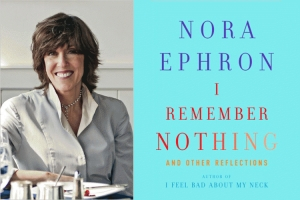
Nora Ephron has a new book out, I Remember Nothing: And Other Reflections, and you can bet I’m ordering it.

In addition to the family connection … she and my brother have done a thing a couple of times … and starting long before that was made, the woman’s work has spoken to me … for me? … whatever … and very obviously, from what I’ve read so far, continues to do exactly that in this most recent work:

One good thing I’d like to say about divorce is that it sometimes makes it possible for you to be a much bet­ter wife to your next husband because you have a place for your anger; it’s not directed at the person you’re currently with.

Another good thing about divorce is that it makes clear something that marriage obscures, which is that you’re on your own. There’s no power struggle over which of you is going to get up in the middle of the night; you are.

But I can’t think of anything good about divorce as far as the children are concerned. You can’t kid yourself about that, although many people do. They say things like, “It’s better for children not to grow up with their parents in an unhappy marriage.” But unless the par­ents are beating each other up, or abusing the children, kids are better off if their parents are together. Chil­dren are much too young to shuttle between houses. They’re too young to handle the idea that the two peo­ple they love most in the world don’t love each other anymore, if they ever did. They’re too young to under­stand that all the wishful thinking in the world won’t bring their parents back together. And the newfangled rigmarole of joint custody doesn’t do anything to ease the cold reality: in order to see one parent, the divorced child must walk out on the other.

Yep.

Nora first spoke to me with Heartburn, hands down the BEST getback any betrayed wife has ever pulled, made even more appropriately brutal when it was made into a film. It lobbed key lime pie directly at the crotch of ex-husband Carl Bernstein, one half of the team that uncovered the Watergate scandal and wrote a book about it, and made it bloody hard for the man to get a date for a very long time.

It is said that revenge is a dish best served up cold, but Nora’s Heartburn warmed the cockles of damaged heart in very healing ways. I laughed … oh! how I laughed … as she got up the thumb-like nose of the bitch who’d aimed her sites on the married man and let the world know just what a prize he wasn’t, no matter the idolatry he fostered widely, and if I was the sort of woman who cooked, I’m sure I would have made good use of the recipes included in the story.

And speaking of stories … here’s a true one:

Once upon a time, I was in New York City on a night out with friends. We’d eaten well in a fabulous penthouse apartment, then danced to Brazilian music at a fabulous club … New York is all about ‘fabulous’ you see. Deciding eventually it was time for some great coffee and rich desserts, we headed for the West Side and the restaurant of another friend on Columbus Circle where we took up residence at one of the larger tables, cramming in chairs from left and right and setting up a right ruckus as we did what New Yorkers do at 3 am — discussing everything under the sun, arguing points and enjoying being one-upped by people whose knowledge is deeper.

Coffee doing what it does, a ladies trip to the ladys’ took up a good 20 minutes, what with all queueing and makeup touchups such ventures into basement toilets require when 9 girls all have to go at the same time and the geography of hip spots in Manhattan puts the bathroom down two floors.

Reentry created the desired effect, and most of the seats we’d vacated were relinquished to us previous tenants, but there were some new faces at the table.

One was a pleasant-looking gentleman seated to my left in the middle of an explanation to my friend sitting across from us on the ins and outs of dealing effectively with photographers from Architectural Digest invading a flat, his just having been featured, apparently.

Interesting enough a discussion, I suppose, but not one that grabbed my attention until some mention was made of the fact that he worked for the Washington Post.

At the time, I had a good friend working in the newsroom at the Post and the thought crossed my mind that perhaps this guy could fill me in a bit on how my buddy was fairing, so at a break in the conversation I asked, innocently enough: I’m sorry, but do you work for the Washington Post?

My friend on the other side of the table went apoplectic, perhaps embarrassed by what was apparently a blatant show of un-hipness causing my out-of-towner faux pas, and with barely an eye-blink passing … no time at all for the dude to respond to my question … she said:

Sandra … this is Carl Bernstein!

Light speed fast, the connections were made in my head: Woodward/Bernstein, Watergate, Washington Post, All the President’s Men … he’s shorter than I would have thought …

Yes. All that.

Now, it often happens that my mouth moves before my brain fully engages, and — blame it on the wine, the coffee, the hour, if you like — this was the case that night.

The very first thing I blurted out to this man who had just been impressing the shit out of the table with tales of fame and fortune and his apartment on the East Side was:

REALLY??? How cool. I LOVED your wife’s book!

Read Full Post »

Anyone else noticing it’s been too heavy around here lately? All this blah, blah on
time and religion, and I’m heading ’round the bend.

So … time for a bit of verse. Some of this stuff is new, but some has been sitting around for a couple of weeks, so if you think I’m up to something fishy … well … today’s post is just for the halibut.

Hope Flings Infernos

When the going gets tough
so gnarly and rough
and nothing is working out right
what can a girl do?
just sit there and stew
or fuck it and put up a fight

It’s exhausting, it seems
that so many dreams
end up like a punch in the nose
What appeared to have hope
ends up in a ‘nope’
and you just have to roll with the blows

Cuz hope flings infernos
so cover up your nose
and breathe through the space in your fingers
remove glasses rosy
stop being so dozy
and work toward something you know lingers

The “y what rose joe” is an intentional mess inspired by exposure to the punctuation-impaired in a comment on an article about politics:

y what rose joe
(or punk28 2 c)

little joe didn’t make it
he died in the war toendallwars
but jack did he make it
preferring the stars toendallstars

young rose was defective
so joe made a directive
to get her life lobotomized
while kath was being criticized
for falling for duke protestant
and eunice married sargent

patty did the star thing too
and broke that old divorce ground
while bobby had a zillion kids
he had the catholic rules down
jeans quiet and so still around

ted bridged the generations
politically for family
60some years veneration
that dc has a kennedy

Can’t do verse without angst now, can we?

Grim … and bear it

The idea has come niggling that
a thought I should be giggling at
might actually have merit

That you and I should suck it up
and try not now to fuck it up
and see if we can wear it

It seems it’s been not all that great
since what was ‘us’ succumbed to fate
but, Lordy, could I bear it?

You say that if I marry you,
yet promise not to harry you
on women when you share it,

perfection would be happening
we both could have our little fling
but that would be the rare bit

If giving all that in and out
while putting yourself all about
means I cannot care, it

seems it may not be so wise
to do this drastic compromise
for what can I inherit?

Oh, yes, I get to be the Queen
but what that gives me can’t be seen.
With what shall I compare it?

Two artists living as they will
by different rules, but yet there’s still
the worry: Can I bear it?

And, of course, we get down to the meat of the matter:

Spank the Monkey

Got a hank, hank, hankerin’
For who? I don’t know who …
sigh …
So a wank, wank, wankerin’
seems just the thing to do …
my! …
Give a thank, thank, thankerin’
if it happened to be you …
guy …
but not bank, bank, bankerin’
that a promise would come true …
sly …
There’re those skank, skank, skankerin’
bitches with their brew …
sty …
that you drank, drank, drankerin’
since it’s all about you, you …
lie …
simply blank, blank, blankerin’
but this we know you knew …
fry …
So we sank, sank, sankerin’
until all was painted blue …
cry …
But this hank, hank, hankerin’
is through and through and through…
why? …
So I’m spank, spank, spankerin’
the monkey till we do …
try …

Read Full Post »

Ack!

What’s the difference between a theoretical physicist and me?

For starters, in the last third of my life I’m writing a book about wild sex, but can only dream of getting a grip on mathematical formulas, while today’s premier theoretical physicist … also of a certain age … publishes volumes based on complicated math, and can only dream about wild sex.

Yes, I’m notoriously crap with numbers and Stephen Hawking has ALS.

I would never presume to have anything in my head that comes anywhere close to the vast stores of knowledge the professor carries around. The man is a genius whose dumbing-down for the masses even gives me a massive headache.

I have read “A Brief History of Time” … many times … yet still can’t even begin to wrap my head around a black hole, those massive light-gravity-time suckers that he not only understands, but can prove.

Nope. I’m a simple poet; a writer of fluff and nonsense and speeches and status updates, a mere mortal handicapped from birth with a math aversion.

So … there are some differences.

But, what’s the same? We both dream. And we both think. We both ponder.

And one of the things we ponder separately in our parallel universes … his being the rarified atmosphere of academia, while mine is this island … is time.

Over the past days I’ve been watching all the YouTube vids available on the Professor, the topic of time and his theories on traveling through it and have come up with another difference between us.

Professor Hawking sees time travel as an eventual possibility given the physics involved and future potential for building the sort of equipment necessary to take advantage of the laws of the universe and travel fast enough to hit the groove of time’s warping.

I see it as a sure thing for every one of us as soon as we manage to get rid of the sort of equipment that makes it impossible.

Although I have no doubt that he’s spot on with the numbers, it seems the Prof is missing the point … or, rather, making a point that will end up being rather pointless, which is, after all, what theoretical science is often about, adding to the wealth of knowledge humans can mull.

One thing science knows is that the law says nothing in the universe can travel faster than light; Hawking puts this well within even my grasp when he clearly signposts 186,000 miles per second as the universal speed limit. Interestingly, anything approaching that speed has funny things happening to time, and as Einstein so succinctly put it with his E = mc2 thingy — go that fast and you’re no longer you, but the energy of you, which is kind of the same, but different. Go just a bit slower and you’re still you, but what passes for a year in some places happens in a week.

The equation E = mc2 indicates that energy always exhibits mass in whatever form the energy takes. Mass–energy equivalence also means that mass conservation becomes a restatement, or requirement, of the law of energy conservation, which is the first law of thermodynamics. Mass–energy equivalence does not imply that mass may be “converted” to energy, and indeed implies the opposite. Modern theory holds that neither mass nor energy may be destroyed, but only moved from one location to another. In physics, mass must be differentiated from matter, a more poorly defined idea in the physical sciences. Matter, when seen as certain types of particles, can be created and destroyed, but the precursors and products of such reactions retain both the original mass and energy, both of which remain unchanged (conserved) throughout the process.

Yeah … headache stuff, but stick with me …

So … mass / energy. What are we? At the moment, both, and that’s where the time travel thing goes tricky. Check this:

“The brain is the ‘local’ creator of time, space and space-time as our special maps of reality we ‘observe’ and participate in” (Catalin et al., 2005). “Time is a fundamental dimension of life. It is crucial for decisions about quantity, speed of movement and rate of return, as well as for motor control in walking, speech, playing or appreciating music, and participating in sports. Traditionally, the way in which time is perceived, represented and estimated has been explained using a pacemaker–accumulator model that is not only straightforward, but also surprisingly powerful in explaining behavioral and biological data. However, recent advances have challenged this traditional view. It is now proposed that, the brain represents time in a distributed manner and tells the time by detecting the coincidental activation of different neural populations (Hitchcock, 2003).

Linear time “past-present-future” is psychological time. Physical time is run of clocks in a space. Motion that we experience through psychological time happens in space that is timeless; past, present and future do not exist in space. There is no physical time existing behind run of clocks.

Somethings to think on …

The brain creates time. Space is timeless. “Matter, when seen as certain types of particles, can be created and destroyed, but the precursors and products of such reactions retain both the original mass and energy, both of which remain unchanged (conserved) throughout the process.”

And the kicker: Time is a fundamental dimension of life.

Yep. There’s the key to time travel … kick the life habit.

The body of knowledge gathered from Near Death Experiences, a misnomer since the peeps reporting back were not near death but dead, suggest the limits imposed by our biology.

A recent study by Dr. Sam Parnia (despite his acknowledgment that he was initially a skeptic), shows that such patients are “effectively dead”, with their brains shut down and no thoughts or feelings possible for the complex brain activity required for dreaming or hallucinating; additionally, to rule out the possibility that near-death experiences resulted from hallucinations after the brain had collapsed through lack of oxygen, Parnia rigorously monitored the concentrations of the vital gas in the patients’ blood, and found that none of those who underwent the experiences had low levels of oxygen. He was also able to rule out claims that unusual combinations of drugs were to blame because the resuscitation procedure was the same in every case, regardless of whether they had a near-death experience or not. According to Parnia, “Arch sceptics will always attack our work. I’m content with that. That’s how science progresses. What is clear is that something profound is happening. The mind – the thing that is ‘you’ – your ‘soul’ if you will – carries on after conventional science says it should have drifted into nothingness.”

Although Richard Dawkins would disagree with my self-evaluation, I consider myself an atheist. Dawkins, you see, considers us nothing more than our biology, when I see our physical form the least of us but having more to do with science than anything god-given.

What the heck, heh? It’s a Jedi master that sums it up in my book:

Luminous beings are we, not this crude matter.

Okay, Yoda is very much not Stephen Hawking, and the limits of the imagination that created him still have that future depending on flying machines. (We’re hooked on gadgets, we are … and I’d blame it on being a boy thing, and could be right about that. Look back at visions of the future past and recognize that we’re not getting around in flying cars, but we ARE connected by the millions, and what comic book ever had Skype superheroes?)

Machines are still where the mind goes because we’ve yet to get a grip on the fact that when the mind goes we have no need of the bloody machines. We are no more our brains, nor our brains us, than our hearts are the repository of our love.

Given the brevity of the human lifespan, it’s no wonder that the idea of traveling through time during it captures the imagination. Truth is, though, I suspect, that it’s old hat to us as we bounce around in time and space, but beyond our capacity to recall … seeing the home movies we have of vacation from flesh and bone only run in our sleep.

Read Full Post »

Sagrada Familia. Does this look finished?

Another Sunday presents with Pope poop … how kind of the old git to continue to religiously supply me with fodder.

Today, he’s in Spain on one of his most blatant panderings yet, a mass at the Sagrada Familia, a church that’s been under construction for 128 years and won’t be completed until 2026.

The Sagrada Familia was designed by Antoni Gaudí (1852–1926), who worked on the project from 1883 and devoted the last fifteen years of his life entirely to the endeavour. In 1882, prior to Gaudí’s involvement, Francesc del Villar was commissioned to design a church on the site. He resigned a year later and Gaudí was appointed the project architect, redesigning the project entirely. The project is scheduled to be completed in 2026. On the subject of the extremely long construction period, Gaudí is said to have remarked, “My client is not in a hurry.”

Apparently, that’s no longer the case. Me thinks Old Ben has an agenda.

Only 14.4% of Spaniards regularly attend mass, and legal changes to allow divorce, gay marriage and abortion have caused concern to the Church.

Yeah … that might be it.

Plus, since the church doesn’t give a peseta toward the construction, the fundraising ops are good, too.

Jordi Bonet Armengol, the current chief architect, said he hoped the Pope’s visit would provide the boost needed to finish the construction, which is funded by private donations and visitors’ fees.

“He will bring a message of spirituality and it’s a stimulus to finish the work,” he told the Reuters news agency.

And, of course, being a church and all, Catholic at that, is has to be about the money … none of which dribbles from the bursting coffers in Rome.

Visitors can go into the Nave, Crypt, Museum, Shop and up the Passion and Nativity towers. An entry fee of €12 for adults, €10 for students, and €8 for children (prices as of July 2010) is payable for the Nave, Crypt, Museum, and Shop. Access to the towers (Nativity Façade and Passion Façade) is now only possible by lift (€2.50) and then walking up the remainder of the tower, over the bridge between the towers and descent via the opposite tower by spiral staircase. Previously, visitors were able to walk up the towers for free. As of August 2010, there will be a new service of fast entering. Visitors can buy their tickets at any Servicaixa ATM (part of ‘La Caixa’) or on the internet at servicaixa.com. They will get a code with which they can enter the Temple via a fast line. The service has a fee of €1.30 extra.

Construction on Sagrada Família is not supported by any government or official church sources. Private patrons funded the initial stages.Money from tickets purchased by tourists is now used to pay for the work, and private donations are accepted through the Friends of the Temple.

I’m not saying it’s not worth the price of admission … it most certainly is. The building is impressive, a melting toffee of religious iconicity that, along with other Gaudi structures, defines Barcelona.

And speaking of money, unlike the popester’s trip to the UK in September that raised a fuss amongst taxpayers there, there’s no talk now on what the Spaniards will be shelling out for this show. You can bet it won’t be a light touch, though, as the old man does not travel on a shoestring.

You think the guy would be grateful for all the free shit he’ll be enjoying in Spain, but with all his usual grace he instead chooses to walk in swingin’ …

In Santiago de Compostela on Saturday, he warned of an “aggressive anti-clericalism” in Spain which was akin to that experienced during the 1930s.

The comments were a reference to the civil war era, during which Republicans killed thousands of priests and nuns, and burned churches.

Whoa … hold the fucking phone! Does he really have the nerve to bring THAT up?

A little history, Mate. Do the name Franco ring a bell? How ’bout more than two million dead?

After the army revolted against the Republican government of Spain in 1936, Franco quickly rose to be the leader of the insurrection, which was supported by the Catholic Church. Franco’s propaganda presented him as a modern Catholic Crusader: “The analogy was given the sanction of the Church on 30 September by the long pastoral letter, entitled ‘The Two Cities’, issued by the Bishop of Salamanca Dr Enrique Pli y Deniel. The Church had long since come out in favour of the military rebels but not hitherto as explicitly as Pli y Deniel. His pastoral built on the blessing given by Plus XI to exiled Spaniards at Castelgandolfo on 14 September in which the Pope had distinguished between the Christian heroism of the Nationalists and the savage barbarism of the Republic. Pli y Deniel’s text quoted St Augustine to distinguish between the earthly city (the Republican zone) where hatred, anarchy and Communism prevailed, and the celestial city (the Nationalist zone) where the love of God, heroism and martyrdom were the rule. For the first time, the word ‘crusade’ was used to describe the Civil War.” The text was submitted to Franco before being published.

Any reason you can see for the Spanish to be a bit peeved?

It wasn’t just the athiest anarchists and socialists that the Catholic Church wanted Franco to slaughter: anyone who even believed in democracy was executed: “Indeed, the Republican will to resist was kept alive only by the fear born of Franco’s much-publicized determination to eradicate liberals, socialists and Communists from Spain.

So, here’s Old Ben, old enough to remember well where the fuck that “aggressive anti-clericalism” started, spouting off his warnings amidst his fundraising. What an asshole.

Not counting soldiers on the Republican side actually killed in the fighting, the probably total of executions carried out by Franco was in the vicinity of 2 million.The Catholic Church not only did not make any effort to stop the slaughter. Priests reported citizens who had not attended mass during or before the Civil War; that in itself was enough to result in execution.

Yes, those numbers may be disputed … the WIKI cites only 500,000 executions with other dead tacked on here and there … but there’s no doubt about the church-sanctioned murder and brutality that was Spain in those years.

Today, however, folks will show up in droves … and, yes, there is a cattle reference there — mooooo … to watch the spectacle of on old man in a dress hold up what he says is a piece of a dead guy’s flesh in an unfinished building to pull in some bucks while attempting to gloss over yet more disgusting behavior and bitching at everybody at the cost of millions.

I’m sorry. I think I just lost the plot …

Read Full Post »

« Newer Posts - Older Posts »