Feeds:
Posts
Comments

Archive for the ‘Smarten up’ Category

Way back when, when my big kids were little, I opted out of the whole Bunny thing at Easter. The late-night visitor at our house ladened with chocolate was, instead, the Easter Ape.

Working as I did at the time with various non-human primates that charmed me daily … and even being peed at and threatened repeatedly by one perpetually pissed off Golden Bellied Mangaby (RIP, Pinot) didn’t tarnish the experience … certainly put the color in my jellybeans, so the substitution made perfect sense.

After all, an orang utan nest looks much more like the contents of an Easter basket than anything a rabbit would leave behind.

Imagine my delight, then, when this story popped up at the tail end of my Easter weekend!

A hitherto unknown population of orangutans numbering perhaps 1-2,000 has been found on the island of Borneo, conservation researchers say.

What a gift!

Not that 1,200 individuals will be enough to resurrect an entire species from the threat of extinction, but if this population is genetically diverse, it sure won’t hurt.

Finding more than 200 night nests in a few kilometers of forest has researchers speculating that this might be, ” … a kind of orangutan refugee camp – with several groups moving into the same area following widespread forest fires.”

That is not only worrying, but extremely interesting, as orangs are solitary living beings by nature and any version of communal congregating is very unusual outside the captive population that is forced to adjust to constant proximity of others.

This says a lot about the adaptability of these great apes. If, indeed, it is the case that in times of habitat loss and the tremendous stress that creates orang utans are able to forgo their reclusive wanderings, gather together and coexist in a self-made “community” without artificial prompts like reintroduction of captives into the population or feeding stations, their resourcefulness should be noted and admired.

Now, if the humans around will just leave them alone, stop destroying the forests for the environmental and eventual economic nightmare of monoculture and develop at least a fraction of the good sense the apes have … well, I for one will be happy to leave Easter to the rabbits.
Read Full Post »

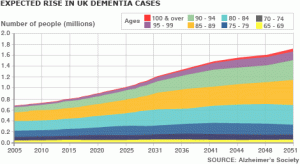
_45430494_dementia_466-1A new study in Britain suggests that a rise in the age of compulsory schooling there some 50 years ago may be responsible for a slow down in dementia rates amongst the elderly today.

Referring to what a Cambridge University Professor calls an “epidemic of dementia”, it is reported that around 700,000 people in the UK have dementia with expectations of the number to rise to 1.7 million by 2051. (More on dementia … fact, figures, treatments, etc. here)

The study suggests that increasing the number of neural connections in the brain in youth, a natural consequence of learning, has benefits beyond just being smarter and more interested and interesting throughout life.

Makes sense to me all the way around. After all, like Doritos in a bag, the more there are to begin with, the later you’re left with just the crumbs.

One issue is, however, the fact that people are living longer, and although the knee jerk reaction to that is usually YIPEE, the reality is less chirpy.

Yes, there are the examples trotted out regularly of the spry 90-year-old kickboxing university professor who just fathered triplets … or something like that … but those people are so far out on the fringes of the normal that, although inspiring, the impression left is misleading.

Being old is hard. It is also uncomfortable, frustrating and frightening. And no matter what, it always ends up the same way.

Why it is that our species, or at least the culture most blog readers share, has a hard time getting their heads around the fact that everybody dies never ceases to amaze me. It is, after all, the one thing we can all count on.

The most basic premise before us all is: No one gets out of this alive.

Pushing the edges of the envelope on this is futile, and although long life sounds dandy to the young and healthy, ask most of the aged how much fun they’re having and the answer will very often be, “not much”.

Exactly what it is about dead that people find so scary and has them attempting to stay off the day is puzzling for me. For one thing, it seems to get in the way of the living part that life is really about. If a person accepts the fact that life is short and then you die, they’d be far more likely to enjoy the time they do have, not procrastinate on happiness and would spend far less precious energy fretting over details that are a waste of time.

In my mind, it’s about quality, not quantity, and if my life turns out to be short in comparison to others … well, I will have given up my seat on this bus, making room for someone else to enjoy the ride.

It is my job to use my time to justify my use of resources, do what I can to make other lives as pleasant as I can and enjoy what can be enjoyed. Not an easy mandate for sure, but that’s life.

Read Full Post »

Writing the other day as I did on medical research that sounds hopeful, I was primed for sciency topics, so this post on my friend Grant’s blog … the ever-interesting and always entertaining Guild of Scientific Troubadours, where science meets music, shakes hands and dances … caught my eye and held it long enough to create no little despair.

Referring to an article from Science Daily titled American Adults Flunk Basic Science, Grant is apparently as bemused as I am over the results of a survey commissioned by the California Academy of Sciences that found that:

* Only 53% of adults know how long it takes for the Earth to revolve around the Sun.

* Only 59% of adults know that the earliest humans and dinosaurs did not live at the same time.

* Only 47% of adults can roughly approximate the percent of the Earth’s surface that is covered with water.*

* Only 21% of adults answered all three questions correctly.

Also worrying is the discovery that “40% of U.S. adults say they are ‘not at all knowledgeable’ about sustainability.”

Well, of course they’re not, thinking that “The Flintstones” is a documentary series and clueless about what makes a year a year and all.

Feel free to test your science savvy here … and while you’re on the site you can launch the penguin cam and learn something about monogamy … and a species that needs ours to really grasp the concept of sustainability.

Read Full Post »

« Newer Posts