Feeds:
Posts
Comments

Archive for the ‘science’ Category

There is so much cool stuff going on in the science news today that I’m giving myself a break and not going anywhere near the flap over face veils in France and the UK. Not that I don’t have an opinion or twelve. I’d simply so much rather focus on little tiny hairs in bat ears and such.

For a population of animals known for acute hearing, the bats in my jack fruit tree have been raising a ruckus audible to an aging rocker with major ear damage, but these, of course, are fruit batsPteropus seychellensis seychellensis, locally known as sousouri … not their smaller insectivorous cousins.

Since fruit tends to hang around rather than flit furtively, sousouri haven’t been working on their echolocation skills, but it’s looking like a couple of parallel universes have managed convergent evolution.

Scientists have found a striking similarity in the DNA that enables some bats and dolphins to echolocate.

A key gene that gives their ears the ability to detect high-frequency sound has undergone the exact same changes over time in both creatures.

The researchers report their findings in the journal Current Biology.

It may be the first time that identical genetics has been shown to underpin the evolution of similar characteristics in very different organisms.

And how cool is that?

Although most of us would find a sudden gift of echolocation more than a bit distracting, the hearing we do have comes in very handy, even when what we’re listening to is a load of bollocks.

Seems a tendency to keep it short is an evolutionary choice made by many primates, and although the article is flawed, it is interesting.

Scientists found that macaques use short calls far more often than lengthier vocalisations.

Humans also do this: the words that we use most often, such as “a”, “of” and “the”, do not take long to say.

The fact that we both share this vocal trait could shed more light on the origin of human language, the team writes in the journal Biology Letters.

Although the report on the study must oversimplify … and with the research credited to Dr. Semple, I suppose that makes sense … I will assume that the work went much deeper and resulted in more less-obvious science than is written by the BBC.

For a new turn on the old “monkey see, monkey do”, take a look at what happens when monkey shoots.

The world’s first film shot entirely by chimpanzees is to be broadcast by the BBC as part of a natural history documentary.

The apes created the movie using a specially designed chimp-proof camera given to them by primatologists.

The film-making exercise is part of a scientific study into how chimpanzees perceive the world and each other.

My hat is off to whoever managed to make a chimp-proof camera!

And just because common wisdom says that sex sells … and I do like drawing readers to the blog … I’ll end with the world’s most promiscuous bird, proving size really doesn’t matter …

Read Full Post »

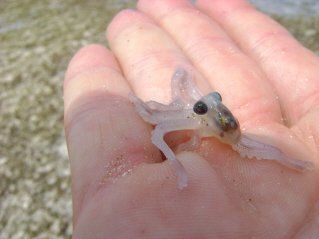
Baby octopus on Bird Island. Photo credit: Greg Berke

Since my twice-daily drive to town taking the kids back and forth to school gets grindingly dull as I pass the same stunningly beautiful scenery time and time again .. azure seas, white sand beaches, verdant forest, ho hum … I frequently offer lifts to neighbors waiting for busses, and although ensuing conversations too often consist of tedious discussions of the three most popular topics here — a limited range of weather (all tropical), fish (also tropical), or sex (not as steamy as you’d think) — occasionally something gets me thinking.

My passenger this afternoon was an octopus diver, which is to say he puts food on the table by hunting, then selling, octopi for the tables of others. Since Sam has recently started snorkeling, we’ve been on the hunt ourselves for a sight of an eight-armed wonder, but they’re bloody hard to find.

Having access to an expert, I sought some advice, but ended up getting more questions than I asked. Knowing that I spend much of my time online, he asked if I could do a bit of research on the tasty cephalopods, then report back.

Asking about the lifespan of an octopus started the wondering, since Stephen has no idea if the creature he finds, stabs in the eye, then pots has been around for five months of fifty years.

Turns out, the fifty year thing isn’t possible. According to the octowiki, these amazingly intelligent, bilaterally symmetric dudes aren’t around for long at all … and they can blame that on sex (which we knew we’d get around to eventually).

Octopuses have a relatively short life expectancy, and some species live for as little as six months. Larger species, such as the North Pacific Giant Octopus, may live for up to five years under suitable circumstances. However, reproduction is a cause of death: males can only live for a few months after mating, and females die shortly after their eggs hatch. They neglect to eat during the (roughly) one month period spent taking care of their unhatched eggs, but they don’t die of starvation. Endocrine secretions from the two optic glands are the cause of genetically-programmed death.

According to the octopus hunter in my car, there are plenty of octopuses that are hard as hell to find, and since they breed by the zillions and don’t last long, I’m not too fussed about the occasional curry I enjoy.

I am, however, a bit bothered about dining on someone so much smarter than a cow.

Octopuses are highly intelligent, likely more so than any other order of invertebrates. The exact extent of their intelligence and learning capability is much debated among biologists, but maze and problem-solving experiments have shown that they do have both short- and long-term memory.

In laboratory experiments, octopuses can be readily trained to distinguish between different shapes and patterns. They have been reported to practice observational learning, although the validity of these findings is widely contested on a number of grounds. Octopuses have also been observed in what some have described as play: repeatedly releasing bottles or toys into a circular current in their aquariums and then catching them. Octopuses often break out of their aquariums and sometimes into others in search of food. They have even boarded fishing boats and opened holds to eat crabs.

Thanks to my car companion du jour, I now have a bit of an idea where to start looking for an octopus to share with Sam in the sea instead of over dinner, and I can’t wait until he catches sight of his first as it suddenly appears, moves, settles, then disappears in the flash of color morph that perfectly mimics its new spot.

Side note: a sack of dead octopuses is a pulsating bag of color … fascinating and sad, but when I come across the option I usually buy one for dinner.

Read Full Post »

Like the conundrum “If a tree falls in the forest and there is no one around to hear it, does it make a sound?”, the following quote from the president of the Royal Society and Astronomer Royal in this article about “discovering” life on other planets serves to underline the arrogance of humans:

It would change our view of ourselves and our place in the cosmos, he said.

It is too true that many people assume our puny species holds primo place in the universe, that we are either an end result of evolution that worked beautifully or were designed in an image of a god who intentionally set out to put us in charge of everything.

Back in the days before ships began sailing the globe, it was well accepted that each little pocket of humanity was a stand-alone example of perfection, and when other little pockets were “discovered”, they were considered less by the “discoverers” who were simultaneously deemed weird by the newly “discovered”.

Even with the widely accepted knowledge that our universe is huge and filled with billions upon billions of stars, billions and billions of which have planets going around them, our little brains don’t quite have the oomph to project far enough to grasp with certainty the fact that we are not alone.

Nope. We won’t change our view of ourselves and our place in the cosmos until we sit down over a turkey dinner and compare notes.

Earthnocentricity has us looking for the familiar, because that’s what we can deal with.

“Technology has advanced so that for the very first time we can actually have the realistic hope of detecting planets no bigger than the earth orbiting other stars.

“(We’ll be able to learn) whether they have continents and oceans, learning what type of atmosphere they have.

“Although it is a long shot to be able to learn more about any life of them, then it’s tremendous progress to be able to get some sort of image of another planet, rather like the earth orbiting another star.”

Because we need continents and oceans, others must, too? That strikes me as more than a bit limited in imagination. Who’s to say that gaseous balls don’t support intelligent beings comprised of light or heat equipped with gaseous balls for reproduction?

Lord Rees touches on this a bit, but drops the ball …

“I suspect there could be life and intelligence out there in forms that we can’t conceive.

“And there could, of course, be forms of intelligence beyond human capacity, beyond as much as we are beyond a chimpanzee,” he added.

Considering how much DNA we share with chimps, those from other worlds would very likely consider us one species while we’re busy thinking that bright flicker in the corner was nothing but a power surge.

Read Full Post »

Striking me in today’s news is a prevalence of stories on religion from a few different angles, and if it weren’t the BBC I was reading this morning … and if I looked at things a bit differently … I might say ‘different angels’.

The first gives an historical perspective, considering that it’s a temple to a cat god found in Egypt that’s reported upon.

Archaeologists found statues of Bastet, worshipped by the Greek-speaking Egyptians as the moon goddess.

For thousands of years the Egyptian Pharaohs believed Bastet was a lion-headed goddess, a relative of the sun-god Ra and a ferocious protector.

But her influence waned as the Pharaohs declined, and the Hellenistic Egyptians resurrected her as the equivalent of the ancient Greek deity Artemis.

Seems somehow fitting that concepts of a moon goddess could wax and wane over the centuries.

On a modern note, this story about biblical references to Jesus marked on gunsights of weapons “widely used by the US and British military in Iraq and Afghanistan” should give much pause for thought for the thinking.

The company that makes the sights says it runs to “Biblical standards” … an interesting idea in the manufacture of items designed to make killing easier, and considering the fact that the US DOD expenditure for 2009 alone on these “aim in the name” items was around $66 mil, that’s a whole lot of John 8:12s out there.

The issue has been thrust into the spotlight by the US Military Religious Freedom Foundation (MRFF) – an advocacy group that seeks to preserve the separation of church and state in the military.

On 14 January, the MRFF received an e-mail, purportedly from a Muslim US Army infantryman, complaining about the markings.

“Many soldiers know of them and are very confused as to why they are there and what it is supposed to mean.”

The email adds: “Everyone is worried that if they were captured in combat that the enemy would use the Bible quotes against them in captivity or some other form of propaganda.”

And I can’t help wondering what Jewish soldiers think training their eye down the barrel of the New Testament . The very idea that we need a group like the MRFF, given the US constitution and all, shows just how tenuous freedom can be. “Fanaticier than thou” is not where anyone should be going, especially when armed.

The last I have the time for today is titled Why does God allow natural disasters? and asks the question of a few.

Archbishop of York John Sentamu said he had “nothing to say to make sense of this horror”, while another clergyman, Canon Giles Fraser, preferred to respond “not with clever argument but with prayer”.

How helpful.

But not as blatantly moronic as:

Less reticent is the American evangelist Pat Robertson. He has suggested Haiti has been cursed ever since the population swore a pact with the Devil to gain their freedom from the French at the beginning of the 19th Century.

Or, how about this circular thinking … ?

The second century saint, Irenaeus, and the 20th Century philosopher, John Hick, appeal instead to what is sometimes called soul-making. God created a universe in which disasters occur, they think, because goodness only develops in response to people’s suffering.

In contemplating all this, one thing comes to mind …

It occurs to me that cats move in mysterious ways.

Read Full Post »

My dear friend, Gay, touts a simple solution to many of the world’s problems: universal male castration.

Her thinking goes party as follows:

Naturally produced sperm is no longer necessary for the manufacture of new people, and who needs it by the bucket-load anyway?

Ridding the world of the testosterone-ladened can only reduce violence, and have the added advantage of allowing men to do more thinking with their big heads, rather than be ruled by their little ones.

Testicles are hardly the most attractive of male features.

Being a huge fan of male danglies myself, I find her proposal a bit drastic, but must admit to an attraction to the thought, nonetheless.

An article from the BBC today does go far toward illustrating Gay’s point.

One in four South African men questioned in a survey said they had raped someone, and nearly half of them admitted more than one attack.

With a recent report quoted as saying ” … a child was being raped in South Africa every three minutes … “, the suggestion of ball removal does have appeal.

Given that today happens to be the anniversary of the attack on Pearl Harbor, the whole testosterone-driven, conquer-the-world-and-kill-a-whole-bunch-of-people-while-you’re-at-it thing resonates more than a bit.

Would the world be a better place, and would men be happier creatures, if the juice that drives so much of the machine lost its compelling oomph? Would male bonding have more positive impact if they didn’t each carry their best friend around in their pants?

Feel free to discuss, and if you’d like to put Gay in charge, I’ll pass along the message.

Read Full Post »

Photo Credit: AFP

Photo Credit: AFP

Archeology has long been an interest of mine, and if my life had gone according to plans made when I was about nine I would have spent a good deal of time digging around places like the Olduvai Gorge, doing my utmost to follow Mary Leakey’s immense footsteps, or looking for the roots of Quetzalcoatl at Tenochtitlan.

Of course, it turns out that John Lennon was right … life is what happens when you’re busy making other plans … but the physical evidence of history continues to fascinate me.

This story demanded my attention today, and set me toward a mental meander I’ve been wandering for hours.

A 3,700-year-old wall has been discovered in east Jerusalem, Israeli archaeologists say.

The structure was built to protect the city’s water supply as part of what dig director Ronny Reich described as the region’s earliest fortifications.

The 26-ft (8-m) high wall showed the Canaanite people who built it were a sophisticated civilisation, he said.

I’ll completely ignore the mention of the fact that the guy in charge of the dig has the surname “Reich” and move along to the more salient points, one being the stunningly naive statement attributed to him about the wall showing “… the Canaanite people who built it were a sophisticated civilization” that I’m hoping was an under-educated reporter’s version and not words actually uttered by an archeologist.

Considering that the Canaanites came up with the alphabet … their city of Byblos was the inspiration for the Greek word for book and hence Bible … figured out how to navigate and set up major ports and trading posts from Britain to Africa shipping and selling everything from salt to wine to ebony, started the first lending institutions, and had a system of government that included legal rights for women that allowed them to sue, invest and even adopt children, a wall that managed to stick around for almost 4,000 years seems superfluous to need when it comes to defining “sophisticated civilization”.

Even slaves … and everyone had slaves in those days … got a fair shake:

As was commonplace in the ancient days, there were slaves, but laws protected them from mistreatment and authorized payment to them in redress of grievances. They could earn their own money, purchasing property and eventually their own freedom. A freed slave could reach high office.

Let’s also not forget that the Canaanites were named for the color purple …Kinakhu: the purple people .. since they were the only source for the die that indicates royalty to this day.

Jump ahead 3,700 years … Shall we? … and take a gander at our modern world and the progress humankind has made in almost 4 millennia. We could start with the fact that the method of making purple from sea snails is a long-lost art, then move along to the mess the Middle East is so well known for these days, as witnessed by reaction to the discovery of this old wall:

Critics say Israel uses such projects as a political tool to bolster Jewish claims to occupied Palestinian land.

Perhaps if ancient walls could talk we’d learn a lesson or two. If nothing else, maybe we’d rethink our arrogance, our perpetual self-congratulatory back patting over our advancements, our short-sighted claims of enlightenment, and realize that we’ve not come a long way, Baby, at all.

Read Full Post »

The ever-more-rapid passing of time captures my attention, albeit fleetingly since a quick ponder is all there is ever time for, so a headline from the BBC today grabbed both of my eyes.

ANCIENT DIAL SOLVES TIME RIDDLE

“Ah ha!” thought I. “As unlikely as it may be, the Beeb sorts it.”

But no.

It’s a story about how a sundial on the Firth of Forth kept monks from wandering from the mandated lockstep of nibble, work, pray, sleep, nibble.

Aside from some minor astonishment that a sundial would do jack in a place as often perpetually dark as Scotland can be, the idea that Augustinian brothers were compelled to wrangle time into digestible tidbits fails to shed light on anything at all.

As limited by our biology as humans are, we mere mortals can only grasp what we can wrap our brains around … see a recent tangent on this … and providing boxes for those bits we have a handle on is so, so handy.

So, we make boxes for minutes and hours and days and weeks, and on an on, and fill those as we see fit.

Some are so attached to the labels on the boxes that confusion results; the labels are deemed actual as if the contents … and keep in mind that the boxes themselves are nothing more than figments … constitute matter that matters.

Conveniently, the BBC provides evidence of this today, too.

An Australian scientist says the continent needs five or six seasons to suit its climate.

Tim Entwisle, chief of Sydney’s Royal Botanic Gardens, says Australia should “unhook” itself from the “arbitrary” four seasons it inherited from Britain.

Mr Entwisle has proposed “sprummer” – the season between spring and summer – and “sprinter” – an early spring.

He says a new system could help people better understand their environment and monitor signs of climate change.

“Having four three-month seasons… doesn’t make any sense in the place we live,” he told Australia’s public broadcaster ABC News.

The continent needs 5 or 6 seasons to suit its climate? Hm.

Allow me to mention that the continent needs nothing at all from hapless inhabitants; it was there a few bazillion years before bipedalism became de rigueur and will still be there … with some sort of climate, as a nuclear winter snow falling with no one to see it could sound much like a tree falling in the forest … long after we fuck up the planet so badly that our frail forms go tits up.

May I, also, point out to Mr. Entwisle that it matters not the least what the heck name humans put, the globe spins and stuff happens?

He has suggested holding a national debate on the subject, and a public competition to name the new seasons.

If Australians need more boxes, that’s okay by me, even though it seems a silly waste of time … which is not linear and cares not one whit as it passes faster every day … which is an arbitrary designation based on where one happens to stand on this rotating globe.

Time marches on … or doesn’t, if that non-linear thing clicks … whether or not we attach names to its bits, and there’s something smacking of ‘too precious’ in the compulsion to confine the nebulous rather than attempt to appreciate the amorphous nature of stuff we can’t hang a handle on.

Read Full Post »

Music ... for the soul. Photo: Kim Pockpas

Music ... for the soul. Photo: Kim Pockpas

It has longed seemed to me that as humans we are over-engineered and severely limited by our biology.

I suppose that could be why Yoda’s line … in addition to many issuing from sources less mainstream and more respected … resonates:

Luminous beings are we, not this crude matter.

Crude matter, for sure, even when we fix ourselves up, often to the detriment of luminosity.

What could be the reason for minds that allow us to imagine everything, but bodies that begin falling apart as soon as we’re born, spend a lifetime secreting disgusting fluids, can’t see in the dark, breathe under water or fly?

Only one answer makes sense to me, and that is that this life is merely a pit stop, a quick duck-in for some sort of tuning up or tuning in or tuning out … whatever ends up being made of our time.

I know many who are convinced that this is it, that in becoming human we have hit the wall, that we’re born, we live, we die, and that’s the whole story, and I have no problem with that, except that it makes no sense … it’s just bloody wasteful.

We can easily track the reasons for many evolutionary developments … whales lost their legs because they hampered swimming, mandrills developed colorful butts to keep track of each other in dense forest … and much of human change, from bipedalism allowing for quicker spotting of predators, leading to shapely asses in the process, to color vision letting us find ripe fruits, fits the program. At some point, however, it just got silly.

Science may argue that our capacity to dream up Shakespearian plays, grand music, art and philosophy is some sort of side dish, a naturally occurring consequence arising in tandem with the ability to hunt and gather, but I’d have to ask: What would be the point?

Did we need to be able to put man on the moon to put food on the table … Did we need a table? … and reproduce? Other animals that have been around much longer than we have, tortoises, for example, haven’t been compelled as a species to invent French horns to enrich their environment .

Our evolutionary biology has worked against us as we’ve been honed. We’ve lost the capacity to smell sexual readiness, fear and illness as we’ve relied more and more upon vision, even while knowing well that we can’t trust our eyes much of the time, the hand being quicker than and all that.

And as great as our minds can be, our bodies limit us; our brains can only process so much of the information in our world. We know, for instance, that time is not linear. This has been proven, but can we wrap our heads around that? Even those who can quote formulas live one day at a time.

Stephen Hawking, for one, who said: “It is not clear that intelligence has any long-term survival value.”

How much in our world do we miss, ignore, refuse to incorporate into our version of reality? We know that we are constantly surrounded by energy; light and heat are two we notice, but it’s likely that there is much more. We may even sense the occasional touch of something, but not being able to classify we chalk it up to whatever …

There was a case of a “new tribal people” discovered in South America some years back. Poor slobs were inundated by scientists wanting to study this unique and untouched society. At one point one of the researchers, noting the weekly overflight of an airplane, asked the people what this object in the sky was called in their culture. He was looked at with amusement … poor guy was obviously batty … because the plane simply did not exist in their world. They didn’t even see it.

It is possible that we exist in simultaneous multiple universes, even though we can conceive of them wonderfully without really “getting it”, so are very likely missing a lot.

Or are we? Perhaps we know more than we think we do. After all, we create art and music for our souls … the part of us we know and touch without proof. We are more than our biology, and death is a door, nothing more.

Okay. Tangent over …

Read Full Post »

When sitting down to compose a new blog post, I sift through a variety of sources. From personal experiences to global events, there’s almost always something that strikes whatever part of my body could be referred to as my “fancy” and gets me typing.

Today, however, I’m spoiled for choice, so rather than pick one topic, I’m bouncing from one to the other like a barefoot tourist on hot sand.

Starting with news from the world of medicine, this story on the potential viability of a contraceptive for men has me hoping that they work out the bugs and that men will actually line up to take responsibility for reproduction.

I worry, however, that big doses of hey-you-ain’t-touchin’-my-sperm may come into play, and that may be happening already.

Despite the injection having no serious side effects, almost a third of the 1,045 men in the two-and-a-half year trial did not complete it and no reason was given for this.

Moving right along, and sticking to the body … or not, as the case may be … this possible revelation has me all ears …

Vincent van Gogh did not cut off his own ear but lost it in a fight with fellow artist Paul Gauguin in a row outside a brothel, it has been claimed.

It has long been accepted that the mentally ill Dutch painter cut off his own ear with a razor after the row in Arles, southern France, in 1888.

But a new book, based on the original police investigation, claims Gauguin swiped Van Gogh’s ear with a sword.

No shit? That’s a tug at the old lobe, now, isn’t it?

Moving from medicine to law, here’s a story that’s so nuts I can’t begin to follow it. (Sorry about that … )

And speaking of nuts, for contenders for the title see this.

They’re well known because of these pickets which they’ve been doing for at least 15 years now. The pickets weren’t always of soldiers’ funerals, but it got more extreme as it went on. Originally it started as pickets of places where gay people congregated – a local park becoming a cruising area which they objected to, and then when Aids came along they said it was punishment for homosexuality and they began picketing Gay Pride parades and marches and also then the funerals of people who died of Aids. And they didn’t originally use offensive words like “fag”. They would say “homosexuality”, but then it just escalated.

Great. And they’re getting press in the UK where they LOVE watching American loonies … and there never seems to be any shortage of good-value-for-money fodder across the pond

And while they’re at it, the Brits have published their “least wanted” list of nuts they don’t want in their country.

The names of some of the people barred from entering the UK for fostering extremism or hatred have been published for the first time.

Islamic extremists, white supremacists and a US radio host are among the 16 of 22 excluded in the five months to March to have been named by the Home Office.

Please. Please. Don’t let the radio host be Rush. I’ve been wishing for more twenty years … way back when he was selling diet plans on Sacramento television — yes, he’s been fat for that long … that he’d move to Wigan and drive a milk float.

Read Full Post »

My name is Sandra, and I’m a smoker.

There. That’s out of the way.

I started smoking when I was thirteen, but strongly suspect that had anyone stuck a fag in my gob at the age of, say, three, I would have puffed away quite happily.

Even when I’m not smoking … and I’ve gone as long as 14 years without lighting up habitually … I’m a smoker, and although I’ve attempted to examine the motives behind my infatuation with filthy cancer sticks I have yet to come up with the ultimate attraction.

Until today.

This report from the BBC does strike a chord, I must admit. Apparently, my addiction has something to do with the fact that I’m pissed off a lot, and if I could get over that, ciggies would have less appeal.

Researchers hypothesised smokers were more likely to be people prone to anger and said tackling this could be a vital part of smoking cessation services.

“Anger management” lessons are being considered for inclusion in stop smoking services by the NHS in Britain, and I think that’s a plan and a half.

I’m wondering, however, how well those lessons would take in a world where this story shares the page with the calmy-downy-stub-out-that-butt article.

Plans to promote medical treatment for homosexuality at a religious conference have been criticised by doctors.

The event will hear from prominent American psychologist Dr Joseph Nicolosi who said he had helped many people to become heterosexual.

… Dr Nicolosi said he had been helping people to “increase their heterosexual potential” for 25 years, and put his success rate among men at about two out of three.

He said he was offering a choice for people who were unhappy being gay.

Yeah … I know. I just jumped from fags to fags. Got a problem with that?

Anybody got a light … ?

Read Full Post »

« Newer Posts - Older Posts »