Feeds:
Posts
Comments

Archive for the ‘On getting older’ Category

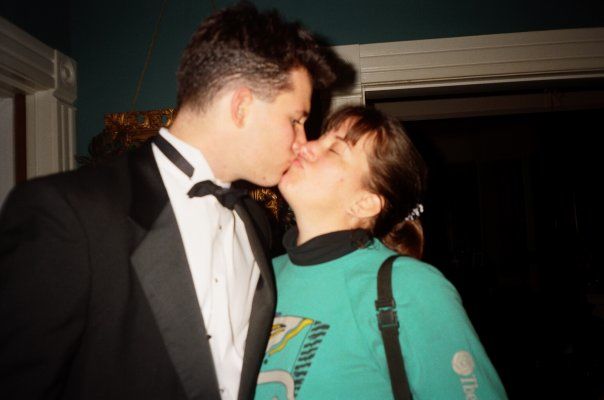
Jaren kissing me goodbye on his way to a Christmas Party

No, he doesn’t look a bit like the kindly grandfather-like figure in the 1951 movie version of “A Christmas Carol”, probably because I never had a grandfather. My Ghost of Christmas Past is a nebulous shape-shifter morphing around as he drags me from scene to scene. Since this isn’t about the guide, but the journey, it matters little since he does employ that cool fade technique.

Fade in:

Christmas morning. Suburban living room. 1950s.

An oval braided rug echos forest green drapes and the dark brown of a skirted sofa framed by blond wood side tables. Tree in one corner lit with bulbs the size of thumbs, some glowing white through scrapes and scratches in their paint and reflecting on massive amounts of tinsel. The sound and smell of percolating coffee invades from the kitchen. My maternal grandmother sits and smokes as we wait for Christmas to start.

Dissolve to:

Same day, different year, same house.

My brothers and I wear new flannel pajamas our mom made. A sewing basket sits beside the sofa. A sock with a light bulb stuffed in the toe awaits darning.

A walnut table has been added to the room. Intricately carved legs are my duty to dust. It had been in Grandma’s house before she died, now it is my mother’s.

A bicycle! What a beauty! Blue and white with a basket attached to the handlebars. Ribbons and bows.

Dissolve to:

Same day, different year, different house, different town.

Oak floors polished by some guy sliding my brothers and me around on towels to buff the wax. Much bigger tree, same strings of lights with more scratches. Dad promised French pancakes for breakfast. Christmas Eve dinner had been at the hotel with us running in and out of the kitchen and getting festive with the cooks and waitresses that worked for our dad.

We go to Mass. I’m in the fifth grade at St. Joseph’s and Sister Mary Stanislaus would not be happy if I didn’t put in an appearance. My father refuses to go through the motions … no genuflecting, no standing, no kneeling … and although I’m embarrassed by the idea that he doesn’t know what’s expected, he impresses me with scoffing. The music was nice, though, and I like to sing.

Dissolve to:

Same day, different year, different house, back to the first town, different family.

Crowded suburban house with a step-mother and five step-sibs in addition to me and two brothers. My mother sends fudge and a Barbie doll that looks like her. My brothers and I don’t share the fudge with the others.

Dissolve to:

Same day, different year, different town, apartment next to the freeway so new it smells like paint and plaster, just us again.

Tiny tree on a table in a small living room. Y.A. Tittle gives my little brother a football uniform. All our gifts are from someone famous. None say they are really from Dad, but we get the joke.

Dissolve to:

Same day, different year, different town, another new apartment.

Christmas dinner at a restaurant that makes great hot turkey sandwiches.

Dissolve to:

Same day, different year, different town, different family.

Chinese food with a new step-family.

Dissolve to:

Same day, different year, different town, different family.

Mom’s house in Small Town USA. Moronic step-father reads the paper upside-down … or might as well. Jenn and Jaren are little and my brothers wear out the batteries in their Star Trek communicators before Christmas Eve is over. I get a TV from Mom. A brother gets an ID bracelet.

A turkey neck simmers on a back burner, the grinder comes out from the bottom drawer and a turkey is stuffed with Grandma’s recipe. Green jello. Stuffed celery. Pumpkin pies on the washing machine.

Fade to: Calendar flipping through years …

Fade in:

Christmas Day, huge Victorian house in mid-town California city.

A tree stands fourteen-feet tall in the doorway, lights reflected in the oak floors. Burgundy walls and green rugs add a festive feel.

Husband once again has coerced me into letting him open one gift on Christmas Eve. As always, he chooses the BIG box with the fancy wrapping paper. As he does every year, he falls for the socks. Jenn is home from college. Jaren is living in the basement apartment. Brothers are there with girlfriends. Dad has written a poem and we give him a computer. Step-sisters come with Chinese food and their families. The guys play basketball in the living room once the mayhem of gift opening is cleared.

Dissolve to:

Same day, different, different house, different country, different husband.

Doors wide open to catch the morning breeze as the plastic tree rotates. Cj crawls around wearing Rudolf antlers. Sam waits for Christmas to start as the kettle boils. The mess from the annual Christmas Eve party has been cleared away. We open our gifts, smile, play with the kids and their new toys, then dress and head to Gay’s for Christmas lunch.

Dissolve to:

Same day, different year, same house, no husband.

Friends spend Christmas Eve with us and are still around in the morning to help open gifts and spread cheer. Fiance is on Skype from Mexico watching and commenting and hopes are expressed that the next year won’t see us so far flung. Kids play with their new stuff.

Fade to black.

If life is to follow Victorian fiction, these scenes should dovetail into a viz from a Ghost of Christmas Present where I learn yet more about the true meaning of this holiday.

Hm.

Read Full Post »

Sounds almost pleasant, doesn’t it? It’s not. Oxymoronic in its essence, free-floating anxiety sees the anxious bit hijacking anything that might be considered free and the sucker floats like a anvil.

Anxiety that lacks a definite focus or content.

And that, folks, comes before the first cup of tea.

I have always lived with demons … depression being the biggest bugger with the fiercest bite … but anxiety is rather new to me. Sure, I’m a worrier. What woman isn’t, especially living alone and having kids to raise? But it’s not often my worries cause me to lose sleep.

In fact, I usually sleep fairly well; I drop off without effort, and if disturbed have little to no trouble drifting back into slumber. Yes, my sleep is dream-plagued/blessed and often not as restful as I’d like, but I do sleep and for the allotted hours.

No, it’s not the sleeping that’s my issue, my demon … whatever … but the waking.

Before my eyes open I now realize I’ve shifted from sleep to awake by the sudden onset of that free-floating anxiety thing. It takes a bit of time to recognize and even more to run it through the filters: I’m late; I’m early; I’m breathing; kids are okay; nothing horrible happened in the night; scan the list of what’s on for the day; yes, I’m here alone. Check. Check. Check.

So, why am I shaking and where is this panic over a new day coming from? Am I sixth-sensing portents of doom? Has a shit asteroid been plummeting toward me in the night? Why is every drop of sadness in my body rushing in to welcome another twenty-four hours of the same old crap? Is the day now tainted? Have I contaminated the glass of opportunity by dropping in a dollop of shite with my quaking hands? Will these backed-up tears cloud my vision? Or drown me?

Tea. I need tea.

And thus begins my day.

It’s not every day that starts this way. Thankfully, I do go through periods where I wake up like a normal person, slowy and with a lovely touch of fog misting my corners. On those mornings my eyes open, the view presents itself in all its glory and potential rolls out in front of me. Those occasions take a second cup of tea to bring recognition of and appreciation for the ease of sliding into what had been tomorrow.

More often than not, however, it’s choking sad and shaking panic that form my salute to the sun.

I can trace the roots of this relatively new … what? … affliction? … waking nightmare? … free-floating anxiety … yeah, that’s it.

Close to eighteen months ago my waking moments changed drastically with the 6-am-ish phone call that told me my son was dead. And although this will not only sound trite, but obvious, I’ve not been the same since.

It’s a fact of life that the older we get, the longer our loss list grows. Over the past few years I’ve lost a lot … a son, a husband, a great love, all semblance of security, the last vestiges of youth, a load of nerve, hopes, dreams, wishes … even, from time to time, the will to live. (Yes, I have a list of gains, too, but I’ve just passed a week being thankful and that’s not what this is about this morning.)

I can deal with each and every loss … one-by-one, please … but first thing in the morning and before I’m fully awake? Not so well. Not at all, actually, since dealing isn’t what happens when I’m trembling and feeling the sting of tears before my eyes even open.

The result, of course, of this free-floating shit is an effort to flail a lasso about and pull it close enough to examine just what the fuck it might be. That sure pulls out the list, and as my mind leaps like a frog across sinking lily pads I am forced to recollect most every crappy thing that has happened, may happen or will happen. And I haven’t even peed yet …

At least I get words out of it, heh? Here are a few from this morning:

Good Morning, Sword

Within my realm I awaken each day
to a view of the sea and bird song
It is in my power to make what I may
But the first works I utter are:
What’s wrong?

I don’t see the sword hanging over my head
but I know that it’s there and suspended
by something no stronger than one single hair
if should break means the world is
upended …

Read Full Post »

Let us not look back in anger, nor forward in fear, but around in awareness. ~James Thurber

Not that I have a lot of it spare, but I have been thinking about time quite a bit lately — the non-existance of, the travel through, the wastes of.

You reading me often and in various places must have noticed I have a monkey mind … and I’m not talking evolutionary remnants of a brow ridge but the aptly descriptive Buddhist term for one whose brain is: unsettled; restless; capricious; whimsical; fanciful; inconstant; confused; indecisive; uncontrollable. Yeah … that would be what happens under my hair most of the time, illuminated here in an article listing six steps to living in the moment.

“We’re living in a world that contributes in a major way to mental fragmentation, disintegration, distraction, decoherence,” says Buddhist scholar B. Alan Wallace. We’re always doing something, and we allow little time to practice stillness and calm.

When we’re at work, we fantasize about being on vacation; on vacation, we worry about the work piling up on our desks. We dwell on intrusive memories of the past or fret about what may or may not happen in the future. We don’t appreciate the living present because our “monkey minds,” as Buddhists call them, vault from thought to thought like monkeys swinging from tree to tree.

I’m a worrier by nature, a ponderer by profession and with a conscience that rarely has me leaving things to rest, all which have me agitating and ruminating when I should just be experiencing.

Today’s Huff Post puts me in this moment, however, so I pause to consider the ideas in an article called: How Often Are We on Mental Autopilot? You Might Be Surprised.

Although I’m not surprised a study suggests people spend 46.9% of their brain time doing a wander, nor that most don’t consider it a particularly happy path, there is some interesting science in the report.

They discovered that people have two distinct ways of interacting with the world, using two different sets of networks. One network for experiencing your experience involves what is called the “study by Kirk Brown found that people high on a mindfulness scale were more aware of their unconscious processes. Additionally these people had more cognitive control, and a greater ability to shape what they do and what they say, than people lower on the mindfulness scale. If you’re on the jetty in the breeze and you’re someone with a good level or mindfulness, you are more likely to notice that you’re missing a lovely day worrying about tonight’s dinner, and focus your attention onto the warm sun instead. When you make this change in your attention, you change the functioning of your brain, and this can have a long-term impact on how your brain works too.

Living where I do and working from my veranda, I have developed the habit of pulling myself out of my work or my ass or wherever my head might be at any given moment at intervals throughout the day to take some time to gaze upon and appreciate the beauty on offer. Right now, it’s a sapphire sea, the viridescent forest and a few puffy, white clouds navigating their way westward that fill my soul right along with my eyes. Throw in a couple of long-tailed tropic birds and the fruit bats in my jack fruit tree and I’m breathing again in that way I forget to breathe when my mind is full of whatever I’m writing, my heart is heavy with longing for what is no more and my nerves fray with concern over the illusive ‘what’s next’.

Inspired by beautiful music, I once wrote for the description of the video that went along with it:

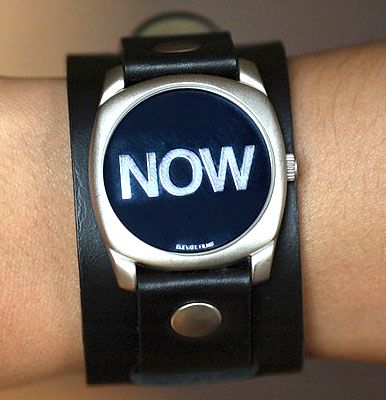
“For me, one of the most precious gifts the universe gives is the Now, and the Now embraced is the Eternal Hug … a gift without conditions of past or future, but only the joy of the moment. And what is life but a series of moments?

The moments bringing those words are now in my past, but I can and do continue to conjure their joys.

It’s remembering to do it that’s the key:

“Mindfulness is a habit, it’s something the more one does, the more likely one is to be in that mode with less and less effort… it’s a skill that can be learned. It’s accessing something we already have. Mindfulness isn’t difficult. What’s difficult is to remember to be mindful.” I love this last statement. Mindfulness isn’t difficult: the hard part is remembering to do it.

Having studied the work of Abraham Maslow way back when, I trust his assessment of moments.

The ability to be in the present moment is a major component of mental wellness.

But life does do its bit to beat that out of a girl, doesn’t it?

I’m not one for wallowing in regrets, and it’s too often the future that robs me of moments; not the desire of it, but the anxiety over having some asteroid of shit fall from this clear blue sky and splatter on my life. It’s an ancestor who provides perspective and a bit of solace on this concern:

The best thing about the future is that it comes only one day at a time. ~Abraham Lincoln

True enough, thankfully, and one day leads to another.

Yep. This moment is now the past and the next is still the future and each letter I type becomes a sentence and sentence is a pretty good description of life.

As for quantum physics and that business about the past, like the future, being indefinite and existing only as a spectrum of possibilities … well, I rather like a poet’s version today:

Forever is composed of nows.
~Emily Dickinson”

Read Full Post »

Before anyone weighs in with comments about how what follows is based on faulty logic, I’ll start the post off with a full disclosure: it makes no sense at all, has ’bout nothing based in science or fact or undisputed info and I don’t even end up agreeing with myself completely.

Okay?

This is simply a morning diversion, since, after all, I love to go a pondering along strangely convoluted tracks before I settle my brain down before the anvil and commence pounding away.

Today’s journey began at this article on sugar addiction.

One study out of France, presented at the 2007 annual meeting of the Society for Neuroscience, showed that when rats (who metabolize sugar much like we do) were given the choice between water sweetened with saccharin and intravenous cocaine, 94 percent chose the saccharin water. When the water was sweetened with sucrose (sugar), the same preference was observed — the rats overwhelmingly chose the sugar water. When the rats were offered larger doses of cocaine, it did not alter their preference for the saccharin or sugar water. Even rats addicted to cocaine, switched to sweetened water when given the choice. In other words, intense sweetness was more rewarding to the brain than cocaine.

But this isn’t about sugar, or cocaine and addresses addictions only peripherally. No, it’s about one of the big questions in life:

Why are all the good things so bad for us? And if they are so bad for us, why are they so good?

(Well … that and some other stuff …)

Those are two different questions, and it’s actually the second that interests me this morning since health professionals have no trouble reeling off reasons sugar, fat, alcohol, tobacco, drugs, casual sex and narcissistic men are bad, and we’ve heard them all; include them in your life at your inevitable peril.

My wander is more about why we’re so deeply attracted to shit we know will kill us, and in my wander I wonder if there’s a reason as primal as our ancestral genetic mandate to collect calories when we can.

Back in the early days of humans, life was a short prospect. Breeding started at puberty when hormone secretions kicked off the process that made sex desirable and babies possible, and anyone managing to live past thirty was considered either a burden or a deity. Feeding the clan took more effort than a stroll to the fridge and people were considered snacks-on-the-hoof by some of the neighbors. Yes, we lived fast, died young and … well … pretty is as pretty does.

Some of that fast living included a predilection for a tipple and a partiality for getting high, so there’s nothing new about our fondness for altered states.

Of course, the ancients didn’t know they were playing with their health.

We do.

We’ve made a slew of changes in the way we spend our time on the planet … we moved out of caves, traded our pelts for Prada and prefer Merlot over mead … so many so that our ability to conceptualize the way our ancestors lived has been greatly influenced by Fred and Wilma. These changes have resulted in extending our lives many decades beyond what would have been even remotely conceivable, but to date we have yet to unload the baggage that is a hankering for some stuff our species has been craving since Day One.

Again with the Why?

I’m guessing here one reason may just be that somewhere under our modern veneer, a place deep in our most primal of being, we actually understand that we will someday be dead.

Yeah, yeah … I know that’s a stretch. After all, we’re constantly getting messages about how if we reduce this and give up that and forego the fun of whatever we can cut the death rate (Funny how often that pops up.), giving some the impression that living forever is an option if rules are assiduously followed and enough sacrifices are made.

Okay … much is actually focused –in intent, if not in words — on dying younger than the average death or on being healthier in old age. Fine. I get that. But until there’s a way to stop the cycle — you’re born, you live, you die — there are only two options available; you die, or you get old.

Back in 1960, Maurice Chevalier summed up his ideas on the options when he said: Old age isn’t so bad when you consider the alternative.

Allow me to point out that Monsieur may now have a better base of comparison.

Actually, there are three options, the third being you live as best you can, and John Mortimer nails that point to the wall:

There is no pleasure worth forgoing just for an extra three years in the geriatric ward.

Could it be that we carry remnants of our Paleolithic selves — those beings we once were who knew for fact that life is short and then you die — that prompt us to go for the gusto?

An aside:

At this moment I have three friends engaged in fights against cancers of various types. All are significantly younger than I am (two in their 30s), none ever smoked, all followed reasonable dietary plans, drank in moderation and did not partake in illegal substances.

Back in the 80s I worked with a group of people who, although bound by certain interests, varied widely in lifestyle. My dear friend Robbie and I were the oldest of the bunch and by far the most debauched. Two of those people, perhaps the cleanest livers amongst us then, have now been dead for a number of years. Robbie and I are still kicking … and debauching.

I’m not afraid of death. It’s the stake one puts up in order to play the game of life. ~Jean Giraudoux, Amphitryon, 1929

Toss those dice … and while you’re up, can you pour me another glass of the white, please?

Read Full Post »

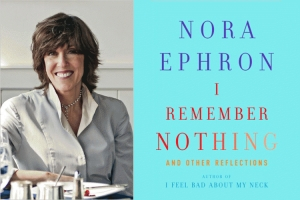
Nora Ephron has a new book out, I Remember Nothing: And Other Reflections, and you can bet I’m ordering it.

In addition to the family connection … she and my brother have done a thing a couple of times … and starting long before that was made, the woman’s work has spoken to me … for me? … whatever … and very obviously, from what I’ve read so far, continues to do exactly that in this most recent work:

One good thing I’d like to say about divorce is that it sometimes makes it possible for you to be a much bet­ter wife to your next husband because you have a place for your anger; it’s not directed at the person you’re currently with.

Another good thing about divorce is that it makes clear something that marriage obscures, which is that you’re on your own. There’s no power struggle over which of you is going to get up in the middle of the night; you are.

But I can’t think of anything good about divorce as far as the children are concerned. You can’t kid yourself about that, although many people do. They say things like, “It’s better for children not to grow up with their parents in an unhappy marriage.” But unless the par­ents are beating each other up, or abusing the children, kids are better off if their parents are together. Chil­dren are much too young to shuttle between houses. They’re too young to handle the idea that the two peo­ple they love most in the world don’t love each other anymore, if they ever did. They’re too young to under­stand that all the wishful thinking in the world won’t bring their parents back together. And the newfangled rigmarole of joint custody doesn’t do anything to ease the cold reality: in order to see one parent, the divorced child must walk out on the other.

Yep.

Nora first spoke to me with Heartburn, hands down the BEST getback any betrayed wife has ever pulled, made even more appropriately brutal when it was made into a film. It lobbed key lime pie directly at the crotch of ex-husband Carl Bernstein, one half of the team that uncovered the Watergate scandal and wrote a book about it, and made it bloody hard for the man to get a date for a very long time.

It is said that revenge is a dish best served up cold, but Nora’s Heartburn warmed the cockles of damaged heart in very healing ways. I laughed … oh! how I laughed … as she got up the thumb-like nose of the bitch who’d aimed her sites on the married man and let the world know just what a prize he wasn’t, no matter the idolatry he fostered widely, and if I was the sort of woman who cooked, I’m sure I would have made good use of the recipes included in the story.

And speaking of stories … here’s a true one:

Once upon a time, I was in New York City on a night out with friends. We’d eaten well in a fabulous penthouse apartment, then danced to Brazilian music at a fabulous club … New York is all about ‘fabulous’ you see. Deciding eventually it was time for some great coffee and rich desserts, we headed for the West Side and the restaurant of another friend on Columbus Circle where we took up residence at one of the larger tables, cramming in chairs from left and right and setting up a right ruckus as we did what New Yorkers do at 3 am — discussing everything under the sun, arguing points and enjoying being one-upped by people whose knowledge is deeper.

Coffee doing what it does, a ladies trip to the ladys’ took up a good 20 minutes, what with all queueing and makeup touchups such ventures into basement toilets require when 9 girls all have to go at the same time and the geography of hip spots in Manhattan puts the bathroom down two floors.

Reentry created the desired effect, and most of the seats we’d vacated were relinquished to us previous tenants, but there were some new faces at the table.

One was a pleasant-looking gentleman seated to my left in the middle of an explanation to my friend sitting across from us on the ins and outs of dealing effectively with photographers from Architectural Digest invading a flat, his just having been featured, apparently.

Interesting enough a discussion, I suppose, but not one that grabbed my attention until some mention was made of the fact that he worked for the Washington Post.

At the time, I had a good friend working in the newsroom at the Post and the thought crossed my mind that perhaps this guy could fill me in a bit on how my buddy was fairing, so at a break in the conversation I asked, innocently enough: I’m sorry, but do you work for the Washington Post?

My friend on the other side of the table went apoplectic, perhaps embarrassed by what was apparently a blatant show of un-hipness causing my out-of-towner faux pas, and with barely an eye-blink passing … no time at all for the dude to respond to my question … she said:

Sandra … this is Carl Bernstein!

Light speed fast, the connections were made in my head: Woodward/Bernstein, Watergate, Washington Post, All the President’s Men … he’s shorter than I would have thought …

Yes. All that.

Now, it often happens that my mouth moves before my brain fully engages, and — blame it on the wine, the coffee, the hour, if you like — this was the case that night.

The very first thing I blurted out to this man who had just been impressing the shit out of the table with tales of fame and fortune and his apartment on the East Side was:

REALLY??? How cool. I LOVED your wife’s book!

Read Full Post »

Ack!

What’s the difference between a theoretical physicist and me?

For starters, in the last third of my life I’m writing a book about wild sex, but can only dream of getting a grip on mathematical formulas, while today’s premier theoretical physicist … also of a certain age … publishes volumes based on complicated math, and can only dream about wild sex.

Yes, I’m notoriously crap with numbers and Stephen Hawking has ALS.

I would never presume to have anything in my head that comes anywhere close to the vast stores of knowledge the professor carries around. The man is a genius whose dumbing-down for the masses even gives me a massive headache.

I have read “A Brief History of Time” … many times … yet still can’t even begin to wrap my head around a black hole, those massive light-gravity-time suckers that he not only understands, but can prove.

Nope. I’m a simple poet; a writer of fluff and nonsense and speeches and status updates, a mere mortal handicapped from birth with a math aversion.

So … there are some differences.

But, what’s the same? We both dream. And we both think. We both ponder.

And one of the things we ponder separately in our parallel universes … his being the rarified atmosphere of academia, while mine is this island … is time.

Over the past days I’ve been watching all the YouTube vids available on the Professor, the topic of time and his theories on traveling through it and have come up with another difference between us.

Professor Hawking sees time travel as an eventual possibility given the physics involved and future potential for building the sort of equipment necessary to take advantage of the laws of the universe and travel fast enough to hit the groove of time’s warping.

I see it as a sure thing for every one of us as soon as we manage to get rid of the sort of equipment that makes it impossible.

Although I have no doubt that he’s spot on with the numbers, it seems the Prof is missing the point … or, rather, making a point that will end up being rather pointless, which is, after all, what theoretical science is often about, adding to the wealth of knowledge humans can mull.

One thing science knows is that the law says nothing in the universe can travel faster than light; Hawking puts this well within even my grasp when he clearly signposts 186,000 miles per second as the universal speed limit. Interestingly, anything approaching that speed has funny things happening to time, and as Einstein so succinctly put it with his E = mc2 thingy — go that fast and you’re no longer you, but the energy of you, which is kind of the same, but different. Go just a bit slower and you’re still you, but what passes for a year in some places happens in a week.

The equation E = mc2 indicates that energy always exhibits mass in whatever form the energy takes. Mass–energy equivalence also means that mass conservation becomes a restatement, or requirement, of the law of energy conservation, which is the first law of thermodynamics. Mass–energy equivalence does not imply that mass may be “converted” to energy, and indeed implies the opposite. Modern theory holds that neither mass nor energy may be destroyed, but only moved from one location to another. In physics, mass must be differentiated from matter, a more poorly defined idea in the physical sciences. Matter, when seen as certain types of particles, can be created and destroyed, but the precursors and products of such reactions retain both the original mass and energy, both of which remain unchanged (conserved) throughout the process.

Yeah … headache stuff, but stick with me …

So … mass / energy. What are we? At the moment, both, and that’s where the time travel thing goes tricky. Check this:

“The brain is the ‘local’ creator of time, space and space-time as our special maps of reality we ‘observe’ and participate in” (Catalin et al., 2005). “Time is a fundamental dimension of life. It is crucial for decisions about quantity, speed of movement and rate of return, as well as for motor control in walking, speech, playing or appreciating music, and participating in sports. Traditionally, the way in which time is perceived, represented and estimated has been explained using a pacemaker–accumulator model that is not only straightforward, but also surprisingly powerful in explaining behavioral and biological data. However, recent advances have challenged this traditional view. It is now proposed that, the brain represents time in a distributed manner and tells the time by detecting the coincidental activation of different neural populations (Hitchcock, 2003).

Linear time “past-present-future” is psychological time. Physical time is run of clocks in a space. Motion that we experience through psychological time happens in space that is timeless; past, present and future do not exist in space. There is no physical time existing behind run of clocks.

Somethings to think on …

The brain creates time. Space is timeless. “Matter, when seen as certain types of particles, can be created and destroyed, but the precursors and products of such reactions retain both the original mass and energy, both of which remain unchanged (conserved) throughout the process.”

And the kicker: Time is a fundamental dimension of life.

Yep. There’s the key to time travel … kick the life habit.

The body of knowledge gathered from Near Death Experiences, a misnomer since the peeps reporting back were not near death but dead, suggest the limits imposed by our biology.

A recent study by Dr. Sam Parnia (despite his acknowledgment that he was initially a skeptic), shows that such patients are “effectively dead”, with their brains shut down and no thoughts or feelings possible for the complex brain activity required for dreaming or hallucinating; additionally, to rule out the possibility that near-death experiences resulted from hallucinations after the brain had collapsed through lack of oxygen, Parnia rigorously monitored the concentrations of the vital gas in the patients’ blood, and found that none of those who underwent the experiences had low levels of oxygen. He was also able to rule out claims that unusual combinations of drugs were to blame because the resuscitation procedure was the same in every case, regardless of whether they had a near-death experience or not. According to Parnia, “Arch sceptics will always attack our work. I’m content with that. That’s how science progresses. What is clear is that something profound is happening. The mind – the thing that is ‘you’ – your ‘soul’ if you will – carries on after conventional science says it should have drifted into nothingness.”

Although Richard Dawkins would disagree with my self-evaluation, I consider myself an atheist. Dawkins, you see, considers us nothing more than our biology, when I see our physical form the least of us but having more to do with science than anything god-given.

What the heck, heh? It’s a Jedi master that sums it up in my book:

Luminous beings are we, not this crude matter.

Okay, Yoda is very much not Stephen Hawking, and the limits of the imagination that created him still have that future depending on flying machines. (We’re hooked on gadgets, we are … and I’d blame it on being a boy thing, and could be right about that. Look back at visions of the future past and recognize that we’re not getting around in flying cars, but we ARE connected by the millions, and what comic book ever had Skype superheroes?)

Machines are still where the mind goes because we’ve yet to get a grip on the fact that when the mind goes we have no need of the bloody machines. We are no more our brains, nor our brains us, than our hearts are the repository of our love.

Given the brevity of the human lifespan, it’s no wonder that the idea of traveling through time during it captures the imagination. Truth is, though, I suspect, that it’s old hat to us as we bounce around in time and space, but beyond our capacity to recall … seeing the home movies we have of vacation from flesh and bone only run in our sleep.

Read Full Post »

Yes, today it’s about time. It is also about immortality. A weird mix, perhaps … especially in a post starting out with the intro from one of the dumbest shows in TV history … but in actuality is where the rubber meets the road we travel.

Now he has departed from this strange world a little ahead of me. That signifies nothing. For us believing physicists the distinction between past, present, and future is only a stubbornly persistent illusion. ~Albert Einstein

I like it. There’s something William Penn in that, since he did say, “For death is no more than a turning of us over from time to eternity,” and that seems a freeing conversion.

But I’m not dead yet and today is an illusion. Hm. Does that mean I can just go back to sleep? Sure. But if today is an illusion, and so is tomorrow … the past, present and future … it’s probably a better idea to pay attention and see if I can figure at least some of it out. After all, if someone was to saw me in half someday, I wouldn’t sleep through that, even if it was merely deception of the entertaining kind.

Instead of plopping back to the pillow, I’m giving my mind a wander around the wonder of time, a favorite confused meander, prompted by this article in the Huff Post titled: Is Death the End? Experiments Suggest You Create Time.

We watch our loved ones age and die, and we assume that an external entity called time is responsible for the crime. But experiments increasingly cast doubt on the existence of time as we know it. In fact, the reality of time has long been questioned by philosophers and physicists. When we speak of time, we’re usually referring to change.

Philosophers have been taking this on for as long as there have been philosophers, going back to the oh-so-cool-named Zeno, who came up with the Arrow Paradox mentioned in the article.

Zeno states that for motion to occur, an object must change the position which it occupies. He gives an example of an arrow in flight. He states that in any one instant of time, for the arrow to be moving it must either move to where it is, or it must move to where it is not. However, it cannot move to where it is not, because this is a single instant, and it cannot move to where it is because it is already there. In other words, in any instant of time there is no motion occurring, because an instant is a snapshot. Therefore, if it cannot move in a single instant it cannot move in any instant, making any motion impossible.

… this paradox starts by dividing time—and not into segments, but into points.

Wrapped your head around that one? Then take on the the idea that “space and time are forms of animal intuition”, simply “tools of the mind and thus don’t exist as external objects independent of life.”

An experiment published in 1990 suggests that Zeno was right. In this experiment, scientists demonstrated the quantum equivalent of the adage that “a watched pot doesn’t boil.” This behavior, the “quantum Zeno effect,” turns out to be a function of observation. “It seems,”said physicist Peter Coveney, “that the act of looking at an atom prevents it from changing”. Theoretically, if a nuclear bomb were watched intently enough — that is, if you could check its atoms every million trillionth of a second — it wouldn’t explode. Bizarre? The problem lies not in the experiments but in our way of thinking about time. Biocentrism is the only comprehensible way to explain these results, which are only “weird” in the context of the existing paradigm.

We are limited by our biology, peeps, packed into a container that can only perceive space and time in relation to our point in both.

Oh! For Stephen Hawking’s brain, who said, “There is no way to remove the observer — us — from our perceptions of the world … In classical physics, the past is assumed to exist as a definite series of events, but according to quantum physics, the past, like the future, is indefinite and exists only as a spectrum of possibilities.” The guy who finds thinking about paradoxes great fun and probably never gets headaches like the one I’m developing just writing this bloody post.

The whole series, plus another 5-parter, is on YouTube, so if you have the inclination you can fill up on his ideas … since it seems time is not a problem.

Check out the bit in the episode above about the worm holes that are everywhere. Tiny, yes, but I can’t help wondering what that’s all about and what would be different if there weren’t there.

Yes, those tiny, tiny passages through time exist in the quantum world, but is that not our world, too?

But this “two-world” view (that is, the view that there is one set of laws for quantum objects and another for the rest of the universe, including us) has no basis in reason and is being challenged in labs around the world. Last year, researchers published a study in Nature suggesting that quantum behavior extends into the everyday realm. Pairs of ions were coaxed to entangle, and then their properties remained bound together when separated by large distances (“spooky action at a distance,” as Einstein put it) as if there were no time or space. And in 2005, KHCO3 crystals exhibited entanglement ridges half an inch high, demonstrating that quantum behavior could nudge into the ordinary world of human-scale objects.

Do you realize that we all see our own noses all the time? It’s right there in our vision every time we open our eyes, but our brain ignores it. Our noses are big … some more than others … not anything close to microscopic, yet invisible to us unless we consciously focus attention. What in the nanosphere is just as ‘there’ that we’re missing?

Okay. So we know time is not linear, and although it’s trippy to watch someone talking on a cell phone in footage shot in 1928, that’s really not the point. Time travel … backward, forward, sideways … sounds like fun, sure — who wouldn’t want to hear Lincoln deliver the Gettysburg Address or tool around in a flying car or see themselves young and their lost loved ones walking around — but if there is no time, aren’t we doing that already?

Maybe we’re just missing our noses again …

Read Full Post »

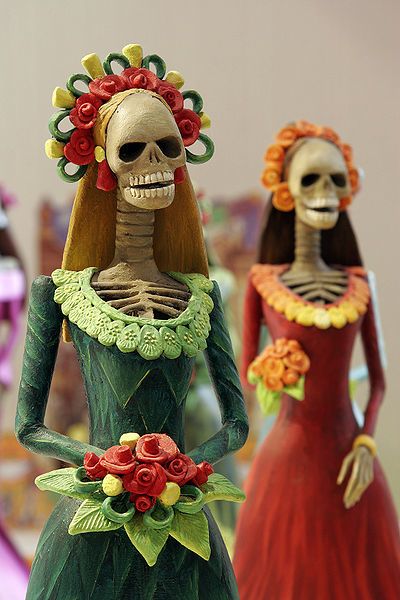
Today is the Day of the Dead, an event marked with celebration in Mexico, which is an idea that pleases me mucho.

The Day of the Dead celebrations in Mexico can be traced back to the indigenous cultures. Rituals celebrating the deaths of ancestors have been observed by these civilizations perhaps for as long as 2,500–3,000 years.

There is something so rational about skeletal characters parading around cities while sugar skulls and bottles of tequila, mezcal and pulque get offered up for their “spiritual essence”, then consumed by those still living.

It makes more sense to me than dressing up as superheroes or princesses and ignoring the whole death thing, as seems to be more the case in the US.

Death being the one thing we should all be positive about as an eventuality, it is amazing how surprised most people are by it, and how stubbornly negative. As the ancients put it:

There’s nothing certain in a man’s life except this: That he must lose it. ~Aeschylus, Agamemnon

No one knows whether death is really the greatest blessing a man can have, but they fear it is the greatest curse, as if they knew well. ~Plato

Death may be the greatest of all human blessings. ~Socrates

Yeah, yeah … all that wisdom does jackshit for bringing any cheer when we someone we love dies. FUCK! There’s not a day I breathe that doesn’t have the fact of my son’s death rattling agonizingly somewhere inside me, and that will not stop. Nor should it.

A man’s dying is more the survivors’ affair than his own. ~Thomas Mann

It’s been 17 months today since Jaren died, and although I do now manage some days in a row without tears, I carry the loss of him wherever I am. As his mother, that’s not only my job, it is my privilege.

He who has gone, so we but cherish his memory, abides with us, more potent, nay, more present than the living man. ~Antoine de Saint-Exupery

Now he has departed from this strange world a little ahead of me. That signifies nothing. For us believing physicists the distinction between past, present, and future is only a stubbornly persistent illusion. ~Albert Einstein

Although I would not choose to picture the dead I love dancing in their bones, there is something very comforting in the fact that some do see the life in that, and having loved a Mexican for a long time I can so fully appreciate the bright colors, the music, the fiesta, the food and family, that can make a party out of death, and wish I’d had some of that growing up.

Instead, as Dia de los Muertos comes around this year, what I get is dreams … and that’s okay, too. I see my son in what I consider visits, not all pleasant, but I’ll take what I can get. Some are disturbing, but what’s more disturbing than having a dead child? I can take it.

In something that could almost seem like weird symmetry, my mom’s husband died yesterday. He was not a man I was close to in any way, but she was, and her loss is tremendous. He was 80 and sick and probably more than a bit tired of being 80 and sick, so I have to assume this turn of events in easier on him than it is on her.

A dying man needs to die, as a sleepy man needs to sleep, and there comes a time when it is wrong, as well as useless, to resist. ~Stewart Alsop

I’m spouting what I can of words of comfort and hoping it takes only a small toll on her health and well being … she being neither young nor spectacularly healthy, herself … but I know only too well, as does she, having lost her father when she was only 12, that dealing with death is a game of solitaire.

For the moment, I can give her only this:

People do not die for us immediately, but remain bathed in a sort of aura of life which bears no relation to true immortality but through which they continue to occupy our thoughts in the same way as when they were alive. It is as though they were traveling abroad. ~Marcel Proust

So, while in Mexico skeletons cavort carelessly … and how else would a skeleton cavort? … in celebration of death, the living cope as they can, not only with their dead, with with the idea of their death.

Because I could not stop for Death,
He kindly stopped for me.
The Carriage held but just ourselves
And Immortality
~Emily Dickinson

Feliz el Die de los Muertos, todo. Feliz …Celebre, mi amor!

Read Full Post »

Not bad for an old broad ...

We turn not older with years, but newer every day. ~ Emily Dickinson

Some time back while perusing facebook, I came across a status update from a friend whose grandfather had just celebrated his 90-something birthday. In the comments it was asked if he’d spoken of any regrets he might carry from his many years of life. The answer went something like this:

The one thing I regret most is having felt old in my 50s and 60s. I wasted those decades because I had convinced myself that I was too old to enjoy them in many of the ways I well could have.

Of course!

To someone close to hitting 100, 50 is a kid only half way through, and with 50 more years on offer.

Although there is little to no chance I’ll ever get anywhere near 100, I’ve incorporated this man’s thinking and keep the words of Mark Twain handy:

Age is an issue of mind over matter. If you don’t mind, it doesn’t matter.

And the fact is, I don’t mind. I don’t mind my age … I’m really crap with numbers, and like Erma Bombeck, “As a graduate of the Zsa Zsa Gabor School of Creative mathematics, I honestly do not know how old I am”, and in dog years, I’m dead …. and I don’t mind the ages of the people in my life. I don’t mind that my youngest child is 5 and that my oldest is 41 or that my last boyfriend is 39 or that some of my friends are in their 70s and others are in their 20s. I don’t mind that my mother is close to 80 … although I wish she was more comfortable.

I do mind that my son died at 38, my father at 69 and the boy I could have grown old with at 19.

As that prolific sage, Anon, once said:

Do not regret growing older. It is a privilege denied to many.

No. I don’t regret my years. In fact, there are few minutes that ring the regret bell for me.

I do, however, fear senectitude … not the numbers, but the toll … much more than I fear death, although both come in the natural order of things.

It is old age, rather than death, that is to be contrasted with life. Old age is life’s parody, whereas death transforms life into a destiny: in a way it preserves it by giving it the absolute dimension. Death does away with time.
~ Simone de Beauvoir

But I’m not there yet … neither destination … and although I’m faced daily with the evidence of my own personal senescence, I can still ignore much of it, so I do. I wear what I damned well please, parent little kids, dance with whomever I like, talk too much, sing loud, add tattoos to my collection, do tequila shots, take my top off at the beach … whateverthefuck I want to do, I do.

There is no pleasure worth forgoing just for an extra three years in the geriatric ward. ~ John Mortimer

No shit.

Given that I’m single again, I have been giving some thought to just how many years of cute I have left in me, so was encouraged by an article in the news today that showed Jane Fonda, 72, and Raquel Welsh, 70, looking and obviously feeling good.

Despite their combined age of 142, Jane Fonda and Raquel Welch were still turning heads as they appeared together at a charity event in Beverly Hills.

Okay … it sucks that men get away with this all the time without anyone making a big deal of their age (Did anyone ever think Cary Grant at 70 or Gregory Peck at 84 looked anything but hot?), but this is Planet Earth in 2010, so I live with it.

I know people decades younger who are too old for me … lackluster, boring twits with little imagination and no curiosity, wastes of space and youth … and that’s depressing as hell. Thoreau was too right when he said, “None are so old as those who have outlived enthusiasm.”

Anyone who stops learning is old, whether at twenty or eighty. ~ Henry Ford

I know that timing has been lucky for me. I’m a Boomer and people have been talkin’ ’bout my generation for decades. I’m aging along with the likes of Keith Richards, although he has years on me, as he wades back through his foggy past and reminds us all what a fuckin’ good time we’ve had … and how much fun we’re still having.

And because my generation has buying power, marketing is finally setting out to make us feel pretty … after all, we’re neither blind, nor stupid, so do know that what hugs a 20-year-old ass won’t ride quite the same on one that’s been ridden longer … and models in their 40s, 50s and 60s are making the point of beauty beyond presumed boundaries well.

‘It’s been really fulfilling to create shots that celebrate the wonder of getting older.
‘It’s important to challenge what we see in our media with a broader reflection of beauty.
‘Enjoy the magic of these women, their confidence, their attitudes and their allure.
‘These wonderful faces express the joy of getting older – not something we see enough of.’

Would I turn back the clock if I could? Nah, although I’m not opposed to a bit of the old nip and tuck to make it look like the calendar missed a few pages and may go that route someday. I see nothing wrong with someone opting for a trade-in on a new set of tits or less eye baggage. I, like Oscar Wilde, do have limits, however:

To get back my youth I would do anything in the world, except take exercise, get up early, or be respectable.

As Brigette Bardot so aptly put it: It’s sad to grow old, but nice to ripen.

Yes … I’m ripening, and I’m okay with that. What was once firm isn’t so much now, my hair has less brown in it daily and I don’t shake off a hangover with anywhere near the ease I did a few years ago, but I’m still here and I’m still cute and I’m smarter than I used to be. And I have a good bloody time.

Unless I’m lucky enough to have death sneak up and bite me on the ass, the day will come, however, when I’ll wake up one morning and know I’m old. I’m hoping it will be a false alarm:

There is always some specific moment when we realize our youth is gone; but years after, we know it was much later. ~Mignon McLaughlin

Call me delusional, but I’ve not yet experienced that “specific moment” and I plan on putting that off as long as I can. After all …

How old would you be if you didn’t know how old you were?
~Satchel Paige

Read Full Post »

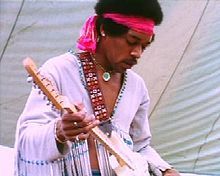
“I used to live in a room full of mirrors; all I could see was me. I take my spirit and I crash my mirrors, now the whole world is here for me to see.” ~ Jimi Hendrix

One of the great things about not being young is having a raft of experience that has pitched up in some interesting places during momentous occasions, so when a day like today comes along I don’t have only vague notions of pop culture-fed imaginings, but personal recollections that pull me along and surround me in a sea of memories I can touch, smell and taste.

I can cast my mind back to the day before today 40 years ago … September 17, 1970 … and conjure that world of long, flowing locks on everyone, Indian bedspread material curtains on widows of VW vans, the fragrance of brown rice bubbling with patchouli and weed undertones wafting just about everywhere, the tingly-tongue-taste about to bloom to bare feet from a dot of blotter.

Was there ever another such time? Has history ever gifted such a hopeful youth, one so committed and convinced it perched on the edge of greatness and could easily force feed a future on hope, dreams and hallelujah hallucinations of humanity humbled?

There was a war happening and we shook off our parents’ orchestrated baaing and sang back into their faces that we should all give peace a chance instead of playing dominos and watching our friends and brothers fall in organized lines … confident in the fact that if you want to end war and stuff, you gotta sing loud.

Much of mass media was kept well beyond our reach, but we had our music, and it took over the world. Any song had anthem potential and could become a rallying point, and those who made the music became heros … but everyday heros. The stars of those times inhabited the world we lived in, not some distant, exotic celestial body. They created music for the world, not at it, dissecting and reflecting common experience. (Even the most obscure themes were easily grasped when minds eagerly altered to span distance, ethnicity, exposure and any other differences that weren’t.)

Yes, it was a sanguine saga, a buoyant, confident and expectant generation, but by definition youth lacks experience and growing up had to happen.

Some of that growing up started today 40 years ago … September 18, 1970 … hence this post, today being the anniversary of the death of one of the best guitarist to ever pluck a string, Jimi Hendrix.

Sixteen days later, the world lost Janis. Nine months after that it was Morrison.

We had been accustom to death by war, by accident, by disease, but we’d rather missed the specter of death by life … by excess of passion, by a profligacy of youth, by presumption that power manifested assured immortality.

Or did we?

We grew up … for sure … grasped impermanence and assimilated the assumption of disillusionment into our core just like every generation before us. We’ve shifted gears and goals, darkened the rose tint on our shades, and some have developed a conservative shell to fend off what they once may have embraced.

But … and this is huge …

the music lives, and will outlive us.

Read Full Post »

« Newer Posts - Older Posts »