Feeds:
Posts
Comments

Archive for the ‘News’ Category

Let us not look back in anger, nor forward in fear, but around in awareness. ~James Thurber

Not that I have a lot of it spare, but I have been thinking about time quite a bit lately — the non-existance of, the travel through, the wastes of.

You reading me often and in various places must have noticed I have a monkey mind … and I’m not talking evolutionary remnants of a brow ridge but the aptly descriptive Buddhist term for one whose brain is: unsettled; restless; capricious; whimsical; fanciful; inconstant; confused; indecisive; uncontrollable. Yeah … that would be what happens under my hair most of the time, illuminated here in an article listing six steps to living in the moment.

“We’re living in a world that contributes in a major way to mental fragmentation, disintegration, distraction, decoherence,” says Buddhist scholar B. Alan Wallace. We’re always doing something, and we allow little time to practice stillness and calm.

When we’re at work, we fantasize about being on vacation; on vacation, we worry about the work piling up on our desks. We dwell on intrusive memories of the past or fret about what may or may not happen in the future. We don’t appreciate the living present because our “monkey minds,” as Buddhists call them, vault from thought to thought like monkeys swinging from tree to tree.

I’m a worrier by nature, a ponderer by profession and with a conscience that rarely has me leaving things to rest, all which have me agitating and ruminating when I should just be experiencing.

Today’s Huff Post puts me in this moment, however, so I pause to consider the ideas in an article called: How Often Are We on Mental Autopilot? You Might Be Surprised.

Although I’m not surprised a study suggests people spend 46.9% of their brain time doing a wander, nor that most don’t consider it a particularly happy path, there is some interesting science in the report.

They discovered that people have two distinct ways of interacting with the world, using two different sets of networks. One network for experiencing your experience involves what is called the “study by Kirk Brown found that people high on a mindfulness scale were more aware of their unconscious processes. Additionally these people had more cognitive control, and a greater ability to shape what they do and what they say, than people lower on the mindfulness scale. If you’re on the jetty in the breeze and you’re someone with a good level or mindfulness, you are more likely to notice that you’re missing a lovely day worrying about tonight’s dinner, and focus your attention onto the warm sun instead. When you make this change in your attention, you change the functioning of your brain, and this can have a long-term impact on how your brain works too.

Living where I do and working from my veranda, I have developed the habit of pulling myself out of my work or my ass or wherever my head might be at any given moment at intervals throughout the day to take some time to gaze upon and appreciate the beauty on offer. Right now, it’s a sapphire sea, the viridescent forest and a few puffy, white clouds navigating their way westward that fill my soul right along with my eyes. Throw in a couple of long-tailed tropic birds and the fruit bats in my jack fruit tree and I’m breathing again in that way I forget to breathe when my mind is full of whatever I’m writing, my heart is heavy with longing for what is no more and my nerves fray with concern over the illusive ‘what’s next’.

Inspired by beautiful music, I once wrote for the description of the video that went along with it:

“For me, one of the most precious gifts the universe gives is the Now, and the Now embraced is the Eternal Hug … a gift without conditions of past or future, but only the joy of the moment. And what is life but a series of moments?

The moments bringing those words are now in my past, but I can and do continue to conjure their joys.

It’s remembering to do it that’s the key:

“Mindfulness is a habit, it’s something the more one does, the more likely one is to be in that mode with less and less effort… it’s a skill that can be learned. It’s accessing something we already have. Mindfulness isn’t difficult. What’s difficult is to remember to be mindful.” I love this last statement. Mindfulness isn’t difficult: the hard part is remembering to do it.

Having studied the work of Abraham Maslow way back when, I trust his assessment of moments.

The ability to be in the present moment is a major component of mental wellness.

But life does do its bit to beat that out of a girl, doesn’t it?

I’m not one for wallowing in regrets, and it’s too often the future that robs me of moments; not the desire of it, but the anxiety over having some asteroid of shit fall from this clear blue sky and splatter on my life. It’s an ancestor who provides perspective and a bit of solace on this concern:

The best thing about the future is that it comes only one day at a time. ~Abraham Lincoln

True enough, thankfully, and one day leads to another.

Yep. This moment is now the past and the next is still the future and each letter I type becomes a sentence and sentence is a pretty good description of life.

As for quantum physics and that business about the past, like the future, being indefinite and existing only as a spectrum of possibilities … well, I rather like a poet’s version today:

Forever is composed of nows.
~Emily Dickinson”

Read Full Post »

Before anyone weighs in with comments about how what follows is based on faulty logic, I’ll start the post off with a full disclosure: it makes no sense at all, has ’bout nothing based in science or fact or undisputed info and I don’t even end up agreeing with myself completely.

Okay?

This is simply a morning diversion, since, after all, I love to go a pondering along strangely convoluted tracks before I settle my brain down before the anvil and commence pounding away.

Today’s journey began at this article on sugar addiction.

One study out of France, presented at the 2007 annual meeting of the Society for Neuroscience, showed that when rats (who metabolize sugar much like we do) were given the choice between water sweetened with saccharin and intravenous cocaine, 94 percent chose the saccharin water. When the water was sweetened with sucrose (sugar), the same preference was observed — the rats overwhelmingly chose the sugar water. When the rats were offered larger doses of cocaine, it did not alter their preference for the saccharin or sugar water. Even rats addicted to cocaine, switched to sweetened water when given the choice. In other words, intense sweetness was more rewarding to the brain than cocaine.

But this isn’t about sugar, or cocaine and addresses addictions only peripherally. No, it’s about one of the big questions in life:

Why are all the good things so bad for us? And if they are so bad for us, why are they so good?

(Well … that and some other stuff …)

Those are two different questions, and it’s actually the second that interests me this morning since health professionals have no trouble reeling off reasons sugar, fat, alcohol, tobacco, drugs, casual sex and narcissistic men are bad, and we’ve heard them all; include them in your life at your inevitable peril.

My wander is more about why we’re so deeply attracted to shit we know will kill us, and in my wander I wonder if there’s a reason as primal as our ancestral genetic mandate to collect calories when we can.

Back in the early days of humans, life was a short prospect. Breeding started at puberty when hormone secretions kicked off the process that made sex desirable and babies possible, and anyone managing to live past thirty was considered either a burden or a deity. Feeding the clan took more effort than a stroll to the fridge and people were considered snacks-on-the-hoof by some of the neighbors. Yes, we lived fast, died young and … well … pretty is as pretty does.

Some of that fast living included a predilection for a tipple and a partiality for getting high, so there’s nothing new about our fondness for altered states.

Of course, the ancients didn’t know they were playing with their health.

We do.

We’ve made a slew of changes in the way we spend our time on the planet … we moved out of caves, traded our pelts for Prada and prefer Merlot over mead … so many so that our ability to conceptualize the way our ancestors lived has been greatly influenced by Fred and Wilma. These changes have resulted in extending our lives many decades beyond what would have been even remotely conceivable, but to date we have yet to unload the baggage that is a hankering for some stuff our species has been craving since Day One.

Again with the Why?

I’m guessing here one reason may just be that somewhere under our modern veneer, a place deep in our most primal of being, we actually understand that we will someday be dead.

Yeah, yeah … I know that’s a stretch. After all, we’re constantly getting messages about how if we reduce this and give up that and forego the fun of whatever we can cut the death rate (Funny how often that pops up.), giving some the impression that living forever is an option if rules are assiduously followed and enough sacrifices are made.

Okay … much is actually focused –in intent, if not in words — on dying younger than the average death or on being healthier in old age. Fine. I get that. But until there’s a way to stop the cycle — you’re born, you live, you die — there are only two options available; you die, or you get old.

Back in 1960, Maurice Chevalier summed up his ideas on the options when he said: Old age isn’t so bad when you consider the alternative.

Allow me to point out that Monsieur may now have a better base of comparison.

Actually, there are three options, the third being you live as best you can, and John Mortimer nails that point to the wall:

There is no pleasure worth forgoing just for an extra three years in the geriatric ward.

Could it be that we carry remnants of our Paleolithic selves — those beings we once were who knew for fact that life is short and then you die — that prompt us to go for the gusto?

An aside:

At this moment I have three friends engaged in fights against cancers of various types. All are significantly younger than I am (two in their 30s), none ever smoked, all followed reasonable dietary plans, drank in moderation and did not partake in illegal substances.

Back in the 80s I worked with a group of people who, although bound by certain interests, varied widely in lifestyle. My dear friend Robbie and I were the oldest of the bunch and by far the most debauched. Two of those people, perhaps the cleanest livers amongst us then, have now been dead for a number of years. Robbie and I are still kicking … and debauching.

I’m not afraid of death. It’s the stake one puts up in order to play the game of life. ~Jean Giraudoux, Amphitryon, 1929

Toss those dice … and while you’re up, can you pour me another glass of the white, please?

Read Full Post »

I am blessed/cursed with a prodigious memory in both the modern and archaic senses of the adjective. My head is stuffed with stuff … including my grandmother’s recipe for stuffing even though I so rarely cook … and although this provides a deep well when looking for a bucketful of references to, say, common experiences with toothpastes, do I really need to carry around, “Crest has been proved to be an effective decay preventive dentifrice that can be of significant value when used in a conscientiously applied program of oral hygiene and regular professional care … ” and a 40-year-old jingle from Ipana commercials, both of which I can conjure in an instant at any given time? (And just did … sigh … )

This is why I almost didn’t bother looking at this article, titled, “A Novel Way to Improve Memory”. After all, why the hell would I want to get any better at stacking more useless crap between my ears?

But I did … read it, that is … and although finding it peripherally interesting, it doesn’t fit.

The most amazing thing about memory is how precisely we forget. Our brain retains only what it predicts will be important in the future and forgets the rest. There is no point in remembering where you parked your car at Wal-Mart last February — unless it was stolen. That would be unforgettable. Scientists have long known how the brain predicts which experiences to retain in long-term memory and which ones to let fade away. But now they have made a new discovery: why we often remember useless stuff.

The first rule of learning is repetition. Repeating something over and over, as you did to learn your multiplication tables, moves memory from temporary short-term storage into permanent long-term memory. This is because the brain views something that is encountered repeatedly as more likely to be important to the person (or animal) in the future.

The second way events get seared permanently into memory is if they are associated with extremely strong emotional reactions, as would happen if, upon emerging from Wal-Mart with your shopping goodies, you were to find your car gone. This is because, in evolutionary terms, an organism shouldn’t risk repeating a stressful, potentially life-threatening experience to remember it.

Okay … so why do I still not have access to the multiplication tables, but know the name of the dog that played the dog on Topper? The first were repeated ad nauseam year after year in my childhood while the second may have have been noticed a couple of times as the credits rolled at the end of a TV show that went off the air when I was about 7.

Did my brain reject 14×7 as not important to this person’s future. Was I more traumatized by the ghosts of George and Marian Kirby that I realized?

In the last 15 years, neuroscientists have determined the cellular and molecular mechanisms for how these two kinds of experiences are moved from short-term memory into long-term memory. But memory researcher Richard Morris of the University of Edinburgh noticed something about memory that is not explained by these well-accepted rules and molecular mechanisms of memory. Our minds are filled with scraps of completely irrelevant information. This includes snippets of experiences that were neither repeated nor associated with a traumatic event. Indeed, they are useless and would be better forgotten, but they persist nevertheless. How these remnants of trivial memories are retained cannot be explained by the detailed molecular mechanisms that have been carefully worked out in studies of memory in laboratory animals.

Well … no shit, and isn’t that not helpful.

According to the article, a third pot of memory glue has more recently been illuminated:

The answer is found in another factor that helps the brain predict whether or not an experience should be saved in long-term memory: novelty. When our daily routine is suddenly disrupted by an experience that is truly novel, the mind “perks up.” It makes good sense to activate the long-term memory mechanism in this case, because a new experience is likely to provide important new information that will be useful to an individual in the future, and so the experience should be added to the long-term memory store. In the brain, novelty is signaled by neurons that use the neurotransmitter dopamine. Dopamine circuits do not code sensory perceptions; instead they rev up the level of activity broadly across neural networks in the brain.

Hm. So, Bucky Beaver and the Buck (the dog who played Neil) kicked off dopamine production in my head? I doubt it, no matter how impressed rats have been in experiments on memory.

The rats, of course, are remembering where to find food, not the lyrics from the opening sequence of Mr. Ed, so do nothing to, ” … explain how “useless” scraps of information in your mind might have gotten stuck there.”

They could have been surrounded by some truly novel experience that had nothing at all to do with the memory.

Like what? What could possibly have been the truly novel experience in late-50s suburbia that leaves me with full access to the name of every dog on our block and the inability to see Nestlés Quick without thinking of Farfel?

So, I have a head full of useless crap that gives the occasional advantage when trivial knowledge is tested … I was kick-ass at Jeopardy back in the days I had access to such programming … makes me hell to argue with, being able to replay exact conversations without having taken notes, allows me to sing along with every song by the Beatles and lets me identify Paladin’s holster in less than two seconds. I remember my very first telephone number … YEllowstone 50147 … could draw (if I could draw) the dashboard of a 1955 Ford and conjure the smell of the old lady’s house next door to where I lived for about two months at the age of 10. Whoopie.

And, apparently, science has yet to give me one good reason for any of this.

On the up-side, these new studies on memory are providing a prompt for educators to look differently at how children learn:

While the ancient methods of repetition and punishment to drum information into a school kid’s mind can be effective, so too should breaking up the doldrums of a lesson with a fascinating new experience that is completely unrelated to the lesson.

A point taken further in the vid here explaining how a shift in the paradigm is a bloody good idea …

Read Full Post »

Today’s topic is biocentrism … and, yes, I’m out of my fucking mind even beginning to go there on a Saturday morning in November, especially after an evening involving wine … and starts with its seven principles:

1. What we perceive as reality is a process that involves our consciousness. An “external” reality, if it existed, would by definition have to exist in space. But this is meaningless, because space and time are not absolute realities but rather tools of the human and animal mind.

2. Our external and internal perceptions are inextricably intertwined. They are different sides of the same coin and cannot be divorced from one another.

3. The behavior of subatomic particles, indeed all particles and objects, is inextricably linked to the presence of an observer. Without the presence of a conscious observer, they at best exist in an undetermined state of probability waves.

4. Without consciousness, “matter” dwells in an undetermined state of probability. Any universe that could have preceded consciousness only existed in a probability state.

5. The structure of the universe is explainable only through biocentrism. The universe is fine-tuned for life, which makes perfect sense as life creates the universe, not the other way around. The “universe” is simply the complete spatio-temporal logic of the self.

6. Time does not have a real existence outside of animal-sense perception. It is the process by which we perceive changes in the universe.

7. Space, like time, is not an object or a thing. Space is another form of our animal understanding and does not have an independent reality. We carry space and time around with us like turtles with shells. Thus, there is no absolute self-existing matrix in which physical events occur independent of life.

Got that? No … me neither.

I’ve been giving this thought since learning about that whole particles need observers to do much thing, chicken/egg/cart/horse thinking that shakes my brain like a rattle in the hand of Insane Demon Baby.

It’s this article in the Huff post that handed the noise toy to the toddler-from-hell-living-in-my-head this morning, luring me in by speaking directly to me in the opening sentence:

Why do you happen to be alive on this lush little planet with its warm sun and coconut trees?

Why, indeed.

Although the bit about the coconut trees is nothing but overkill, the Why are you here? question is one I ask often, although usually framed differently: What the fuck do you think you’re doing? … How the fuck did you end up here? … Now what?

Although those questions-posed-to-self are often self-focused, I do ponder the point of me in the greater sense … What is the point of me and him and her and them and those thingies over there? … and the article puts the little in little ole me:

How did inert, random bits of carbon ever morph into that Japanese guy who always wins the hot-dog-eating contest?

In short, attempts to explain the nature of the universe, its origins, and what’s really going on require an understanding of how the observer, our presence, plays a role. According to the current paradigm, the universe, and the laws of nature themselves, just popped out of nothingness. The story goes something like this: From the Big Bang until the present time, we’ve been incredibly lucky. This good fortune started from the moment of creation; if the Big Bang had been one-part-in-a-million more powerful, the cosmos would have rushed out too fast for the galaxies and stars to have developed. If the gravitational force were decreased by a hair, stars (including the Sun) wouldn’t have ignited. There are over 200 physical parameters like this that could have any value but happen to be exactly right for us to be here. Tweak any of them and you never existed.

Okay, so I’m a statistical probability as remote as my coconut tree sprouting legs and jogging on the beach … and so are you, neener neener neener.

Or not.

Indeed, according to biocentrism, it’s us, the observer, who create space and time (which is the reason you’re here now). Consider everything you see around you right now. Language and custom say it all lies outside us in the external world. Yet you can’t see anything through the vault of bone that surrounds your brain. Your eyes aren’t just portals to the world. In fact, everything you experience, including your body, is part of an active process occurring in your mind. Space and time are simply the mind’s tools for putting it all together.

So, we are all legends in our own mind?

Cogito ergo sum, folks.

In ethics, biocentrism puts us in our place:

Biocentrism states that nature does not exist simply to be used or consumed by humans, but that humans are simply one species amongst many, and that because we are part of an ecosystem, any actions which negatively affect the living systems of which we are a part, adversely affect us as well, whether or not we maintain a biocentric worldview. Biocentrists believe that all species have inherent value, and that humans are not “superior” in a moral or ethical sense.

There is no doubt my dog’s version of me varies greatly from mine, as does mine from hers, and since both she and I exist on the same plane … or veranda, as is the case at the moment … each reality is as valid as the other.

I find the notion of biocentrism in both cosmology and ethics more than interesting, but it falls short for me, lacking just a bit of the imagination it would take to move it just a smidgen beyond the biology that gives the theory its name.

It’s consciousness that seems the point, the indefinable, unmeasurable dimension of consciousness, and it’s biology that limits our capacity to fully grasp what must be accessible when the biojar that contains consciousness is eventually jettisoned.

As Einstein put it:

“A human being is part of a whole, called by us the Universe, a part limited in time and space. He experiences himself, his thoughts and feelings, as something separated from the rest a kind of optical delusion of his consciousness. This delusion is a kind of prison for us, restricting us to our personal desires and to affection for a few persons nearest us. Our task must be to free ourselves from this prison by widening our circles of compassion to embrace all living creatures and the whole of nature in its beauty.”

Although there are plenty of peeps whose consciousness is suspect … yeah, they watch Fox News … it’s still the elephant in every room — the invisible, densely-packed-empty-vacuum, infinitely there-and-not-there-always-never powering the deus ex machina life inserts to cause all to lose the plot, yet save the day after day after day.

In the case of that ‘particles need observers’ deal, it’s not the fact that eyeballs are aimed in the general direction, it’s that consciousness is, and as Ray Charles proved beyond doubt, functioning eyes are no requirement for soul.

Much like a tortoise is not the shell, yet defined by it … since without a carapace it’s either dead or not a tortoise … we are not our biology. It does define us and, like the tortoise, it also CONfines us.

Einstein again:

“My feeling is religious insofar as I am imbued with the consciousness of the insufficiency of the human mind to understand more deeply the harmony of the Universe which we try to formulate as “laws of nature”.

It’s the limiting nature … biology … of the human mind that makes so illusive the far reaches of consciousness, not the other way round, and it’s the consciousness that makes everything else, including the biology. It follows, then, that we are more than our physical form. We’re like tequila … whether it be rotgut or nectar de dioses … most of our potential is wasted while in the bottle.

Read Full Post »

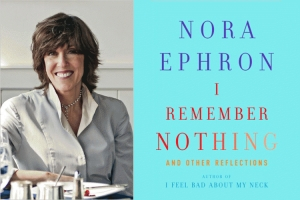
Nora Ephron has a new book out, I Remember Nothing: And Other Reflections, and you can bet I’m ordering it.

In addition to the family connection … she and my brother have done a thing a couple of times … and starting long before that was made, the woman’s work has spoken to me … for me? … whatever … and very obviously, from what I’ve read so far, continues to do exactly that in this most recent work:

One good thing I’d like to say about divorce is that it sometimes makes it possible for you to be a much bet­ter wife to your next husband because you have a place for your anger; it’s not directed at the person you’re currently with.

Another good thing about divorce is that it makes clear something that marriage obscures, which is that you’re on your own. There’s no power struggle over which of you is going to get up in the middle of the night; you are.

But I can’t think of anything good about divorce as far as the children are concerned. You can’t kid yourself about that, although many people do. They say things like, “It’s better for children not to grow up with their parents in an unhappy marriage.” But unless the par­ents are beating each other up, or abusing the children, kids are better off if their parents are together. Chil­dren are much too young to shuttle between houses. They’re too young to handle the idea that the two peo­ple they love most in the world don’t love each other anymore, if they ever did. They’re too young to under­stand that all the wishful thinking in the world won’t bring their parents back together. And the newfangled rigmarole of joint custody doesn’t do anything to ease the cold reality: in order to see one parent, the divorced child must walk out on the other.

Yep.

Nora first spoke to me with Heartburn, hands down the BEST getback any betrayed wife has ever pulled, made even more appropriately brutal when it was made into a film. It lobbed key lime pie directly at the crotch of ex-husband Carl Bernstein, one half of the team that uncovered the Watergate scandal and wrote a book about it, and made it bloody hard for the man to get a date for a very long time.

It is said that revenge is a dish best served up cold, but Nora’s Heartburn warmed the cockles of damaged heart in very healing ways. I laughed … oh! how I laughed … as she got up the thumb-like nose of the bitch who’d aimed her sites on the married man and let the world know just what a prize he wasn’t, no matter the idolatry he fostered widely, and if I was the sort of woman who cooked, I’m sure I would have made good use of the recipes included in the story.

And speaking of stories … here’s a true one:

Once upon a time, I was in New York City on a night out with friends. We’d eaten well in a fabulous penthouse apartment, then danced to Brazilian music at a fabulous club … New York is all about ‘fabulous’ you see. Deciding eventually it was time for some great coffee and rich desserts, we headed for the West Side and the restaurant of another friend on Columbus Circle where we took up residence at one of the larger tables, cramming in chairs from left and right and setting up a right ruckus as we did what New Yorkers do at 3 am — discussing everything under the sun, arguing points and enjoying being one-upped by people whose knowledge is deeper.

Coffee doing what it does, a ladies trip to the ladys’ took up a good 20 minutes, what with all queueing and makeup touchups such ventures into basement toilets require when 9 girls all have to go at the same time and the geography of hip spots in Manhattan puts the bathroom down two floors.

Reentry created the desired effect, and most of the seats we’d vacated were relinquished to us previous tenants, but there were some new faces at the table.

One was a pleasant-looking gentleman seated to my left in the middle of an explanation to my friend sitting across from us on the ins and outs of dealing effectively with photographers from Architectural Digest invading a flat, his just having been featured, apparently.

Interesting enough a discussion, I suppose, but not one that grabbed my attention until some mention was made of the fact that he worked for the Washington Post.

At the time, I had a good friend working in the newsroom at the Post and the thought crossed my mind that perhaps this guy could fill me in a bit on how my buddy was fairing, so at a break in the conversation I asked, innocently enough: I’m sorry, but do you work for the Washington Post?

My friend on the other side of the table went apoplectic, perhaps embarrassed by what was apparently a blatant show of un-hipness causing my out-of-towner faux pas, and with barely an eye-blink passing … no time at all for the dude to respond to my question … she said:

Sandra … this is Carl Bernstein!

Light speed fast, the connections were made in my head: Woodward/Bernstein, Watergate, Washington Post, All the President’s Men … he’s shorter than I would have thought …

Yes. All that.

Now, it often happens that my mouth moves before my brain fully engages, and — blame it on the wine, the coffee, the hour, if you like — this was the case that night.

The very first thing I blurted out to this man who had just been impressing the shit out of the table with tales of fame and fortune and his apartment on the East Side was:

REALLY??? How cool. I LOVED your wife’s book!

Read Full Post »

Sagrada Familia. Does this look finished?

Another Sunday presents with Pope poop … how kind of the old git to continue to religiously supply me with fodder.

Today, he’s in Spain on one of his most blatant panderings yet, a mass at the Sagrada Familia, a church that’s been under construction for 128 years and won’t be completed until 2026.

The Sagrada Familia was designed by Antoni Gaudí (1852–1926), who worked on the project from 1883 and devoted the last fifteen years of his life entirely to the endeavour. In 1882, prior to Gaudí’s involvement, Francesc del Villar was commissioned to design a church on the site. He resigned a year later and Gaudí was appointed the project architect, redesigning the project entirely. The project is scheduled to be completed in 2026. On the subject of the extremely long construction period, Gaudí is said to have remarked, “My client is not in a hurry.”

Apparently, that’s no longer the case. Me thinks Old Ben has an agenda.

Only 14.4% of Spaniards regularly attend mass, and legal changes to allow divorce, gay marriage and abortion have caused concern to the Church.

Yeah … that might be it.

Plus, since the church doesn’t give a peseta toward the construction, the fundraising ops are good, too.

Jordi Bonet Armengol, the current chief architect, said he hoped the Pope’s visit would provide the boost needed to finish the construction, which is funded by private donations and visitors’ fees.

“He will bring a message of spirituality and it’s a stimulus to finish the work,” he told the Reuters news agency.

And, of course, being a church and all, Catholic at that, is has to be about the money … none of which dribbles from the bursting coffers in Rome.

Visitors can go into the Nave, Crypt, Museum, Shop and up the Passion and Nativity towers. An entry fee of €12 for adults, €10 for students, and €8 for children (prices as of July 2010) is payable for the Nave, Crypt, Museum, and Shop. Access to the towers (Nativity Façade and Passion Façade) is now only possible by lift (€2.50) and then walking up the remainder of the tower, over the bridge between the towers and descent via the opposite tower by spiral staircase. Previously, visitors were able to walk up the towers for free. As of August 2010, there will be a new service of fast entering. Visitors can buy their tickets at any Servicaixa ATM (part of ‘La Caixa’) or on the internet at servicaixa.com. They will get a code with which they can enter the Temple via a fast line. The service has a fee of €1.30 extra.

Construction on Sagrada Família is not supported by any government or official church sources. Private patrons funded the initial stages.Money from tickets purchased by tourists is now used to pay for the work, and private donations are accepted through the Friends of the Temple.

I’m not saying it’s not worth the price of admission … it most certainly is. The building is impressive, a melting toffee of religious iconicity that, along with other Gaudi structures, defines Barcelona.

And speaking of money, unlike the popester’s trip to the UK in September that raised a fuss amongst taxpayers there, there’s no talk now on what the Spaniards will be shelling out for this show. You can bet it won’t be a light touch, though, as the old man does not travel on a shoestring.

You think the guy would be grateful for all the free shit he’ll be enjoying in Spain, but with all his usual grace he instead chooses to walk in swingin’ …

In Santiago de Compostela on Saturday, he warned of an “aggressive anti-clericalism” in Spain which was akin to that experienced during the 1930s.

The comments were a reference to the civil war era, during which Republicans killed thousands of priests and nuns, and burned churches.

Whoa … hold the fucking phone! Does he really have the nerve to bring THAT up?

A little history, Mate. Do the name Franco ring a bell? How ’bout more than two million dead?

After the army revolted against the Republican government of Spain in 1936, Franco quickly rose to be the leader of the insurrection, which was supported by the Catholic Church. Franco’s propaganda presented him as a modern Catholic Crusader: “The analogy was given the sanction of the Church on 30 September by the long pastoral letter, entitled ‘The Two Cities’, issued by the Bishop of Salamanca Dr Enrique Pli y Deniel. The Church had long since come out in favour of the military rebels but not hitherto as explicitly as Pli y Deniel. His pastoral built on the blessing given by Plus XI to exiled Spaniards at Castelgandolfo on 14 September in which the Pope had distinguished between the Christian heroism of the Nationalists and the savage barbarism of the Republic. Pli y Deniel’s text quoted St Augustine to distinguish between the earthly city (the Republican zone) where hatred, anarchy and Communism prevailed, and the celestial city (the Nationalist zone) where the love of God, heroism and martyrdom were the rule. For the first time, the word ‘crusade’ was used to describe the Civil War.” The text was submitted to Franco before being published.

Any reason you can see for the Spanish to be a bit peeved?

It wasn’t just the athiest anarchists and socialists that the Catholic Church wanted Franco to slaughter: anyone who even believed in democracy was executed: “Indeed, the Republican will to resist was kept alive only by the fear born of Franco’s much-publicized determination to eradicate liberals, socialists and Communists from Spain.

So, here’s Old Ben, old enough to remember well where the fuck that “aggressive anti-clericalism” started, spouting off his warnings amidst his fundraising. What an asshole.

Not counting soldiers on the Republican side actually killed in the fighting, the probably total of executions carried out by Franco was in the vicinity of 2 million.The Catholic Church not only did not make any effort to stop the slaughter. Priests reported citizens who had not attended mass during or before the Civil War; that in itself was enough to result in execution.

Yes, those numbers may be disputed … the WIKI cites only 500,000 executions with other dead tacked on here and there … but there’s no doubt about the church-sanctioned murder and brutality that was Spain in those years.

Today, however, folks will show up in droves … and, yes, there is a cattle reference there — mooooo … to watch the spectacle of on old man in a dress hold up what he says is a piece of a dead guy’s flesh in an unfinished building to pull in some bucks while attempting to gloss over yet more disgusting behavior and bitching at everybody at the cost of millions.

I’m sorry. I think I just lost the plot …

Read Full Post »

Yes, today it’s about time. It is also about immortality. A weird mix, perhaps … especially in a post starting out with the intro from one of the dumbest shows in TV history … but in actuality is where the rubber meets the road we travel.

Now he has departed from this strange world a little ahead of me. That signifies nothing. For us believing physicists the distinction between past, present, and future is only a stubbornly persistent illusion. ~Albert Einstein

I like it. There’s something William Penn in that, since he did say, “For death is no more than a turning of us over from time to eternity,” and that seems a freeing conversion.

But I’m not dead yet and today is an illusion. Hm. Does that mean I can just go back to sleep? Sure. But if today is an illusion, and so is tomorrow … the past, present and future … it’s probably a better idea to pay attention and see if I can figure at least some of it out. After all, if someone was to saw me in half someday, I wouldn’t sleep through that, even if it was merely deception of the entertaining kind.

Instead of plopping back to the pillow, I’m giving my mind a wander around the wonder of time, a favorite confused meander, prompted by this article in the Huff Post titled: Is Death the End? Experiments Suggest You Create Time.

We watch our loved ones age and die, and we assume that an external entity called time is responsible for the crime. But experiments increasingly cast doubt on the existence of time as we know it. In fact, the reality of time has long been questioned by philosophers and physicists. When we speak of time, we’re usually referring to change.

Philosophers have been taking this on for as long as there have been philosophers, going back to the oh-so-cool-named Zeno, who came up with the Arrow Paradox mentioned in the article.

Zeno states that for motion to occur, an object must change the position which it occupies. He gives an example of an arrow in flight. He states that in any one instant of time, for the arrow to be moving it must either move to where it is, or it must move to where it is not. However, it cannot move to where it is not, because this is a single instant, and it cannot move to where it is because it is already there. In other words, in any instant of time there is no motion occurring, because an instant is a snapshot. Therefore, if it cannot move in a single instant it cannot move in any instant, making any motion impossible.

… this paradox starts by dividing time—and not into segments, but into points.

Wrapped your head around that one? Then take on the the idea that “space and time are forms of animal intuition”, simply “tools of the mind and thus don’t exist as external objects independent of life.”

An experiment published in 1990 suggests that Zeno was right. In this experiment, scientists demonstrated the quantum equivalent of the adage that “a watched pot doesn’t boil.” This behavior, the “quantum Zeno effect,” turns out to be a function of observation. “It seems,”said physicist Peter Coveney, “that the act of looking at an atom prevents it from changing”. Theoretically, if a nuclear bomb were watched intently enough — that is, if you could check its atoms every million trillionth of a second — it wouldn’t explode. Bizarre? The problem lies not in the experiments but in our way of thinking about time. Biocentrism is the only comprehensible way to explain these results, which are only “weird” in the context of the existing paradigm.

We are limited by our biology, peeps, packed into a container that can only perceive space and time in relation to our point in both.

Oh! For Stephen Hawking’s brain, who said, “There is no way to remove the observer — us — from our perceptions of the world … In classical physics, the past is assumed to exist as a definite series of events, but according to quantum physics, the past, like the future, is indefinite and exists only as a spectrum of possibilities.” The guy who finds thinking about paradoxes great fun and probably never gets headaches like the one I’m developing just writing this bloody post.

The whole series, plus another 5-parter, is on YouTube, so if you have the inclination you can fill up on his ideas … since it seems time is not a problem.

Check out the bit in the episode above about the worm holes that are everywhere. Tiny, yes, but I can’t help wondering what that’s all about and what would be different if there weren’t there.

Yes, those tiny, tiny passages through time exist in the quantum world, but is that not our world, too?

But this “two-world” view (that is, the view that there is one set of laws for quantum objects and another for the rest of the universe, including us) has no basis in reason and is being challenged in labs around the world. Last year, researchers published a study in Nature suggesting that quantum behavior extends into the everyday realm. Pairs of ions were coaxed to entangle, and then their properties remained bound together when separated by large distances (“spooky action at a distance,” as Einstein put it) as if there were no time or space. And in 2005, KHCO3 crystals exhibited entanglement ridges half an inch high, demonstrating that quantum behavior could nudge into the ordinary world of human-scale objects.

Do you realize that we all see our own noses all the time? It’s right there in our vision every time we open our eyes, but our brain ignores it. Our noses are big … some more than others … not anything close to microscopic, yet invisible to us unless we consciously focus attention. What in the nanosphere is just as ‘there’ that we’re missing?

Okay. So we know time is not linear, and although it’s trippy to watch someone talking on a cell phone in footage shot in 1928, that’s really not the point. Time travel … backward, forward, sideways … sounds like fun, sure — who wouldn’t want to hear Lincoln deliver the Gettysburg Address or tool around in a flying car or see themselves young and their lost loved ones walking around — but if there is no time, aren’t we doing that already?

Maybe we’re just missing our noses again …

Read Full Post »

The Rangoli of Lights

‘Tis the season to be jolly over a wide range of holidays celebrated by loads of people in various points on the globe and things brighten up considerably after the ghoulish glee of Halloween in the US and Dia de los Muertos in Mexico as the lights go on in India.

Yes, it’s Diwali, दीपावली in Sanskrit, and also known as Deepavali, the Festival of Lights.

The name Diwali is itself a contraction of the word “Deepavali”, which translates into row of lamps. Diwali involves the lighting of small clay lamps (diyas) (or Deep in Sanskrit: दीप) filled with oil to signify the triumph of good over evil. During Diwali, all the celebrants wear new clothes and share sweets and snacks with family members and friends.

I did my bit today by stopping into the Indian-owned shops I frequent with wishes for a Happy Diwali and was treated to big smiles, lovely whiffs of incense and a gander at more-than-usually elaborate alter offerings. The Hindu temple in town will be hoppin’ tonight!

Unlike in the Christian world where only one version of any given holiday is deemed acceptable and all those pagan vestiges like putting trees in houses and hunting for colored eggs are considered mere fluff, those of various beliefs embrace Diwali for a host of different reasons.

Where the Hindus in some regions spend their holiday worshipping Lord Ganesha and mark the marriage of Lakshmi to Vishnu, those in Bengal dedicate the festival to Mother Kali, their goddess of strength.

The Jains use the occasion to celebrate the moment Mahavira attained Nirvana:

Diwali has a very special significance in Jainism, just like Buddha Purnima, the date of Buddha’s Nirvana, is for Buddhists as Easter is for Christians. Lord Mahavira, the last of the Jain Tirthankaras, attained Nirvana or Moksha on this day at Pavapuri on Oct. 15, 527 BC, on Chaturdashi of Kartika, as Tilyapannatti of Yativrashaba from the sixth century states:

Mahavira is responsible for establishing the Dharma followed by Jains even today. According to tradition, the chief disciple of Mahavira, Ganadhara Gautam Swami also attained complete knowledge (Kevalgyana) on this day, thus making Diwali one of the most important Jain festivals.

For the Sikhs, the lights have a glow all their own:

Diwali is a Hindu festival of lights that was appropriated by the Sikhs to celebrate the release from prison of Guru Hargobind, the sixth Guru, from prison in 1619. The Golden Temple was illuminated with lights to welcome the Guru home, and Sikhs continue this tradition by lighting lamps on Diwali each year. The Golden Temple is illuminated with thousands of lights.

There are, of course, roots trailing all the way back to the earth, as all religions to if you follow the path far enough:

Deepavali marks the end of the harvest season in most of India. Farmers give thanks for the bounty of the year gone by, and pray for a good harvest for the year to come. Traditionally this marked the closing of accounts for businesses dependent on the agrarian cycle, and is the last major celebration before winter. Lakshmi symbolizes wealth and prosperity, and her blessings are invoked for a good year ahead.

No matter what the specific focus of worship, there’s a shared perception of Diwali that I find … well … illuminating:

In each legend, myth and story of Deepawali lies the significance of the victory of good over evil; and it is with each Deepawali and the lights that illuminate our homes and hearts, that this simple truth finds new reason and hope. From darkness unto light — the light that empowers us to commit ourselves to good deeds, that which brings us closer to divinity. During Diwali, lights illuminate every corner of India and the scent of incense sticks hangs in the air, mingled with the sounds of fire-crackers, joy, togetherness and hope. Diwali is celebrated around the globe.

So, Happy Diwali to all! No matter what your belief may be, light and good deeds deserve celebrating!

Read Full Post »

Where to start? That’s a tough one this morning because this story in the Huff Post is wonky on so many levels. Of course, it was the headline that drew my attention: Retired Chaplains Come Out Against DADT Repeal, Citing ‘Religious Freedom’.

Sure, I knew pissed off was coming, but I am surprised that I can still be surprised by the complexity of convolutions possible when minds warped by religion put bent thinking to words. I’m in no fit state for eloquent this early on a Saturday in paradise, so you’ll be settling for the annoying sound of sarcasm dripping.

Before wading in, however, let’s start by watching Bill Maher deliver a new rule.

Done? Good.

Moving right along …

Dozens of retired military chaplains say that serving both God and the U.S. armed forces will become impossible for chaplains whose faiths consider homosexuality a sin if the “don’t ask, don’t tell” policy is thrown out.

“The bottom line is religious freedom,” said retired Army Brig. Gen. Douglas Lee, one of 65 former chaplains who signed a letter urging President Barack Obama and Defense Secretary Robert Gates to keep “don’t ask, don’t tell.”

Amazing how the word “freedom” is deemed to have so much oomph when it follows “religious”, ain’t it? It’s ever-so-much more vital that bigotry is allowed to flourish than pushing for any recognition that what consenting adults get up to in the privacy of their own pants in no one’s fucking business, is it?

Of course, we’re not just talking run-of-the-mill clergy here, but those dedicating their careers to serving the military. Hm.

The Southern Baptist Convention, the Roman Catholic Church, the Orthodox Church in America, the Presbyterian Church in America, and the Rabbinical Alliance of America have issued statements or written to the Obama administration this year with their concerns that repealing “don’t ask, don’t tell” could force their chaplains to choose between serving God and serving the military.

Now THERE’S potential for a quandary. Salute, or genuflect? What is the chain of command? Wonder if that’s ever come up before … like … hm … maybe when sending troops out to kill and be killed over some bullshit tale of WMDs?

The Orthodox Church in America, for example, condemns homosexuality and mandates that the appropriate action its ministers should take toward gay people who seek counseling is to steer them to repent and renounce the gay lifestyle.

“If such an attitude were regarded as ‘prejudice’ or the denunciation of homosexuality as ‘hate language,’ or the like, we would be forced to pull out our chaplains from military service,” the church informed the Pentagon in May.

I’m thinkin’ more along the lines of dishonorable discharge, actually … and maybe a lawsuit.

Anyone who can make a living passing the plate and the pap for the armed forces should damned well know how to keep their yaps shut; loose lips do more than sink ships, so GET OVER IT!

Can’t let this bit of hypocrisy by:

The Catholic Church likewise deems homosexual behavior a sin.

“This means that Catholic chaplains must show compassion for persons with a homosexual orientation, but can never condone – even silently – homosexual behavior,” Archbishop Timothy Broglio said in a June letter calling for “don’t ask” to remain in place. Broglio leads the Archdiocese for Military Services and is the church’s chief liaison to the military.

Oh, paaaaallllllleeeeeeeease! Since when, Archie? Your unit has been silently condoning, dodging and covering for priests jumping into any old fox hole for a long, long time, so shut the fuck up.

And get this:

Every officer in the military, including chaplains, is evaluated in an annual report. One criterion is whether the officer supports the military’s equal opportunity policy. If gays and lesbians are included in that policy, careers of chaplains who criticize homosexuality could suffer.

WTF? IF gays and lesbians are included? That suggests that they are not up til now, even under DADT, which I have to assume means that the confidentiality of the confessional hasn’t been a happening thing. Wonder what the catholic god who made that rule has been thinking. Probably understands that he’s been outranked.

Read Full Post »

Sunday … time for a bit of R.E.M.

The hint of the century
Consider this
The slip that brought me
To my knees failed
What if all these fantasies
Come flailing around

From the Huffington Post, this, from David Briggs titled, “An Inconvenient Truth: More Religious Freedom Means Less Religious Conflict”, starts off the day.

Before going into the piece, I will point out that religious freedom also includes the right to be free FROM religion, and although I’m not especially comfy with the idea of atheism or humanism or secularism … whatever … being considered a religion, non-or-othewise, some lumping happens; it must do with secularism hitting Number 3 on the religion-in-the-world charts.

With that established, moving right along …

Citing info in a new offering from Cambridge University Press, The Price of Freedom Denied”, Briggs makes the point well that ramming religion down the throats of anyone is a very bad idea with horrific consequences.

The more severe the levels of religious restriction, the greater the risk of violent persecution, the authors found. Forty-four percent of governments interfering with the right to worship had more than 200 cases of violent religious persecution; only 9 percent of countries with freedom of worship had similar rates of abuse.

And I will add … or NOT to worship … a point he’s not making, but I so am.

Of course, we’re not just talking Islamic nasties in the Muslim world … the disgusting treatment of women, for starters … although there are plenty of those to wag fingers toward.

Hate crimes motivated by a religious bias have been reported to the FBI in nearly all 50 states for every year in the 21st century. In 2006, there were documented reports of one person being killed, 178 assaulted and 718 properties damaged or destroyed due to religious bias.

Although this article focuses mainly on the Ground Zero Mosque and stuff about zoning, my thinking goes more toward those not even included in those numbers, the kids who were literally bullied to death with religion granting the right to bully at the same time the right to love is denied.

Like it or not, religious nut jobs, you do not get to win this one. Really. Just because you’ve imbibed the anti-whatever Kool-Aid does not mean anyone else has to take even a sip.

“We don’t have a law against offending anyone’s sensibilities,” said political scientist Anthony Gill of the University of Washington. “This is just the messiness of democracy.”

You’d think the religious would be most in favor of religious freedom, but that is never the case. So convinced are they of their “rightness”, everyone else MUST be wrong, and that translates to running up their own asses and spending a whole load of time in the dark. Slinging shit is the logical outcome.

Seems the lack of light has so many missing so much of the actually point …

“The clear message is that even though religious freedoms are inconvenient, they’re the very thing that diffuses religious tensions,” Finke said. “Their religious freedoms are my religious freedoms.”

Amen.

Read Full Post »

« Newer Posts - Older Posts »