Feeds:
Posts
Comments

Archive for the ‘Health’ Category

Let us not look back in anger, nor forward in fear, but around in awareness. ~James Thurber

Not that I have a lot of it spare, but I have been thinking about time quite a bit lately — the non-existance of, the travel through, the wastes of.

You reading me often and in various places must have noticed I have a monkey mind … and I’m not talking evolutionary remnants of a brow ridge but the aptly descriptive Buddhist term for one whose brain is: unsettled; restless; capricious; whimsical; fanciful; inconstant; confused; indecisive; uncontrollable. Yeah … that would be what happens under my hair most of the time, illuminated here in an article listing six steps to living in the moment.

“We’re living in a world that contributes in a major way to mental fragmentation, disintegration, distraction, decoherence,” says Buddhist scholar B. Alan Wallace. We’re always doing something, and we allow little time to practice stillness and calm.

When we’re at work, we fantasize about being on vacation; on vacation, we worry about the work piling up on our desks. We dwell on intrusive memories of the past or fret about what may or may not happen in the future. We don’t appreciate the living present because our “monkey minds,” as Buddhists call them, vault from thought to thought like monkeys swinging from tree to tree.

I’m a worrier by nature, a ponderer by profession and with a conscience that rarely has me leaving things to rest, all which have me agitating and ruminating when I should just be experiencing.

Today’s Huff Post puts me in this moment, however, so I pause to consider the ideas in an article called: How Often Are We on Mental Autopilot? You Might Be Surprised.

Although I’m not surprised a study suggests people spend 46.9% of their brain time doing a wander, nor that most don’t consider it a particularly happy path, there is some interesting science in the report.

They discovered that people have two distinct ways of interacting with the world, using two different sets of networks. One network for experiencing your experience involves what is called the “study by Kirk Brown found that people high on a mindfulness scale were more aware of their unconscious processes. Additionally these people had more cognitive control, and a greater ability to shape what they do and what they say, than people lower on the mindfulness scale. If you’re on the jetty in the breeze and you’re someone with a good level or mindfulness, you are more likely to notice that you’re missing a lovely day worrying about tonight’s dinner, and focus your attention onto the warm sun instead. When you make this change in your attention, you change the functioning of your brain, and this can have a long-term impact on how your brain works too.

Living where I do and working from my veranda, I have developed the habit of pulling myself out of my work or my ass or wherever my head might be at any given moment at intervals throughout the day to take some time to gaze upon and appreciate the beauty on offer. Right now, it’s a sapphire sea, the viridescent forest and a few puffy, white clouds navigating their way westward that fill my soul right along with my eyes. Throw in a couple of long-tailed tropic birds and the fruit bats in my jack fruit tree and I’m breathing again in that way I forget to breathe when my mind is full of whatever I’m writing, my heart is heavy with longing for what is no more and my nerves fray with concern over the illusive ‘what’s next’.

Inspired by beautiful music, I once wrote for the description of the video that went along with it:

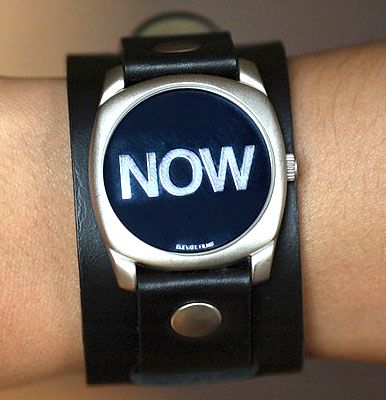
“For me, one of the most precious gifts the universe gives is the Now, and the Now embraced is the Eternal Hug … a gift without conditions of past or future, but only the joy of the moment. And what is life but a series of moments?

The moments bringing those words are now in my past, but I can and do continue to conjure their joys.

It’s remembering to do it that’s the key:

“Mindfulness is a habit, it’s something the more one does, the more likely one is to be in that mode with less and less effort… it’s a skill that can be learned. It’s accessing something we already have. Mindfulness isn’t difficult. What’s difficult is to remember to be mindful.” I love this last statement. Mindfulness isn’t difficult: the hard part is remembering to do it.

Having studied the work of Abraham Maslow way back when, I trust his assessment of moments.

The ability to be in the present moment is a major component of mental wellness.

But life does do its bit to beat that out of a girl, doesn’t it?

I’m not one for wallowing in regrets, and it’s too often the future that robs me of moments; not the desire of it, but the anxiety over having some asteroid of shit fall from this clear blue sky and splatter on my life. It’s an ancestor who provides perspective and a bit of solace on this concern:

The best thing about the future is that it comes only one day at a time. ~Abraham Lincoln

True enough, thankfully, and one day leads to another.

Yep. This moment is now the past and the next is still the future and each letter I type becomes a sentence and sentence is a pretty good description of life.

As for quantum physics and that business about the past, like the future, being indefinite and existing only as a spectrum of possibilities … well, I rather like a poet’s version today:

Forever is composed of nows.
~Emily Dickinson”

Read Full Post »

Before anyone weighs in with comments about how what follows is based on faulty logic, I’ll start the post off with a full disclosure: it makes no sense at all, has ’bout nothing based in science or fact or undisputed info and I don’t even end up agreeing with myself completely.

Okay?

This is simply a morning diversion, since, after all, I love to go a pondering along strangely convoluted tracks before I settle my brain down before the anvil and commence pounding away.

Today’s journey began at this article on sugar addiction.

One study out of France, presented at the 2007 annual meeting of the Society for Neuroscience, showed that when rats (who metabolize sugar much like we do) were given the choice between water sweetened with saccharin and intravenous cocaine, 94 percent chose the saccharin water. When the water was sweetened with sucrose (sugar), the same preference was observed — the rats overwhelmingly chose the sugar water. When the rats were offered larger doses of cocaine, it did not alter their preference for the saccharin or sugar water. Even rats addicted to cocaine, switched to sweetened water when given the choice. In other words, intense sweetness was more rewarding to the brain than cocaine.

But this isn’t about sugar, or cocaine and addresses addictions only peripherally. No, it’s about one of the big questions in life:

Why are all the good things so bad for us? And if they are so bad for us, why are they so good?

(Well … that and some other stuff …)

Those are two different questions, and it’s actually the second that interests me this morning since health professionals have no trouble reeling off reasons sugar, fat, alcohol, tobacco, drugs, casual sex and narcissistic men are bad, and we’ve heard them all; include them in your life at your inevitable peril.

My wander is more about why we’re so deeply attracted to shit we know will kill us, and in my wander I wonder if there’s a reason as primal as our ancestral genetic mandate to collect calories when we can.

Back in the early days of humans, life was a short prospect. Breeding started at puberty when hormone secretions kicked off the process that made sex desirable and babies possible, and anyone managing to live past thirty was considered either a burden or a deity. Feeding the clan took more effort than a stroll to the fridge and people were considered snacks-on-the-hoof by some of the neighbors. Yes, we lived fast, died young and … well … pretty is as pretty does.

Some of that fast living included a predilection for a tipple and a partiality for getting high, so there’s nothing new about our fondness for altered states.

Of course, the ancients didn’t know they were playing with their health.

We do.

We’ve made a slew of changes in the way we spend our time on the planet … we moved out of caves, traded our pelts for Prada and prefer Merlot over mead … so many so that our ability to conceptualize the way our ancestors lived has been greatly influenced by Fred and Wilma. These changes have resulted in extending our lives many decades beyond what would have been even remotely conceivable, but to date we have yet to unload the baggage that is a hankering for some stuff our species has been craving since Day One.

Again with the Why?

I’m guessing here one reason may just be that somewhere under our modern veneer, a place deep in our most primal of being, we actually understand that we will someday be dead.

Yeah, yeah … I know that’s a stretch. After all, we’re constantly getting messages about how if we reduce this and give up that and forego the fun of whatever we can cut the death rate (Funny how often that pops up.), giving some the impression that living forever is an option if rules are assiduously followed and enough sacrifices are made.

Okay … much is actually focused –in intent, if not in words — on dying younger than the average death or on being healthier in old age. Fine. I get that. But until there’s a way to stop the cycle — you’re born, you live, you die — there are only two options available; you die, or you get old.

Back in 1960, Maurice Chevalier summed up his ideas on the options when he said: Old age isn’t so bad when you consider the alternative.

Allow me to point out that Monsieur may now have a better base of comparison.

Actually, there are three options, the third being you live as best you can, and John Mortimer nails that point to the wall:

There is no pleasure worth forgoing just for an extra three years in the geriatric ward.

Could it be that we carry remnants of our Paleolithic selves — those beings we once were who knew for fact that life is short and then you die — that prompt us to go for the gusto?

An aside:

At this moment I have three friends engaged in fights against cancers of various types. All are significantly younger than I am (two in their 30s), none ever smoked, all followed reasonable dietary plans, drank in moderation and did not partake in illegal substances.

Back in the 80s I worked with a group of people who, although bound by certain interests, varied widely in lifestyle. My dear friend Robbie and I were the oldest of the bunch and by far the most debauched. Two of those people, perhaps the cleanest livers amongst us then, have now been dead for a number of years. Robbie and I are still kicking … and debauching.

I’m not afraid of death. It’s the stake one puts up in order to play the game of life. ~Jean Giraudoux, Amphitryon, 1929

Toss those dice … and while you’re up, can you pour me another glass of the white, please?

Read Full Post »

The Creator wants us to Drum. (God) wants us to corrupt the world with drums, dance, and chants. We’ve already corrupted the world with power and greed, which has gotten us nowhere. Now’s the time to corrupt the world with drum, dance, and chants.—-Babatunde Olatungi, Nigerian master drummer

Although the refrain “Feckin’ musicians” has been running through my head and out my mouth more than a little bit lately, I fully admit to having a soft spot … yes, in my head as well as in my heart … for those who create and perform amazing feats of sostenuto virtuosity. The brilliance of a maestro appeals on all levels, and the passion it takes to make music attracts in ways powdered rhino horn can only fake (much to the detriment of a population of wonderful creatures).

Musicians are gifted in a language I don’t speak and construct worlds from far different materials than those I have at my fingertips. The mystery of those worlds can catch my imagination and have me drifting for a very long time on a sea of contented wonder. They also understand my drives and passions, encouraging exploration of my own depths and applauding my less-melodic results, never to question a need to shut myself up within my head and live for a while in realms of my making or a demand to cough up a paycheck to prove my creations have merit. They can also take me out of my orbit and show me other ways a planet spins.

Contributions from the musical world are legion, and there’s no need here to wax lyrical on the rich layers music adds to life and to love. Thanks, however, to new lessons learned from a wonderful teacher who takes the time to show me parts of the world I don’t normally get to see, I have learned some about how music heals.

Of course, I’ve long known that music has charms to soothe the savage breast, as Congreve so succinctly summed a couple of hundred years ago, and have used lilting strains and building crescendos to get myself through traumas both emotional and physical. What I have missed until now, though is the healing powers of drums.

Experts believe that rhythmic drumming can aid health by inducing a deep sense of relaxation, reducing stress, and lowering blood pressure.

Mickey Hart, drummer for The Dead spent a lifetime studying not only the history of drumming, but the effects on the human condition, as well.

In 2000, Mickey Hart became a member of the Board of Directors of the Institute for Music and Neurologic Function, a not-for-profit organization whose mission is to seek to establish new knowledge and develop more effective therapies which awaken, stimulate and heal through the extraordinary power of music — continuing his investigation into the connection between healing and rhythm, and the neural basis of rhythm.

The Institute for Music and Neurologic Function in New York understands the benefits:

Its aim is to restore, maintain and improve the physical, emotional and neurologic functioning in people who have been debilitated through stroke, trauma, dementia, Alzheimer’s disease, Parkinson’s and other processes through the systematic use of music.

Oliver Sacks, famed neurologist and author of many works on the wonders of the mind, provides the scientific guiding hand for the institute. His discovery that drumming interrupts the chaos that is Tourette’s syndrome led to studies of the impact of rhythms on other disorders of the brain.

To hear drumming is to feel it in our bones … I like when it rattles my teeth, too … and the sensation resonates. It’s our heartbeat and our history.

The drum family is considered the most representative of African instruments, found in societies and tribes across the continent. The drums speak in codes the language of the tribes, and are frequently used to communicate news and messages between towns.

The talking drums of West Africa are renowned for their ability to closely imitate the rhythms and intonations of the spoken word, the more skilled players can reproduce dialogue understood by a knowledgeable audience. By sending the messages along, they can be carried for miles.

It is said that the djembe dates from as far back as 500AD, made from a curved tree trunk and goatskin. … Dubbed the ‘magic drum’ for its ability to move people and the ‘healing drum’ for its history as a fundamental tool in healing traditions.

Yes, Koestier did grasp one aspect of the drum when he wrote, “The most persistent sound which reverberates through men’s history is the beating of war drums”, but magic and healing are also the legacy.

And talking, thankfully.

Read Full Post »

The best-laid schemes o’ mice an ‘men
Gang aft agley,
An’lea’e us nought but grief an’ pain,
For promis’d joy!

~ Robbie Burns

(If Burns was writing this morning, he might also substitute paid for laid … although I’m sure well-laid fits in this rant, too …)

I’m choosing to start the week off with a bit of Scottish verse, then quickly moving along to giving the United Nations a big hand … upside the head, and a foot up the ass to see if that does anything to knock the organization out of its PR-spinning, wonky orbit.

I will say one good thing about the Untied Nations … they are good at graphs, as proved by a report in today’s news.

This one, for example:

There are loads of similar graphs, all indicating … well, gee … that the UN’s “Millennium Development Goals (MDGs)” adopted 10 years ago were a waste of time and a ton of money.

So, just guess what the plan is now.

They’re going to meet up in Manhattan next week to “redouble efforts to meet them by 2015”.

“The path that will be set at the summit will determine the direction and results, success or failure, of the entire MDG venture,” says Olav Kjorven, a senior official in the UN’s main development agency, the UNDP.

Yeah … pull the other one.

The truth is that poverty has fallen, but progress has been uneven, and most of the goals are off-target to meet the deadline.

One of them – halving world poverty – is likely to be met, largely because of robust economic growth in China and India.

But less has been achieved on others, such as decreasing hunger, improving access to health and education, and helping mothers and children.

According to their own figures, not only have rates of infant mortality, availability of clean drinking water and reduction of early deaths from nasties like AIDS and malaria not improved since these masses of the well-dressed, well-fed and well paid sat over champers and sturgeon roe a decade ago and dusted crumbs from each others’ lovely lapels, in many cases it has gone worse.

World hunger is on the rise since the adoption of the UN goals, with nearly a billion people suffering.

And the number of women who die in childbirth every year is still in the hundreds of thousands, falling far short of the UN goal to cut maternal deaths by three quarters.

Since the UN can hardly take credit for jumps in the econ strength of China, India and former Soviet countries, it seems more than a tad disingenuous to claim MDGs made much difference, and blaming donor nations’ shortfalls does little to alleviate the notion that these very expensive summits are any more than chichi circle jerks.

This one hasn’t even started, yet already the Kool-Aid is being passed around to the international media:

The summit is expected to declare that achieving the Millennium Development Goals is do-able by 2015, with the right combination of money, policies and, above all, political will.

Drink up, me hearties, yo ho! (Yesterday was Internatonal Talk Like a Pirate Day, sponsored by an organization that probably accomplishes more in one year than the UN does in a decade to improve the lives of a few sad gits, so I’ll give them a plug.)

Want to see some flash PR work? Check out the MDG website and catch a clue as to where some of the money and effort goes. To see where it doesn’t, just look at the world.

Read Full Post »

Eight and a half months of pregnancy, feeling puffy, exhausted, grumpy as hell, with a belly that not only turns your feet into complete strangers, but also decides to rumba every time you want to sleep. The rest of your body is well into the drama, shooting you up with mega-hormonal gushes to set your head spinning, your temperature rising, your moods swinging like a fruit bat in a cyclone and your cervix thinning.

Thinning right along with cervical tissue … patience. Can’t wait to get your body back and meet the little human you’ve been gestating? Well … that’s coming up on the dance card after just a few more sambas, a cha-cha and the bunny hop.

Excited? You bet! Primed to have your personal premises vacated? Sure nuff! Looking forward to a reintroduction to your waist? Deffo! Jazzed about mastering the art of Pamper-ing? Yeah, even that.

It’s all going to happen. There’s just one little thing you have to do first.

There’s more than one reason making a person from scratch takes almost a year. Sure, there’s the baking process that brings the little bun from Open Sesame! Seed to full sweeter than CinnaBun form, but that’s just the biology bit. The really vital thing about the duration of gestation is getting you to the point that you’re so sick and tired of being preggers that the idea of evicting your womb renter sounds really, really good no matter the mess you have to go through to get the bugger out.

Intimidating? Well, yeah, but here are a couple of things to keep in mind over the next days:

1) You’re not the first to go through this. Heck! If your mother could do it, you can certainly pull it off, and with style!

2) Birth is a natural process, neither an illness nor a contrived torture, but finite in its duration and what you were built for.

3) You are the star of the show, so can be as demanding, bitchy and whiny as you want and no one will do anything but applaud at the end of the performance. Plus, you go home with a prize more valuable than any statuette could ever hope to be.

4) It’s a bit too late to change your mind.

Doctors can explain the reasons for the pain in the birthing process … and, yes, it does hurt … and it helps to know why it seems someone is cranking the rack way beyond all limits of even the most sadistic persecutor, so make them tell you exactly what’s going on, and in detail. Focusing on what’s happening where will help, and understanding your body’s responses can bring you into the picture rather than leave you screaming from the sidelines.

This is, after all, an active process. You are not a victim birthing is happening to, but the whole damned team for the only game in town.

Not that it’s play. Oh, no! This is WORK. That’s why they call it LABOR. And it’s a job that you do, then finish. Preparation is important, and you’ve had months for that (See above), so the early pangs of labor won’t come as a surprise.

“It’s time …”, may be your first thought, but don’t panic — you’re ready. Your body is ready. Your baby is ready. And whether you know it or not, you ARE ready.

You’re young, fit and strong. Your muscles know what to do without you having to even think about guiding the process. All you have to do is let it happen and do the work.

It’s a marathon and quitting is not an option, so pull on your Big Girl Panties … crotchless is good in this circumstance … and get ready to sweat. You’ll be running hills and valleys, so let yourself coast when you can, then pull your guts out when the going is steep, the exhaustion sets in and your body starts screaming at you to pull over and throw in the towel. That AIN’T GONNA HAPPEN! You WILL win. You WILL conquer. And all those wimps inside snidely suggesting you’re a loser will eat your dust.

If someone offers some comfort and ease along the way, take it. Having fans shout encouragement is good, too. But you’re in this alone and no one can carry you across the finish line. That you do alone, and for that you get the glory. For that, for the rest of your life, you earn the best title ever bestowed on any woman anywhere: Mom.

I’ve given birth, and it was … hands down … the most exciting experience of my life, and the most fun I’ve ever had. I envy you your upcoming adventure!

Read Full Post »

Continuing on from yesterday’s post where I’ve been taking conversations about maleness for a wander around the blog.

I titled this post with a quote from Marie Curie because it was thoughts of her that tugged me toward today’s tangent.

After hours of researching testosterone-driven aggression, infidelity, abuse, slavery, torture … pick a term for what happens to millions daily, any term … I settled in to do some light reading on patriarchy, the history and manifestations of this man’s world we live in.

Although historically, male domination of societies has prevailed … unevenly often, as is evidenced by ancient differences between Greek and Egyptian cultures and such modern poles as, say, California and Kandahar … prehistorically, matriarchies ran the show for something like 40,000 years.

Matriarchal societies are now virtually nonexistent, although a bare few are still functioning in remote corners of the world. The Mosuo of South East China, for example, a culture in which women rule the roost and the word “rape” doesn’t exist.

Few Mosuo women will have more than one partner at a time, even if they are not expected to do so. Mosuo women can change partners as often as they like. In fact, they practice “serial monogamies”, and some relationships can last for a lifetime. So they are not a culture sexually promiscuous as one might think.

Google “mass rape” and see how different the patriarchal world is. From Bosnia to post-WWII Europe, to today’s Congo, rape is not only an active verb in the vocabulary, it’s a living outrage committed by millions leaving millions of victims.

Add in feckless mates, absent fathers, violent crime in general and we get a whopper of a messy man sandwich that’s causing a global bellyache none may end up surviving.

Can we, for just a moment or two, try to imagine a world where women were able to maintain their ancient power?

Okay. Maybe that’s too much.

Can we imagine a world where the power western women have today, limited as that still is, was allocated … what? … maybe 200 years ago?

Back to Marie Curie for a moment.

Maire Curie won the Nobel Prize for Physics in 1903 … the second year prizes were awarded. (She also won the prize for Chemistry in 1911.) In total, a Nobel has been given 41 times to a woman. (Five in 2009 alone.)

What have they won for? Here are a few examples …

Marie Curie: for her discovery of radium and polonium

Irène Joliot-Curie: for their synthesis of new radioactive elements

Gabriela Mistral: for her lyric poetry which, inspired by powerful emotions, has made her name a symbol of the idealistic aspirations of the entire Latin American world

Dorothy Crowfoot Hodgkin: for her determinations by X-ray techniques of the structures of important biochemical substances

Rosalyn Sussman Yalow: for the development of radioimmunoassays of peptide hormones

Nadine Gordimer: who through her magnificent epic writing has – in the words of Alfred Nobel – been of very great benefit to humanity

Aung San Suu Kyi: for her non-violent struggle for democracy and human rights

In the same period of time, 765 Nobel Prizes have gone to men, also for some great stuff that has made a difference in the world.

And here’s where we get to the imagining bit …

What could our world be like if … even just for the past 200 years … women had had the same opportunities to contribute?

In a bit more than 100 years, look what just 41 women who struggled like hell managed to do.

As Marie Curie, two-time Nobel Laureate was forced to admit:

I have frequently been questioned, especially by women, of how I could reconcile family life with a scientific career. Well, it has not been easy.

Did anyone EVER ask her husband, with whom she shared the first award, that question? I’m betting NOT.

Has humanity been served by an ancient shift that left women powerless and put men firmly in control?

What would I know? I’m just a girl …

Further reading for the interested:

http://www.japss.org/upload/8._Sharmon%5B1%5D.pdf

http://www.musawah.org/docs/pubs/wanted/Wanted-AW-EN.pdf

j-dv.org/writings/essays/witch.pdf

http://www.humanecologyreview.org/pastissues/her62/62catton.pdf

Read Full Post »

Bits on Men

I like men. In fact, I love men, collectively as a gender and individually. A father, three brothers and two sons were born male, and great, and many of my best friends are men. I have up-close-and-personal loved some amazing men. Men contribute to the world in ways appropriate to half the human population, and the art, lit, music, science, discovery and more that have issued from men over the centuries form the basis of what we like to think of as civilization. (For some thoughts on why there’s an imbalance of input from women, take a read through A Room of One’s Own, or any bit of history of our species.)

I adore men’s bodies, can be enraptured by their minds, find conversation with members of that opposite sex entertaining, compelling and often instructive. The smell of them is seductive, the sight can be alluring and their touch can bring sparkle to a day and spark a fire in a dark night that sets me to glowing.

Yes, men are wonderful …

but … and here’s the caveat we all knew was coming …

… there appears to be a marked tendency to jettison wonderful when women aren’t looking … or when women have no power to slap them upside the head on a regular basis.

Whether it be a mother, wife, an Empress or a best friend, having a woman’s perspective perched on one shoulder seems to greatly temper temptations touted by that other-shoulder-devil, the male … what? … ego? imperative?

Although an extreme example, a common practice in Afghanistan makes a point:

It’s after midnight. I’m at a wedding party in a remote village in northern Afghanistan.

There is no sign of the bride or groom, or any women, only men. Some of them are armed, some of them are taking drugs.

Almost everyone’s attention is focused on a 15-year-old boy. He’s dancing for the crowd in a long and shiny woman’s dress, his face covered by a red scarf.

He is wearing fake breasts and bells around his ankles. Someone offers him some US dollars and he grabs them with his teeth.

This is an ancient tradition. People call it bachabaze which literally means “playing with boys”.

The most disturbing thing is what happens after the parties. Often the boys are taken to hotels and sexually abused.

The men behind the practice are often wealthy and powerful. Some of them keep several bachas (boys) and use them as status symbols – a display of their riches. The boys, who can be as young as 12, are usually orphans or from very poor families.

It’s no question that women in Afghanistan have no power. Men in that country don’t have the worry of a wife or mother or female casual observer pointing out that they’re jerks. No, they can debauch with gay abandon. And they do.

“Bachabaze” is slavery, prostitution, evil … and, apparently, an acceptable hobby.

“Some people like dog fighting, some practice cockfighting. Everyone has their hobby, for me, it’s bachabaze,” …

EveryONE, of course, meaning every man.

Yep, all fun and games.

Will even the gentlest male go feral without the taming influence of woman? Does removing women from an equation assure a downward spiral toward decadence?

It would seem so when one considers the consequences of war and the proclivities of male-dominated institutions … the catholic church comes to mind. (See this report on mass rape now happening in the DRC and just about any old news source for info on sex abuse in the church.)

Historically speaking, some might cite Sparta as an example of male rule pulling off something special, but contrary modern perceptions it wasn’t a lack of female power that allowed the rise of that society.

“During the times of the ancient Greeks, women were generally considered inferior to men and afforded very few rights and privileges. In these male dominated societies, a woman’s only function was to bear children and attend to the needs of her husband. However, the Spartans thought very highly of their women and granted them more freedoms than anywhere else in Greece. This is because unlike the women in other cities, Spartan women played an active role in the life of the polis. The role of Spartan women was not merely to produce male warriors, but to uphold Spartan ideals and ensure that the men maintained the standards which Spartan society was built upon.”

While the Greeks were doing the Greek thing and letting Arisotle set the patriarchal tone, down in Egypt things were far different, which may be why anal sex is not referred to as “the Egyptian thing” …

Egypt left no philosophical record, but Herodotus left a record of his shock at the contrast between the roles of Egyptian women and the women of Athens. He observed that they attended market and were employed in trade. In ancient Egypt a middle-class woman might sit on a local tribunal, engage in real estate transactions, and inherit or bequeath property. Women also secured loans, and witnessed legal documents.

Yes, I love men, but I do worry about them. Left to their own devices, they seem to lack sense, and stick them in an environment where no women have any say over anything that goes on and things can deteriorate rapidly.

The thing is, it seems that men are actually happier when not left to those devices. They live longer, are more productive and off themselves half as often.

So, although men may rail at the thought of a world … or a house … in which women have equal power, it’s a partnership of the sexes that can make life on this planet livable.

Read Full Post »

In my time zone … GMT+4 … it’s Friday the 13th, and seeing how crap the rest of the week … month … year … has gone, I’ll be watching my back thankyouverymuch.

In prep for doing so, I gathered some info on history not my own concerning the reasons behind this particular combo of day and date having ominous overtones.

Friggatriskaidekaphobia is the bon mot coined to describe the fear of Friday the 13th, and if that’s not reason enough to stay in bed the whole day, head under the covers, and a refusal to speak to anyone for fear of having to admit to having the condition … well … I could think of a couple of others, but don’t need to.

Thankfully, planning ahead is possible — a stock of tea on hand, a couple of good books, that sort of thing — since every year has at least one … but no more than three … Paraskevi the dekatreis, and any month that begins on a Sunday is warning that the 13th on a Friday will happen.

Funnily enough, while most people now welcome Fridays with open arms and high hopes for a hoot and a half, historically, the whole TGIF thing wasn’t happening until recently:

The actual origin of the superstition, though, appears also to be a tale in Norse mythology. Friday is named for Frigga, the free-spirited goddess of love and fertility. When Norse and Germanic tribes converted to Christianity, Frigga was banished in shame to a mountaintop and labeled a witch. It was believed that every Friday, the spiteful goddess convened a meeting with eleven other witches, plus the devil — a gathering of thirteen — and plotted ill turns of fate for the coming week. For many centuries in Scandinavia, Friday was known as “Witches’ Sabbath.

Unlike moderns eagerly packing up cars and heading outta Dodge in a Dodge, as far back as the 14th century Fridays were considered an unlucky day to begin a journey, as Chauser suggests as he sees his folks off to Canterbury.

So, Friday was a downer, and the idea that 13 is an unlucky number has a few traceable roots:

In numerology, the number twelve is considered the number of completeness, as reflected in the twelve months of the year, twelve signs of the zodiac, twelve hours of the clock, twelve tribes of Israel, twelve Apostles of Jesus, twelve gods of Olympus, etc., whereas the number thirteen was considered irregular, transgressing this completeness. There is also a superstition, thought by some to derive from the Last Supper or a Norse myth, that having thirteen people seated at a table will result in the death of one of the diners.

Numerology, astrology, mythology, Christianity … hang a hat already.

When some bad shit happened on Fridays that fell on 13ths, folks started putting two and two together and came up with a baker’s dozen called spooky.

The Knights Templar weren’t happy about the day after King Philip had a slew of them arrested on Friday the 13th, 1307, the Battle of Hastings startedon the Friday the 13th of 1066 and ended badly for King Harold, Wall Street crashed Friday the 13th of 1929. Hurricane Charley made landfall in south Florida on Friday, August 13, 2004. The “Friday the 13th Storm” struck Buffalo, New York on Friday, October 13, 2006. The Andes Plane Crash of 1972 occurred on Friday, October 13, 1972.(For the same sorts of reasons, the Spanish-speaking world has Tuesday the 13th marked as a bad day in the making.)

And how does all this impact today? Well …

According to the Stress Management Center and Phobia Institute in Asheville, North Carolina, an estimated 17 to 21 million people in the United States are affected by a fear of this day. Some people are so paralyzed by fear that they avoid their normal routines in doing business, taking flights or even getting out of bed. “It’s been estimated that $800 or $900 million is lost in business on this day”.

So my idea of resting recumbent lo lili has me thinking I should have lots of company … so to speak.

But does the day actually attract shit? Hm. Debatable. The wiki:

There are conflicting studies about the risk of accidents on Friday the 13th. The Dutch Centre for Insurance Statistics (CVS) on June 12, 2008, stated that “fewer accidents and reports of fire and theft occur when the 13th of the month falls on a Friday than on other Fridays, because people are preventatively more careful or just stay home. Statistically speaking, driving is slightly safer on Friday the 13th, at least in the Netherlands; in the last two years, Dutch insurers received reports of an average 7,800 traffic accidents each Friday; but the average figure when the 13th fell on a Friday was just 7,500. However, a 1993 study in the British Medical Journal that compared the ratio of traffic accidents between Friday the 6th and Friday the 13th stated that there is a significant increase in traffic-related accidents on Friday the 13th. There are indications that there are more accidents on Fridays than average weekdays (irrespective of the date) probably because of alcohol consumption. Therefore it is less relevant for this purpose to compare Friday the 13th with, say, Tuesday the 13th.

Driving in Holland is okay, but stay well off the roads in the UK? Okay … and I’ll add, avoid the M25 on any day!

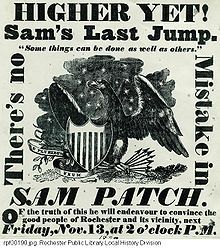
There is, after all, no sense in tempting fate, unless such things get your rocks off. That didn’t work out so well for stuntman Sam Patch who picked the day back in 1829 to make his biggest jump … even bigger than his history-setting plunge over Niagara Falls … and died in the process. (Have to add his personal slogan here, since it cracks me up: Some things can be done as well as others.)

I leave it up to readers to decide what to do with their day … once it rolls around to longitudes more westerly … and take some comfort in the idea that I, for one, can avoid the friggatriskaidekaphobia outbreak warming up already in anticipation of Friday the 13th of April speeding toward us for contact in 2029 … or 2036 … or whatever … when 99942 Apophis puts an end to such silliness.

Read Full Post »

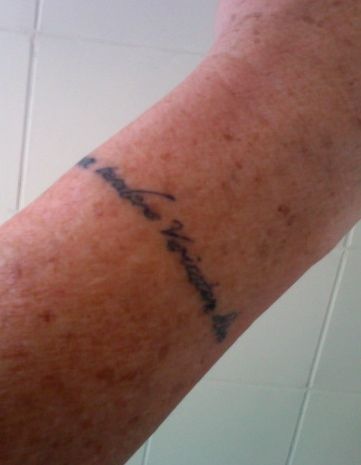
As mentioned in recent post, I have a tattoo on my wrist now that reads: Arcum tenderi Vertatum Dicere. It’s there to remind me as I work that writing true is a responsibility whether I’m writing fact or fiction.

Or even news.

There are rules to journalism, but once again a story from the BBC indicates that a rocko-socko headline, no matter how ridiculous, takes precedent.

Puts me in mind of a bit of Evelyn Waugh verse:

You cannot hope
to bribe or twist,
thank God! the
British journalist.

But, seeing what
the man will do
unbribed, there’s
no occasion to.

The headline that has me on this rant this morning?

Large waist size linked to ‘higher risk of death’

I’m not bothering to mention how annoying I find the BBC’s “compulsion” to wrap quotation marks around “random words” in headlines, as if “qualifying” their “shouts” makes them “less accountable” for “poor choices” and “lazy editing”, although I do find it “very annoying”.

What’s bugging me is the “higher risk of death” thing heading the piece and much of the copy that follows:

… very high waist measurements equivalent to UK size 24-26 in women and XXXXL in men appear to double the risk of mortality.

The study featured was conducted over a nine year period, so the research counted how many involved died over those years. Fine. There’s some science in that. So can we not be shouting from the rooftops that some folks have a “higher risk of death” than others?

Okay. I do understand that what they are trying to say is that obesity is known to cause health issues that may end up being the cause of death … perhaps “premature” death, meaning that extremely fat folks might live longer if they dropped tonnage.

BUT … that not what they write. Well … not until you crawl down the page a bit and fill in some of the blanks, and it becomes the reader’s job to figure out what the heck instead of the writer’s responsibility to clearly report what the heck.

Let’s get something straight … everyone dies, and everyone dies once, so there is no possibility of “doubling the risk of mortality”, at least not until someone gets a handle on that immortality thing and is able to put it on the market.

As ‘infotainment” contaminates more corners of journalism and consumers of “news” are dumbed down daily … outFoxed? … those who see the difference between reporting and appealing, enlightening vs entertaining, sense and sensationalism, should bust the chops of anyone paid to post pap and remind them that when they don’t understand what they’re writing about to ask more questions, because not doing so and simply writing what scans results in a “higher risk of disparagement”.

Read Full Post »

At a dinner the other night, as often happens someone noticed one of my tattoos.

“Are you a big fan of auto racing, or something?”

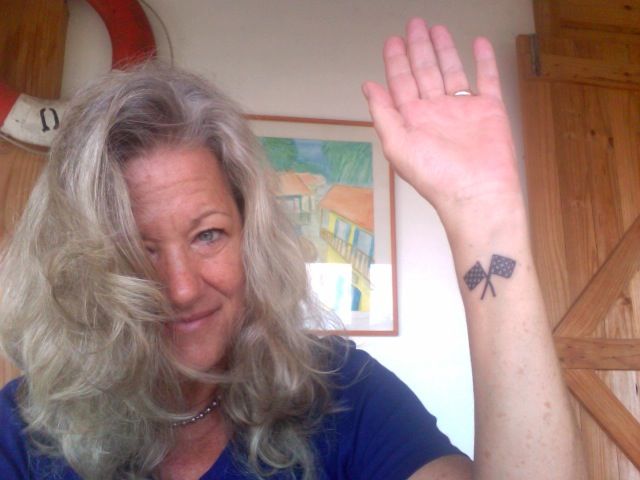
Easy to spot, the Corvette racing flags on my right wrist could give the impression that I’m proud enough a sports fan to permanently ink a symbol into my skin, but as with all my tattoos the meaning goes much deeper.

At present count I have eight tatts, not one a butterfly, fairy, tribal strip, Celtic symbol, dragon or anything else lifted from the Great Book of Body Art folks rifle through at tattoo parlors the world over, looking for something pretty … or pretty ugly … they’d like to live with for the rest of their days.

My ink IS my flesh.

The first tattoo I had done is of a heart. It’s on my ankle. I got it in Singapore after being released from hospital following yet another tinkering on my ticker as it seemed a spare might be a good idea. It’s red, heart-shaped, and includes very visible bypasses … a good representation of the one still beating in my chest. Below it, the Chinese character that translates to ‘long life’. Both of these were modified last year … a boom time for tatts on me … when Jaren’s name was inked into the heart, and my other children’s were written under Long Life.

I had a musical heart done after anther hospital visit in Singapore. (And, yes, there’s a symmetry to getting tattoos in that ancient port city where so many drunken sailors have been inked that appeals to me.) That was Ernesto-inspired, although he is no fan of ink. That’s what happens when I’m alone for such trauma and drama; I make a point of it … or a whole bunch of points as the case may be.

The racing flags I don’t consider a tattoo at all … it’s a scar.

After Jaren died many of his friends had the flags done on their bodies as a tribute to him. Mine are a tribute to those friends, and placed as they are a constant reminder of the love my boy gave and got … a touchstone, if you will.

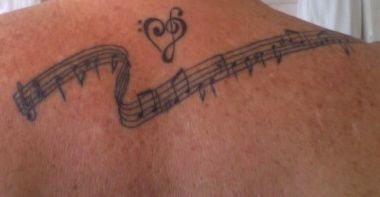
My tribute to my son is across my upper back; four bars of his music that I am proud to wear. Somehow … and I’m not compelled to examine my motives on this … having this translatable bit of him on me makes it easier to carry the parts of him I miss so much in me.

I had two new tatts done for my birthday last month, both just for me … standards to bear leading me into the rest of my life.

On my right wrist:

Arcum tenderi Veratum decere

Although the explanation of this … two-thirds of a motto Karen Blixen, one of my literary heros, used to open “Out of Africa” … has long held deep significance for me, it’s the basic reminder to “shoot straight, write true” that has it in front of my face every day as I sit at my keyboard.

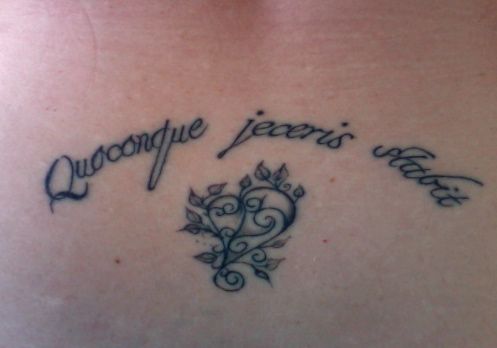
Running out of spaces on my body that can still hold ink without wrinkling or sagging, I resorted to a tramp stamp for my last tattoo, this one inspired by one a friend gave herself for her birthday.

Quoconque jeceris stabit

Which means: Whichever way you throw me I will stand. This curves over a wonky heart and proclaims my determination to make it through whatever life … and love … can toss in my path.

I’m well aware that wearing my heart so obviously on my sleeve … or wrist or leg or back or whatever … opens me to comments and questions. Sometimes I’m just … yeah, yeah … a big fan of snazzy Chevys, but there are occasions I welcome the opportunity to let my tattoos tell some of my story.

Read Full Post »

« Newer Posts - Older Posts »