Feeds:
Posts
Comments

Archive for February, 2011

Thinking is fun and good for you, but … OY … does it make me dizzy! Good thing I’m a long-time fan of dizzy. I have a scar to prove it, too … the result of a gash on my forehead sustained at about age four when living room twirling to achieve total dizziness set me plummeting toward the sharp corner of an end table.

I no longer twirl much, but can achieve the same desired state by reading lots of news. The present situation in Egypt, for example, sets me spinning, and throw in a suicide bomber or two and I’m well confused over wtf peeps are thinking.

Those aren’t fun rotations, although interesting and necessary meanderings for anyone feeling the need to keep abreast, but there are no few coils presenting opportunities for attempted unraveling that are a total hoot.

It’s science and technology that can always get a mental pirouette going in my head, and the faster it goes the dizzier I get and the more I like it.

Yesterday’s post on the new iPhone app for seeking appsolution from the god-of-practicing-catholics set me off down a line of thought that cracked me up all day.

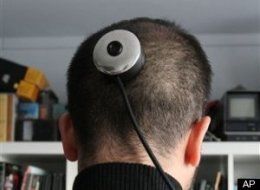
And this morning what to my wandering eyes did appear but this story about an NYU professor who sports a “head-cam”!

Late last year, Bilal had the digital camera inserted into a two-inch hole drilled into the back of his head. According to The Chronicle of High Education, the body-modification artist who performed the surgery also installed three posts between Bilal’s skin and skull to root the setup in place.

Bilal intended to wear the camera around for a year as part of an art project, titled “The 3rd I,” commissioned for the opening of the Mathaf: Arab Museum of Modern Art, reports the AP.

Just the thought of spinning with two eyes toward the front and a camera eye implanted into the back of my head creates dizzy hilarity I can’t stop smiling over, and when I let myself swivel around the questions over why the fuck anyone would be so into where they’ve been or who’s talking behind their back I go positively vertiginous.

YeeeHaww!

Not done yet, however, as a read through a story in Time Mag ramped up the speed on my internal whirligig exponentially, and I’m sure I’ll never look at life in quite the same way I did before this go-round.

The topic is Singularity. From the Wiki:

A Technological singularity is a hypothetical event occurring when technological progress becomes so rapid that it makes the future after the singularity qualitatively different and harder to predict. Many of the most recognized writers on the singularity, such as Vernor Vinge and Ray Kurzweil, define the concept in terms of the technological creation of superintelligence, and allege that a post-singularity world would be unpredictable to humans due to an inability of human beings to imagine the intentions or capabilities of superintelligent entities.

It’s Kurzweil the Time article features, and oooh, do I like it when a science guy gets me going in circles, even when the spin is uncomfortable.

The difficult thing to keep sight of when you’re talking about the Singularity is that even though it sounds like science fiction, it isn’t, no more than a weather forecast is science fiction. It’s not a fringe idea; it’s a serious hypothesis about the future of life on Earth. There’s an intellectual gag reflex that kicks in anytime you try to swallow an idea that involves super-intelligent immortal cyborgs, but suppress it if you can, because while the Singularity appears to be, on the face of it, preposterous, it’s an idea that rewards sober, careful evaluation.

According to Kurzweil, we’re not evolved to think in terms of exponential growth. “It’s not intuitive. Our built-in predictors are linear. When we’re trying to avoid an animal, we pick the linear prediction of where it’s going to be in 20 seconds and what to do about it. That is actually hardwired in our brains.”

Here’s what the exponential curves told him. We will successfully reverse-engineer the human brain by the mid-2020s. By the end of that decade, computers will be capable of human-level intelligence. Kurzweil puts the date of the Singularity — never say he’s not conservative — at 2045. In that year, he estimates, given the vast increases in computing power and the vast reductions in the cost of same, the quantity of artificial intelligence created will be about a billion times the sum of all the human intelligence that exists today.

One result of these vast increases, according to Kurzweil, is immortality, the reason he takes daily doses of supplements in an effort to last stick around long enough to transfer the him that is him from an aging body to a “sturdier vessel”.

I don’t quite get the desire to live forever, but relate well to the W.B. Yeats description of man’s fleshly predicament as a soul fastened to a dying animal.

Questions coming to mind are entertaining, too.

Kurzweil admits that there’s a fundamental level of risk associated with the Singularity that’s impossible to refine away, simply because we don’t know what a highly advanced artificial intelligence, finding itself a newly created inhabitant of the planet Earth, would choose to do. It might not feel like competing with us for resources. One of the goals of the Singularity Institute is to make sure not just that artificial intelligence develops but also that the AI is friendly. You don’t have to be a super-intelligent cyborg to understand that introducing a superior life-form into your own biosphere is a basic Darwinian error.

It seems obvious that we’re heading toward things truly dizzying, and it’s not only head-cams and downloadable sacramental apps …

Five years ago we didn’t have 600 million humans carrying out their social lives over a single electronic network. Now we have Facebook. Five years ago you didn’t see people double-checking what they were saying and where they were going, even as they were saying it and going there, using handheld network-enabled digital prosthetics. Now we have iPhones. Is it an unimaginable step to take the iPhones out of our hands and put them into our skulls?

Already 30,000 patients with Parkinson’s disease have neural implants. Google is experimenting with computers that can drive cars. There are more than 2,000 robots fighting in Afghanistan alongside the human troops. This month a game show will once again figure in the history of artificial intelligence, but this time the computer will be the guest: an IBM super-computer nicknamed Watson will compete on Jeopardy!

Now I’m wondering if Watson picked that nickname.

“The cosmos is a gigantic flywheel making 10,000 revolutions per minute. Man is a sick fly taking a dizzy ride on it.”
~ Henry Louis Mencken

Hop on!

Thanks to Dania for sharing the Time piece!

Read Full Post »

Bless me, Father, for I have sinned. This is my first confession …”

And so started my first session in the dark closet that is a Catholic confessional. I was seven, and scared shitless. The rumors that flew through my particular gaggle of initiates ranged from a congratulatory bowl of M&Ms appearing to the floor giving way at the pull of a lever by a priest unhappy with what he was hearing, and although we’d been well prepped by having the required words drilled into our young brains, no one had bothered to explain the process beyond how bloody vital it was we get it right.

And how I wanted to get it right! After all, there was a brand new dress at home (Bridal white and with a veil, even, and what 7-year-old girl wasn’t put all aflutter by the thought of walking down an aisle in that?), the wearing of which depended upon passing the test of confessed.

Of course, I had by this time succumbed to curiosity enough to have taken a peek or two into the blabbing box … an action I was expected to confess, I suppose … but all had happened in guilt-ridden anxiety and I’d not had anything like a good look around, so its mystery held fast, and by the throat.

Nervous as a Catholic school girl in her first confession, appropriately, when nunned through the door, I dropped to my knees and began the ritual that was pouring out my soul. I told of pinching my brother and filching a cookie and might have mentioned skipping threesies in a game of jacks, all the horrific acts a child was compelled to tell if that dress was to happen.

I must have run on for at least five minutes, then …

a little screen slid open and the priest, who’d apparently been torturing listening to the kid in the closet on the other side of him, was ready to hear MY confession.

One more time, and from the top …

That was a long time ago, and, dammit, to think now I could have just phoned it in!

The news that the popester has given the nod to a new app for iPhones and iPads that makes confession a breeze almost makes me wish I was a Catholic school girl all over again.

Okay, that’s nowhere even close to true, but idea of the $1.99 app on sale through iTunes is cracking me up.

The Catholic Church has approved an iPhone app that helps guide worshippers through confession.

The Confession program has gone on sale through iTunes for £1.19 ($1.99).

Described as “the perfect aid for every penitent”, it offers users tips and guidelines to help them with the sacrament.

Now senior church officials in both the UK and US have given it their seal of approval, in what is thought to be a first.

The app takes users through the sacrament – in which Catholics admit their wrongdoings – and allows them to keep track of their sins.

Ah, the hilarity out of the Vatican!

A bit of explanation for those not familiar with stuff catholiky:

The Sacrament of Reconciliation, more commonly referred to as Confession by most Catholics and Christians, should be a vital part of the Catholic faith.

… When the person enters the confessional, he should kneel (or sit), bless himself (with the sign of the cross) and say “Bless me Father for I have sinned.” The person will then tell the priest how long it has been since his last confession. Then the priest will tell the person to confess his sins. From there, the person will tell his sins to the priest. Once he is done, the person should say an “Act of Contrition.” Once the person has done all of this, the priest will give the person penance. The penance will usually consist of a set amount of prayers (such as The Lord’s Prayer or The Rosary) the person must say. The priest will then say a prayer and absolve the person of the confessed sins.

… Confession helps to rid people of any guilt they may have been feeling because of their sins and also allows them to experience the love and forgiveness offered by God.

Got it?

Okay, so now a bit about sacraments in general:

A sacrament, as defined in Hexam’s Concise Dictionary of Religion, is what Roman Catholics believe to be “a rite in which God is uniquely active.” Augustine of Hippo defined a Christian sacrament as “a visible sign of an invisible reality.” … Examples of sacraments are Baptism and the Eucharist. Therefore a sacrament is a religious symbol or often a rite which conveys divine grace, blessing, or sanctity upon the believer who participates in it, or a tangible symbol which represents an intangible reality. As defined above, an example would be baptism in water, representing (and conveying) the grace of the gift of the Holy Spirit, the Forgiveness of Sins, and membership into the Church. Anointing with holy anointing oil is another example which is often synonymous with receiving the Holy Spirit and salvation. Another way of looking at Sacraments is that they are an external & physical sign of the conferral of Sanctifying Grace.

Apparently, God is now “uniquely active” via iPhone. If one leans toward buying into the church stuff in the first place, this might be bloody fucking handy, dontcha think?

It looks like the new app gives a commandment-by-commandment rundown of possible infractions and provides a handy checklist, making it harder to “forget” transgressions, since lord knows! forgetting is no excuse for not unburdening and taking your holy lumps.

Kill anyone?
a) yes
b) no
c) Does a Muslim count?

Commit any rape?
a) yes
b) no
c) Just an alter boy.

Tell any lies?
a) yes
b) no
c) Only about the alter boy.

Piece o’ cake, heh?

And if that’s so easy, why not apps for sacs other than reconciliation?

There could be a do-it-yourself baptism app, a “Do you take this woman to be your wedded wife” tick-a-box app, and even one for performing last rites and burials. (Pre-order holy water, salt, unction oil, even vacuum-packed communion wafers through the post … $49.99 the set … and have all on hand for the next religion-related emergency.)

If you’re expecting a crowd, everyone will certainly have their phone with them, so have them download the appropriate app and join in the Kyrie, eleisoning. Think of the fortune saved in candles, since the soft light of touch screens would create the same sort of mood, and processions could be led by iPads raised in solemn tribute.

Yep. I think we’re on to something here, and at the right price iTunes and the church might both be happy.

And here’s a little something from me composed before this app thing made news:

The Sacraments

Water drip
Salt to lip
Hand that baby over

Tiny room
doom and gloom
all that’s just to cover

tongue to host
holy ghost
Quite the cool maneuver

Pick a name
now you’re tame
Don’t contain your fervor

Troth to plight
wedding night
doesn’t bind a lover

Finished toil
unction oil
No, you won’t recover

In a grave
no one saved
Now it’s finally over

Amen. Log off.

Read Full Post »

An article in The New Yorker perpetuates my pondering on the propensity of peeps to group themselves according to religion, even otherwise freethinking, competent types you might guess would have little need to join such clubs to feel worthy.

The piece is about screenwriter and director Paul Haggis and his recent break with Scientology, a habit he wore for some 35 years.

Haggis was prominent in both Scientology and Hollywood, two communities that often converge. Although he is less famous than certain other Scientologists, such as Tom Cruise and John Travolta, he had been in the organization for nearly thirty-five years. Haggis wrote the screenplay for “Million Dollar Baby,” which won the Oscar for Best Picture in 2004, and he wrote and directed “Crash,” which won Best Picture the next year—the only time in Academy history that that has happened.

I know I’m far from alone in spending some time wondering wtf the attraction could possibly be to such a whacky system of beliefs, and after 26 pages of New Yorker’s look at Scientology I’m even more confused.

Don’t get me wrong here; I’m not opposed to whacky beliefs, the idea that we’re descended from aliens, have immortal souls that recycle, can up our smartness and effect our health. Sounds good to me, and I’m all for anyone believing whatever the fuck they want to believe. What doesn’t compute is the apparent compulsion to form circle jerks in efforts to somehow make it feel real.

“There was a feeling of camaraderie that was something I’d never experienced—all these atheists looking for something to believe in, and all these loners looking for a club to join.”

Huh?

For fuck sake, dude, join a bowling league. It would be a whole lot cheaper and you’d get matching shirts!

David S. Touretzky, a computer-science professor at Carnegie Mellon University, has done extensive research on Scientology. (He is not a defector.) He estimates that the coursework alone now costs nearly three hundred thousand dollars, and, with the additional auditing and contributions expected of upper-level members, the cumulative cost of the coursework may exceed half a million dollars.

Of course, a bowling league doesn’t usually exert mind control over anything other than a 16 pound ball and some pins, where Scientology makes greater claims:

Recruits had a sense of boundless possibility. Mystical powers were forecast; out-of-body experiences were to be expected; fundamental secrets were to be revealed. Hubbard had boasted that Scientology had raised some people’s I.Q. one point for every hour of auditing. “Our most spectacular feat was raising a boy from 83 I.Q. to 212,” he told the Saturday Evening Post, in 1964.

There’s no question about why such claims are made, and every religion expounds long and hard on the benefits of membership. It matters little if bonus points add up to a higher I.Q., a pearly gate pass or 37 virgins-for-the-ravishing-of, it’s the promise of payoff that gets folks to pay up.

Business is business, and those based in amorphous commodities like eternal salvation or “Clear” need to inflate rewards to infinity to get the attention they need for a queue to form at the door.

A person who becomes Clear is “adaptable to and able to change his environment,” Hubbard writes. “His ethical and moral standards are high, his ability to seek and experience pleasure is great. His personality is heightened and he is creative and constructive.” Someone who is Clear is less susceptible to disease and is free of neuroses, compulsions, repressions, and psychosomatic illnesses. “The dianetic Clear is to a current normal individual as the current normal is to the severely insane.”

And that will be $350,000, thank you, but worth every penny. Maybe.

Going Clear “was not life-changing,” Haggis says. “It wasn’t, like, ‘Oh, my God, I can fly!’ ” At every level of advancement, he was encouraged to write a “success story” saying how effective his training had been. He had read many such stories by other Scientologists, and they felt “overly effusive, done in part to convince yourself, but also slanted toward giving somebody upstairs approval for you to go on to the next level.”

Ah, yes … the ever-present promise that your next fix will be the ultimate high, and once hooked it’s not easy to dislodge a monkey, especially when all your friends are so proudly packing theirs around.

Not unlike most religions, Scientology discourages followers from mixing much with the monkey-less, or those sporting a different species. The chance of comparison or contamination is a dangerous prospect to those heavily invested in maintaining a monoculture, and if that means families are to be tossed overboard, so be it.

In fact, redefining “family” to mean those with monkeys that look like yours rather than roots comes in very handy, as dramatically proved by those 909 Kool-Aid drinkers in Jonestown some years back.

Of course, there’s no future in mass suicide, no money to be made if everybody dies at the same time, so most religions discourage such activities amongst followers … although too often many would be quite happy to see the competition down a few glasses of strawberry-flavored sugar water en masse.

In discussing this as I waited for the kettle to boil, Dave asked if I thought the inclination to glom onto the like-minded religion-wise wasn’t some sort of manifestation of a fear of the unknown.

Hm.

Fear of the unknown I get, and coming up with beliefs to fill in gaps is a human hobby going way back. The sun rises because it’s some guy’s job to hop in his chariot and drive it across the sky every morning. Fine. But did that guy require pricy temples and an army of worshipers, or was all that just a measure to reduce lines at the employment office and set up some in a Zeusified lifestyle here on Earth? Would he not bother showing up for work one dawn unless thousands or millions of people expected him to and agreed on the expectation?

It’s the herding instinct that gets people to agree on the expectation, not the need for answers. Answers to the unanswerable can come one-at-a-time and for free. But you get what you pay for, and free thinking doesn’t come with a crowd and chanting “We are all individuals!” in unison must be comforting for those not sure they really are, like the tree falling in the forest with no one to hear its timber.

We are a social species, and our survival depends upon our need for, and ability to, mix and mingle. It does not, however, rely on us rooting for the same team, supporting the same businesses and thinking the same thoughts.

We should, in fact, rail against being spoon-fed predigested pap, especially pricy pap, and resist the urge to join a pack that requires we swallow. Mass ingestion is a dangerous prospect and far too easy …

Make the lie big, make it simple, keep saying it, and eventually they will believe it.
~Adolf Hitler

Anyone up for unstrapping the monkey and getting in a couple of frames of bowling? We can … ya know … just hang and talk about shit …

Read Full Post »

Yesterday’s post on the interpretation of some perceived holy mandate to go forth and divide leads conveniently to today’s inspired by one of the more reasonable takes on religion I’ve come across lately.

This titled, “The Rabbi Who Believes in Zeus: Why All Intuitions of God Are Incomplete”, comes within spitting distance of rational, although still misses the mark, as it must, being written by one who again makes a living through religion so is therefore obliged to validate the institution.

As a philosophical discussion, this almost works:

There are realms of reality for which our five senses, our frail physicality, and the current evolution of our minds are incapable of fully grasping. Access to the non-physical spiritual realm is through the gift of intuition, which is a dim remembrance of the world from which we came, and that “speaks” to us in images and metaphors. Like James Watson discovering the reality of the DNA double helix structure in a dream of intertwined snakes, we can access deep truths that appear as symbols and metaphors. There are those who, for a variety of reasons, will concretize these visions and insist that these images are literally true, but the initial vision that brought these visions to us, whether Zeus, a man/elephant, or a pair of snakes, are not descriptions of actual people of objects, but are mystical poetry that contain a truth.

That’s pretty, heh? Pondering the meaning of life, searching for said meaning, expanding possible realms beyond the physical … all that sort of stuff … sets us in directions that are, for the most part, good for our souls and keep our brains growing. Coolio. But when the framework is religious it so often ends in a fail.

In this way I believe in Zeus, as a human intuition of a true aspect of the Divine. One could ask if I also believe in Santa Claus or the Jolly Green Giant. The difference here is that every adult knows that Santa Claus is an invention to please children, and that the Jolly Green Giant was designed to sell vegetables. Now one can then say that any image of God is also an invention to appease the childish part of our nature that is confused by the world and afraid of death, and that religion was designed to sell mind control and submission. These simple bromides, though, are not supported by the facts of history or people’s real experiences. No adult has come to a belief in and develop meaningful connection with Santa Claus, while countless people have come to find truth and relationship in their tradition’s interpretation of the unknowable realm of Spirit. And no one has ever struggled with the obligations to be charitable and compassionate as demanded by a can of peas, while billions are elevated by and supported in a religious community and tradition that feeds the poor, cares for the ill, and comforts the bereaved.

And THAT’S where if falls apart. “Elevated and supported”? Maybe, and pie-in-the-sky can do that, but the “feeds the poor, cares for the ill …” biz is what yesterday’s post was all about, and religion does a crap job. Trotting out those old chestnuts should no longer be tolerated and Brownie points for altruism no longer awarded to tax-exempt organizations sitting on billions, yet sucking pennies from the poor.

As far as my grasp of history goes, I can’t come up with one single instance of Santa or the Green Giant bringing on a genocide. Heck, not even one little skirmish inspired by Mr. Claus or Jolly Green pops into my head … aside from my brothers wearing out the batteries on my kids’ Star Trek communicators one Christmas Eve which caused a bit of a tiff … but wars based on “my god’s better than your god” are easily recounted.

The rabbi addresses a bit of this:

Yes, terrible things, like child sacrifice and abuse of women, were done as “religious” acts to appease imagined gods, but these were acts of barbaric cultures disguised as spirituality, and have been — and are being — eradicated as we evolve.

There, for me, is the salient point … the fact that barbaric cultures can and do use the cloak of spirituality to disguise and excuse just about anything. I have far less ‘faith’ in eradication than the good rabbi, and feel if religion came with caveats rather than gravitas many barbarians would find themselves naked and exposed for what they are, rather than idolized for their vision, leadership, conviction to belief… whatever.

The carte blanche so often automatically conveyed to religion, the knee-jerk acceptance of religion as a good thing no matter the evidence to the contrary, the insistence that there is not only a value but also a need to believe, all perpetuated by those with a vested interest in maintaining the status quo is what prompts me to to clang this bloody bell of mine as often as I do.

As for those who do feel that need, I’m thinking Daffy Duck would look mighty good on an icon. No need to spend a fortune on gold-threaded robes, either. He and Donald might not get along, but the most their followers would have to throw at each other would be a few lisps and quacks. And the Word According to Daffy … well, baptism would no longer require a font.

Read Full Post »

… And so it was done, and greed and hypocrisy spread over the Earth as god’s people went forth and divided.

It’s this article winding the Saturday clock today, titled: What the Flap Over Health Care Tells Us About American Religion.

That interesting juxtaposition of words caught my eye since the fact that there is a flap never ceases to amaze me and I’m often curious about religion, American or otherwise. Not curious in a “What’s it all about?” sense as much as “How does such a load of bollocks manage to fly?”, but curious, nonetheless.

One reason it does fly, apparently, has much to do with that hypocrisy thing:

We begin with the teachings of Jesus, for his message was clear.

He told his followers to care for the poor. In fact, providing for those he called “the least of these” was perhaps his highest priority. He didn’t say how to get that job done. He just said, Do it.

But in this richest nation on earth, where 75 percent of its people claim to be Christian, the poor — even the working poor — routinely fall through the cracks. One would think that Christians in this country would utilize “any means necessary” to make sure that no one in this country is homeless or starving or naked or without basic healthcare.

Indeed, one would think that the 75 percent of the nation’s population that claims to follow Jesus would rejoice when the government creates a tool to provide healthcare for virtually all the nation’s poor. And one would think that those same Christians would rise up in furious protest and righteous indignation when some politicians attempt to sabotage that tool — and thereby sabotage the nation’s poor.

But that seldom happens. In fact, many Christians denounce the health care law as a tool of the devil and support its repeal.

How odd.

Or is it?

The guy writing the piece makes a living off religion as “Distinguished Professor of Religion and Director of the Sider Institute for Anabaptist, Pietist, and Wesleyan Studies at Messiah College” … Huh? … so must be well invested in the idea that there’s value in them thar holy hills and pointing out an obvious disconnect is worth the effort it takes to do that.

To me, however, it seems a gianormous waste of time akin to trying to get Sarah Palin to shutthefuckup with the stupid shit by publishing every stupid shit thing she says. Wouldn’t it be easier to just state once and flatly that Palin is a moron and religion is a load of crap, then drop both subjects?

Is it helpful in the least to mention Frederick Douglas and Martin Luther King, as this article does, and their ponderings on the false virtue of sanctimonious pretense as an attempt at finger-wagging when sanctimonious pretense is the name of the game?

In fact, when Christians read the Bible through the lens of American individualism, limited government, and free-market conservatism, there is no way they can acknowledge what the Bible teaches about social justice and compassion for the poor.

A man who responded to one of my editorials, for example, complained, “No where does the Lord, or his Son, Jesus Christ, say that government should take care of the poor and downtrodden.”

Yeah … like that guy will be shamed by a finger-wag in his direction. Not bloody likely. But he will most certainly be proud as all get-out of his adherence to Christianity, consider it some sort of personal moral victory, trot it out often, wave it around and try to shove it down the necks of others.

A handy thing, a defining title, a membership in a club that conveys some version of gravitas; to be able to say “I’m a Christian” and have that taken to mean something significant.

The only question is this: how will America’s Christians respond?

I’m guessing … with greed and hypocrisy, as always.

Read Full Post »

I don’t want to say this very loudly, but … I have both water AND electricity. Shhhhhhhhh …

Yep, toilets are flushing, showers miraculously have water come out when the tap is turned and lights go on when a switch is flipped. Amazed? I am. Maybe there is something to this Year of the Rabbit thing after all.

Funny how days of island shit ups the appreciation ante when it comes to stuff many so take for granted, but even those of us who do without need reminding regularly that blessings are heaped upon us even when when we’re toting water by the bucketful and trying to read by candles.

What follows is one slap up the ungrateful side of my head that comes in regularly … an update from Janne Rikkes, founder of Tabitha, an organization that does great work in Cambodia.

February  2011

Dear friends and partners,

It’s been a week of mixed emotions. Pat, our manager in Prey Veng, asked that I come. Pat is one of our senior managers; he has been with us almost from the beginning. Pat’s area is one of our toughest. In the areas we work, the poverty is rather stark. Pat wanted me to see Prek Komdieng, an area we have worked in since 1998. It was always frustrating to visit because, despite a lot of effort, very little has changed.

As we drove into the area, Pat had us stop. I was looking at a lot of barren fields with splashes of green, here and there. A number of people were working in the fields and came to meet us. The first man to reach us didn’t smile; instead I got a look of utter defiance mixed with pride. Touk looked at me and stated bluntly, I have all my children back from the border. Touk has five children and like so many in the area, when life got too difficult, he would get a loan in exchange for one of his children. The 3 girls and 2 boys had been at the Thai border for two years, the girls in the sex trade, the boys as carriers for heavy loads and of course, the occasional appointment with a man. What Touk did was not uncommon in this area – many families used the practice. Touk was waiting for me to say something.

I looked at Pat who was excited – he shared the story – last year he had asked Touk to be a model for the village. Pat would put in a field well and together they would grow rice and vegetables. It was unheard of in this village – many of the men had gone off to find work, many were too ill to do work – primarily because of malnutrition. Touk agreed and in the past year grew 4 crops of rice and 2 crops of vegetables. He earned enough to get his children back. They don’t need to work anymore, he said. Other men had joined us and the talk began – there were now 12 field wells installed – they needed 20 more – and then what, said I. Come back in March and you will see. We will have rice and vegetables covering 150 hectares. And the children, I asked. And the children they replied, will all be home and in school. March is not a long way off – it’s quite a challenge.

Touk was watching me intently. He was expecting me to pass judgment on his past behavior. All I could think of was who am I to judge these people – what do I know of hunger – I see it but I eat whenever I want and whatever I want. What do I know of being ill and not having medicine? What do I know of having to chose which child is next to go? I know nothing of this – I just know pain when I see it – and hope when I see it. I agreed and so in the latter part of March I will come and see. The challenge is on.

Yesterday I went to see Thary’s projects – she is near to Phnom Penh and easy to get to. Our first stop was at Preah Put village – we walked into the fields – 80 hectares of dry season rice was growing, all from Tabitha wells. The families grow year round food for the first time and their lives are changing rapidly. The husbands and the children are all at home. The smiles are wonderful to see.

We went to the new area of Duang. What a different story. I met 18 of 50 families who have been deeply affected by AIDS and by malaria. In this process the families have sold off their farmland and all have less than 5 square meters to call home. There are lots of children – it seems that this is the one thing in life they can do. None of the children go to school – they cannot – they need to scavenge whatever they can in order to eat each day.  Each small shack has two families living in them – 3 square meters is not a lot for 15 or more people. These families had heard of us and asked us to come and work there. The estimate is that there are 1000 desperately poor families in this area – half of them are ill. Some still have land and so the pressure is on to put in wells. One young husband is growing mushrooms in a space 10 meters square. His income for the next 6 months will be $600 a month but then the rains will start and the mushrooms can’t be grown. So he planted another small field with cucumbers and another with trakun, a type of spinach. He gives us the energy to hope and to do as much as we can. For those who no longer have land – the problems are much greater – I pray that the children don’t become the victims.

It’s been a week of sadness – it’s been a week of hope. I thank my God for all that I have, for the choices I can make, for His goodness to me. I thank Him for each of you – for standing with us as we go through these cycles of sadness and hope.

Janne

Here are some links to Tabitha branches around the world:
http://www.tabitha.ca     http://www.tabithauk.com     http://www.tabithasingapore.com
http://www.tabitha.org.au    www.tabithausa.org   http://www.tabithanz.com

Read Full Post »

Shit asteroids ...It’s Chinese New Year and today kicks off the Year of the Rabbit.

Because I am a rabbit … a metal rabbit to be exact … today is supposed to begin a year of good luck for me and all the rest of us rabbits, and I am more than ready to be a happy bunny. More than ready, so shall we all give a hallelujah in hopes for a turn of the dial toward easier?

I’d really like to do some bitching today, but can’t. Nope. Can’t. Sure, I have no water, but I do now have an electrical supply again, so that’s something. And the water saga has kept David busy, if not actually repairing the problems … well … at least the ever-more-convoluted set of circumstances screwing up the plumbing and that fact that pretty much everything he touches ends up breaking off in his usually-so-capable hands have his brain running in very active circles, and that must be better than being bored. Heh? Maybe?

No, really … check it out …

A couple of days ago a branch fell off a tree and disconnected pipes from my water tank. Okay? Dave fixed those pipes, but suddenly there was no water coming into the upstairs of the house, or into the solar water heater on the roof. Interestingly, hot water WAS coming out of the cold water taps in the downstairs shower. Hm.

Yesterday he managed to completely bypass the only possible area that might have proven to be the problem, yet … guess what … nothing changed. Well, almost nothing. He did decide to repair the leaking toilet downstairs since there’s no pressure today because someone ran over my neighbor’s meter at the top of the road and that cut off all water to everyone and in doing so broke the bloody toilet thingy. Since the toilet tank is oddly shaped, the only sort of replacement part available in Seychelles doesn’t fit, so he needed to modify that … so it’s fixed … but it leaks.

Ah … before I go any further, I should do a bit of describing of yesterday and our efforts to secure the bits needed to get to the point we’ve reached today …

After calling in support in the shape of an Irish builder named Patrick, it was established that what was needed was a length of 1″ pipe with appropriate fittings. Okay. Off we went to town in search of same.

First stop, Bestway Plumbing Supplies where we were told 1″ pipe was not available, but they did have some of the fittings that would sort of work when we found 1″ pipe at any of the three other places we could look.

There was no 1″ pipe. Loads of 3/4″, but 1″ napa (Kreole for “we ain’t got none.)

We decided to get 25 meters of 3/4″ pipe, but now needed new fittings, so more looking around was required to find those. And we did, eventually, find most, and David spent the rest of the day on the roof hooking all the stuff up to the solar tank, etc..

(By the by … Patrick was completely wrong about the 1” thing.)

As mentioned, this accomplished fuck all. Theory had it that it might be a pressure issue, so he connected the house directly from the mains, rather than the tank, but then someone ran over the meter and disconnected all the water except for that in the tank.

The next phase of whateverthefuck is going on involved no water coming into the house AT ALL. No idea why …

BUT … since there is no water, seemed to David a good time to fix the leaking toilet.
Which broke.
And there are no replacement parts to be had.
So, he fiddled it and got it to fit and to work.
Then, we got a bit of water.
And it leaks.
And now there’s no water again.

But some guys did show up and sort out the mess with the electrical situation so we can turn on the light in the bathroom for mopping up the mess in there.

Okay … now I need to explain a bit about David …

He’s a big, brave man who spends a lot of time jumping from cliffs and flying around on updrafts and also enjoys diving, motorcycles and all sorts of guy things involving guts and brains and adrenalin.

We’re calling his time here a holiday …

Read Full Post »

« Newer Posts